
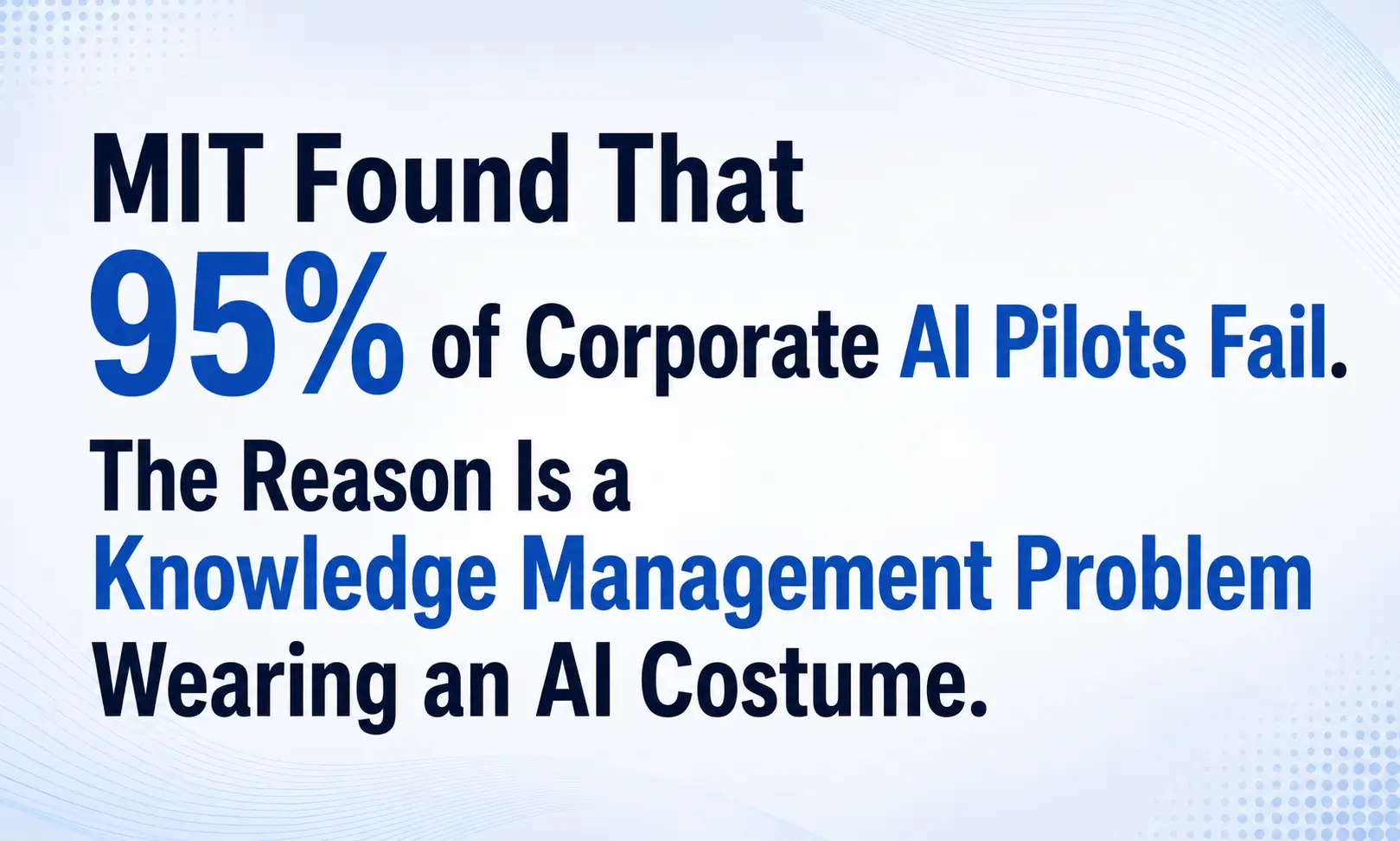
MIT researchers studied 300 enterprise AI deployments and found that 95 percent delivered no measurable financial return. The report's own explanation for why has almost nothing to do with the AI models themselves, and almost everything to do with a problem knowledge management has been naming for decades.
The study, in plain terms
In July 2025, MIT's NANDA initiative published a report titled "The GenAI Divide: State of AI in Business 2025." The research, led by Aditya Challapally and colleagues, was built on a substantial base: 52 structured interviews with business leaders, a survey of 153 senior executives, and an analysis of more than 300 publicly disclosed enterprise AI deployments across sectors including technology, healthcare, financial services, and manufacturing.
The headline finding has since been widely reported, and it is genuinely striking. Despite an estimated $30 to $40 billion in enterprise generative AI investment, only about 5 percent of pilots were extracting meaningful, measurable value. The remaining 95 percent showed no measurable impact on profit and loss. The researchers called this split the GenAI Divide.
It is worth noting, in the interest of giving you the full picture, that the report has not gone unchallenged. It was released as preliminary research rather than peer-reviewed academic work, and some commentators have pointed out that MIT's NANDA initiative has its own institutional interest in promoting agent-based AI infrastructure, which could shape how the findings are framed. That context does not undo the core finding, which has been independently corroborated by outlets including Fortune, Forbes, and several enterprise technology publications, but it is a reasonable caveat to hold alongside the headline number.
What MIT says is actually causing the failure
This is the part of the report that gets far less attention than the 95 percent statistic, and it is the part that matters most if you work in knowledge management.
The researchers were explicit that the core barrier was not what most people assume. It was not model quality. It was not regulation. It was not a shortage of skilled talent. The report states the conclusion directly: the central barrier to scaling generative AI is learning, specifically the fact that most GenAI systems "do not retain feedback, adapt to context, or improve over time."
One executive interviewed for the report described the practical experience of this gap clearly. A general-purpose AI tool worked well for early drafts and brainstorming, but failed for serious, ongoing work because it did not retain knowledge of client preferences, did not learn from previous corrections, and required the same context to be re-explained in every single session. The report summarized the pattern bluntly: these tools forget context, do not learn, and cannot evolve.
Read that description again, and substitute a different subject. This is not a description of an AI failure. This is a description of an organization without functioning institutional memory. It is the exact failure mode knowledge management exists to solve: information that has to be re-explained constantly because nothing persists, context that evaporates between interactions, and judgment that never accumulates because there is no mechanism for it to be retained and built upon.
The shadow AI pattern, and what it actually reveals
The report surfaced a second finding that reinforces this same point from a different angle. While only about 40 percent of companies surveyed had purchased an official enterprise AI subscription, more than 90 percent of employees reported regularly using personal AI tools for work, often multiple times a day. MIT's researchers labeled this the shadow AI economy.
The instinctive reading of this finding is that employees are simply ahead of their slow-moving organizations. The more useful reading is narrower and more specific. Individuals using a general AI tool for a single, self-contained task, draft this email, summarize this document, do not run into the learning gap in the same way an enterprise-wide deployment does, because a single person can hold their own context in their own head. They do not need the tool to remember; they remember. The moment that same capability needs to scale across a team, a department, or an organization, where shared context, accumulated precedent, and institutional judgment actually need to persist beyond any one individual's memory, the gap MIT identified becomes the central obstacle.
In other words, the shadow AI pattern is not really evidence that AI tools work well and organizations are merely slow to adopt them. It is evidence that AI tools work well for tasks that do not require organizational memory, and fail for tasks that do.
Why this is a knowledge management finding, not just an AI finding
Knowledge management as a discipline exists because organizations have always struggled to retain context, preserve institutional judgment, and make accumulated experience available to the people who need it, independent of any particular AI tool. MIT's research describes, in 2025 language and applied to a new technology, a problem that knowledge management practitioners have been documenting in human systems for far longer.
This matters for how organizations should actually respond to the report's findings. If the core barrier truly is a learning and memory gap rather than a model quality gap, then the obvious instinct, wait for better AI models, will not solve the problem on its own. A more capable model dropped into an organization with no functioning system for capturing, structuring, and surfacing institutional knowledge will encounter the same wall MIT documented. The model will still lack the context it needs, because that context was never organized in a form any system, human or artificial, could reliably retrieve.
This reframes what "AI readiness" actually means for most organizations. It is not primarily a question of which model or vendor to choose. It is a question of whether the organization has done the underlying knowledge work, structuring institutional knowledge, maintaining its accuracy over time, and making clear what is current versus outdated, that any system, AI-powered or not, depends on to function well.
The takeaway
MIT's research gives a precise, well-documented answer to a question many organizations are currently asking themselves: why has a major AI investment failed to produce the results that were promised. The answer the report provides is not flattering to the AI industry's usual narrative, and it is also not really about AI at all. It is about whether an organization has built the capacity to retain what it knows in a form that persists, adapts, and remains accessible over time.
Organizations that treat their current AI investment as primarily a model selection problem are likely to encounter the same 95 percent outcome MIT documented. Organizations that treat it as fundamentally a knowledge problem, one that existed before generative AI and will continue to exist regardless of which model is layered on top of it, are positioned to be part of the smaller group actually seeing returns.