
Introduction: The Information Exists. So Why Can’t Employees Find It?
An organization can spend heavily on enterprise search and still leave employees looking through three versions of the same policy. The search engine may be working exactly as designed. The knowledge base may contain thousands of documents. Yet an employee trying to answer a straightforward business question can end up asking a colleague, searching an old email, or recreating work that someone else has already completed.
This is one of the more frustrating problems in Knowledge Management (KM). Organizations invest in capturing and storing information, expecting that making it searchable will make it useful. When employees continue to struggle, the immediate response is often to improve the search interface, introduce a new platform, or add artificial intelligence. Sometimes those investments are necessary. But they can also leave the underlying problem untouched.
Enterprise search fails when the organization treats finding information as a technology problem without addressing how knowledge is created, organized, maintained, and trusted.
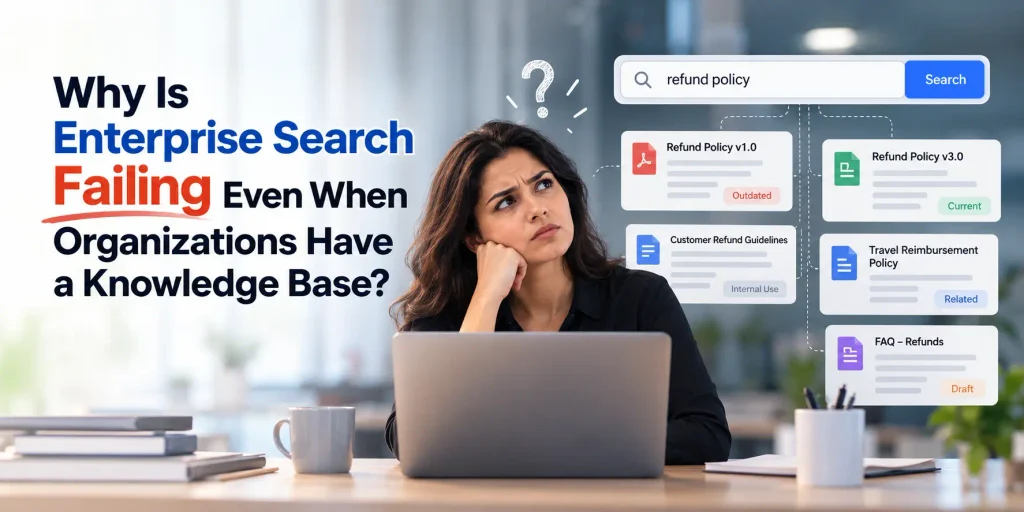
Consider a company that has recently changed its customer refund policy. The updated procedure is available on the intranet, but an older version remains in a shared folder. A customer service employee searches for the refund rules and finds both documents. The older version ranks first because its wording more closely matches the query. The employee follows the outdated instructions, and the customer receives an incorrect response.
The problem is not that the organization lacks information. Nor is it necessarily that the search engine cannot retrieve it. The problem is that the organization has not made the current, authoritative information sufficiently distinguishable from everything else.
This distinction matters even more as companies introduce AI-powered search. An AI assistant may summarize several documents in seconds, but speed does not guarantee accuracy. If the sources conflict, the system may produce a polished answer that conceals the disagreement rather than resolving it.
To understand why enterprise search continues to disappoint employees, we need to look at what happens before, during, and after a search query.
1. Enterprise Search Cannot Fix a Fragmented Knowledge Environment
Most organizations did not design their information landscape from a single blueprint. Systems were introduced at different times to solve different problems. HR adopted an employee portal, sales implemented a CRM, engineering established a technical documentation platform, and project teams began storing working documents in collaboration tools. Over time, information spread across applications, shared drives, intranets, email, and departmental repositories.
Each system may work well for its intended purpose. The difficulty appears when employees need to connect information across them.
Imagine a sales manager preparing a proposal for a customer in a regulated industry. The manager needs the latest product specifications, approved security statements, relevant contract terms, and evidence from previous implementations. These resources may exist, but they could be maintained by four different departments using four different systems.
If enterprise search cannot access all the relevant sources, the manager sees only part of the picture. If it can access them but does not distinguish approved materials from informal working documents, the manager may see everything without knowing what to trust.
This is why a unified search box is not the same as unified knowledge access. Connecting repositories is an important technical step, but the organization must also establish how information from those repositories relates to the questions employees actually need to answer.
APQC’s guidance on finding trusted knowledge across repositories emphasizes the combination of enterprise search, knowledge mapping, consistent classification, content governance, and clear ownership. The lesson is that search needs an understanding of the knowledge environment it is expected to serve.
Organizations do not necessarily need to move every document into one central repository. In many cases, maintaining information in its existing system is sensible. What matters is that employees can discover relevant resources across those systems without needing to know the organization’s internal storage arrangements.
2. The Knowledge Base Has Grown, but Nobody Is Maintaining It
A large knowledge base can create a misleading impression of organizational capability. Thousands of articles, procedures, reports, and presentations suggest that the organization has captured a substantial amount of knowledge. But volume tells us very little about whether that knowledge remains useful.
Documents accumulate more easily than they are retired. A team creates a procedure, another department copies it, and a project team modifies it for a particular situation. A few years later, several documents describe roughly the same process, but nobody can confidently identify the current version.
The problem becomes more serious when the subject changes frequently. A policy may be updated, a product feature may be discontinued, or a regulatory requirement may change. Unless someone is responsible for reviewing the affected content, outdated information can remain available long after it has ceased to be reliable.
Employees then develop their own ways of working around the problem. They bookmark documents they trust, maintain private collections of useful links, or ask colleagues to confirm whether a procedure is still valid. These workarounds may help individuals, but they create a second information system that is largely invisible to the organization.
A knowledge base needs a content lifecycle, not just a publishing process. Important content should have an accountable owner, an appropriate review schedule, a visible status, and a defined method for updating or retiring it. High-risk information, such as compliance procedures or security policies, may require formal approval. Less critical material can follow a lighter process.
The objective is not to review every document every month. It is to ensure that the information employees are most likely to rely on is maintained in proportion to its importance and rate of change.
A knowledge base is not trustworthy simply because its documents are available. It becomes trustworthy when the organization can explain why those documents should still be relied upon.
3. Search Finds the Words but Misses the Meaning
Employees rarely describe a problem using exactly the same terminology as the person who documented it. A customer service representative may search for “customer complaints,” while the relevant reports use “service escalations.” An engineer may search for a component by its internal nickname, while the official documentation uses a product code. A project manager may look for “lessons learned” when the information is stored under “project retrospective.”
When search relies heavily on exact terms, relevant information can remain hidden even though it is indexed correctly.
This is not always a failure of employee behaviour. Organizational language develops naturally. Different departments use their own terminology, specialists use technical expressions, and employees describe problems in the language of their daily work. Expecting everyone to know the precise wording used in every repository places too much responsibility on the person searching.
Semantic search can help by identifying relationships between concepts rather than depending entirely on literal word matches. Modern enterprise search systems may combine keyword matching, metadata, synonyms, vector search, and language models to retrieve content that is relevant to the meaning of a query.
For example, a search for “how do we prevent delays during customer onboarding?” might retrieve documentation about identity verification bottlenecks, incomplete customer records, and approval dependencies. The documents may never use the exact phrase entered by the employee, but their contents could still help answer the question.
However, semantic search has limits. It can help identify related material, but it cannot automatically determine whether a policy is authoritative, whether an exception applies to a particular customer, or whether the underlying content is still valid.
Organizations therefore need both better retrieval technology and a clearer understanding of their knowledge. Consistent terminology, meaningful metadata, and clear document ownership give search systems a stronger foundation on which to identify useful results.
4. Employees Find Documents but Cannot Tell Which One to Trust
Relevance and reliability are different problems. A document can closely match a search query and still be the wrong document to use.
This becomes obvious when several resources contain similar information. A search for a travel reimbursement policy might return the official policy, a presentation from an earlier training session, an email explaining a temporary exception, and an employee-created checklist. Each resource may contain useful information, but they do not necessarily carry the same authority.
The difficulty is not solved by displaying more results. In fact, a longer list can make the decision harder if the system does not help employees distinguish between current policy, historical material, informal advice, and local exceptions.
Organizations need to establish which sources take precedence and make those distinctions visible. The official policy should be identifiable as such. Superseded versions should be clearly marked or removed from normal results where appropriate. Temporary exceptions should include their scope and expiry conditions. Supporting material should point back to the authoritative source when the distinction matters.
This requires cooperation between the people who own the knowledge and the people who manage the search system. The technology can use status, ownership, version information, and other signals to improve how results are presented, but the business must establish what those signals mean.
The same issue arises in AI-powered search, where a system may synthesize information from multiple documents. A generated answer can sound consistent even when the source material is not. Showing source links is useful, but users also need enough context to understand whether those sources are current, authoritative, and applicable to their situation.
For consequential decisions, organizations should make verification straightforward rather than expecting employees to trust an answer simply because it appears at the top of the results.
5. Critical Knowledge Is Often Missing From the Knowledge Base Entirely
There is another limitation that better indexing cannot resolve: some of the most valuable organizational knowledge has never been documented.
An experienced engineer may recognize the early signs of a system failure from patterns that are difficult to describe in a standard procedure. A senior account manager may know which internal specialist can resolve an unusual customer problem. A project leader may understand why a previous implementation failed, even though the formal report records only the outcome.
This is tacit knowledge. It develops through experience, observation, and repeated engagement with complex situations. Some of it can be documented, but not all of it can be transferred effectively through written instructions alone.
When enterprise search returns no useful result, employees may conclude that the organization has failed to document the answer. Sometimes that is true. In other cases, the knowledge exists in a person, a professional community, or a history of conversations that the search system cannot access.
The response should depend on the type of knowledge involved. A recurring technical solution may deserve a troubleshooting guide. A difficult judgment call may be better transferred through mentoring and case discussions. A business problem that repeatedly requires the same specialist may indicate a need for expertise location, connecting employees with people who have the relevant experience.
This is where Knowledge Management needs to extend beyond document management. Organizations must identify which knowledge is critical, where it resides, who can provide it, and what would happen if it became unavailable.
The objective is not to document every conversation or turn every experienced employee into a full-time writer. It is to preserve and connect the knowledge that matters most to business continuity, problem-solving, and decision-making.
6. Metadata and Information Architecture Are Treated as Administrative Tasks
Metadata rarely receives the same attention as search interfaces or AI capabilities, yet it often determines whether employees can distinguish between otherwise similar results.
A document titled “Final_v3_Updated_New” gives little indication of its purpose or status. Another may have a useful title but no owner, effective date, department, or description of the process it supports. In a small repository, employees might recognize these files. In an enterprise environment containing millions of documents, such assumptions do not scale.
Metadata helps search systems and users understand what a resource contains, who it is for, when it applies, and how it relates to other resources. Useful attributes might include the process, product, business unit, region, content type, owner, and approval status. The appropriate fields depend on the information and the decisions employees need to make.
The challenge is to create enough consistency to support discovery without imposing a classification scheme so complicated that employees avoid using it.
A taxonomy developed entirely around the organizational chart may not reflect how people search. Employees often think in terms of tasks, customer problems, products, and business outcomes rather than department names. Information architecture should therefore reflect actual information needs, not simply the structure of the organization.
Organizations should also distinguish between metadata that can be captured automatically and attributes that require human judgment. Dates, authors, and file types are often easy to obtain. Whether a document represents an approved business decision or a temporary exception may require someone who understands the context.
Good metadata is not an end in itself. Its value lies in helping people find relevant information and decide what to do with it.
7. Employees Stop Using Search When It Repeatedly Disappoints Them
A search system can have technically sound infrastructure and still fail to become part of everyday work. One reason is that employees learn from experience.
If a person searches several times for a procedure and repeatedly finds outdated or irrelevant material, the next attempt is less likely to begin with the search box. The employee may message a colleague, return to an old email, or consult a personal collection of links instead.
Over time, these behaviours become informal knowledge-sharing practices. They may be fast for experienced employees, but they create problems for new hires and people working across departments. They can also make the organization dependent on individuals who know where information is hidden.
It is tempting to respond by providing more training or encouraging employees to use the official knowledge base. But that approach misses an important question: why have employees decided that other methods work better?
A study by Paul H. Cleverley and Simon Burnett, published in the Journal of Information Science in 2019, examined enterprise search dissatisfaction using feedback from more than 1,000 users and interviews with search service staff at a multinational organization. The researchers reported that 62% of dissatisfaction events in that study were attributed to human factors, including information and search literacy, rather than technology factors alone. The finding should not be treated as a universal statistic for all organizations, but it illustrates why enterprise search must be understood as a socio-technical problem involving people, information, and systems.
Employees should be able to formulate useful queries, recognize authoritative sources, and use filters where necessary. Yet the system should also make these tasks easier through understandable result descriptions, relevant suggestions, useful filtering options, and clear indications of content status.
Search literacy and system design need to reinforce each other. Training cannot compensate for an unreliable knowledge base, and better software cannot guarantee adoption if employees have learned not to trust the results.
8. AI Can Make Enterprise Search Better, but It Can Also Hide Its Weaknesses
Generative AI has changed what employees expect from enterprise search. Instead of receiving a list of documents, they increasingly expect to ask a question in natural language and receive a synthesized answer.
Retrieval-augmented generation, or RAG, supports this experience by retrieving relevant material from selected sources and providing it to a language model as context for generating a response. This can reduce the effort required to locate and interpret information, particularly when the answer spans several documents.
But retrieval and generation are separate stages, and both can fail.
A system may retrieve an outdated procedure because it has not been properly retired. It may retrieve the correct general policy but miss a regional exception. It may find several documents that use similar terminology but describe different circumstances. Even when the retrieved passages are relevant, the model may omit an important qualification or produce an answer that is not adequately supported by the evidence.
The risk is not limited to obvious factual errors. A fluent answer can make incomplete information appear settled. Employees may be less likely to inspect the original documents when the system presents a concise explanation in confident language.
Organizations introducing AI-powered search should therefore evaluate more than the quality of the generated text. They should test whether the right sources are retrieved, whether the answers accurately reflect those sources, whether permissions are respected, and whether the system recognizes when the evidence is insufficient or contradictory.
Source attribution should help users verify important claims. Content owners should remain accountable for authoritative information, and high-risk decisions should have appropriate review processes.
AI is most valuable when it reduces the effort required to access trustworthy knowledge. It is not a substitute for establishing what the organization knows, which sources it trusts, and how that knowledge should be maintained.
9. Organizations Measure Search Activity Instead of Successful Knowledge Discovery
A search platform can report millions of queries and thousands of indexed documents without demonstrating that employees are finding what they need.
High search volume may indicate that employees are engaged, but it may also mean that they repeatedly search for information they cannot locate. A large repository may reflect a rich knowledge environment, or it may contain years of duplicate and obsolete material. Even a low rate of unsuccessful searches can be misleading if employees abandon their queries before the system records a failure.
A more useful approach is to examine whether search supports the work employees are trying to complete.
Organizations can begin by analysing queries that return no results, repeated reformulations, low engagement with supposedly authoritative documents, and searches that lead to repeated requests for help. These patterns can reveal missing content, terminology mismatches, poor ranking, or information that exists but is difficult to discover.
APQC’s guidance on search analytics describes how organizations can use search behaviour to identify content that needs improvement, information gaps that require new material, and resources that should be made easier to access. The important principle is to treat search data as evidence of knowledge needs rather than simply as a measure of platform usage.
Where possible, these findings should be connected to business outcomes. A customer support team might assess whether employees can find the correct troubleshooting procedure quickly. An engineering group might examine how easily it can retrieve previous incident reports. A compliance team might test whether employees can identify the current approved policy for a given situation.
These measures need a baseline and careful interpretation. Search improvements may contribute to faster task completion, but other process changes can also influence the result.
The ultimate measure is not how much information the system contains or how many searches it processes. It is whether employees can find, evaluate, and apply the knowledge needed to perform their work.
10. How Should Organizations Fix Enterprise Search?
The first step is not necessarily to buy a new platform. It is to identify where the existing knowledge discovery process breaks down.
Organizations should start with a small set of important employee tasks and investigate what happens when people try to complete them. Where does the relevant knowledge reside? Can the search system access it? Are the results accurate and current? Can employees distinguish authoritative sources from historical or informal material? If the answer is generated by AI, can the employee verify its supporting evidence?
These questions help separate technology limitations from content, governance, and behaviour problems.
The organization can then prioritize improvements according to business impact. Critical policies may require clearer ownership and version control. Fragmented repositories may need better integration. Inconsistent terminology may require taxonomy improvements or semantic retrieval. Missing expertise may call for knowledge transfer or an expert directory rather than another document repository.
Search technology should be evaluated against these actual needs. Vendor demonstrations are useful, but testing with representative organizational questions is more revealing. The test set should include ambiguous queries, outdated documents, conflicting sources, access restrictions, and questions whose answers depend on specific business conditions.
Organizations should also establish an ongoing process for reviewing search failures. Repeated unsuccessful queries are not merely technical defects; they can indicate gaps in organizational knowledge. When employees cannot find the information they need, someone should determine whether the information is missing, poorly described, difficult to retrieve, or not maintained correctly.
This creates a continuous improvement cycle: employee search behaviour reveals knowledge problems, KM practices address those problems, and improved knowledge quality supports better search results.
The most effective approach combines technology with clear ownership, appropriate governance, meaningful information architecture, and an understanding of how employees actually work.
Conclusion: The Real Problem Is Not the Absence of Information
Enterprise search often fails for a reason that is easy to overlook: organizations confuse having information with being able to use it.
A knowledge base may contain the right answer, but employees still need to find it, recognize that it is authoritative, understand its context, and determine whether it applies to their situation. When any of these steps breaks down, the information may as well be missing.
Better search technology can reduce some of these barriers. Semantic retrieval can connect different expressions of the same concept, and AI can make large collections easier to explore. But neither capability removes the need for reliable content, clear ownership, consistent classification, and deliberate knowledge management.
For KM leaders, this is an opportunity to reconsider the role of enterprise search. It should not be viewed merely as a technical service that retrieves documents. It is part of the organization’s broader ability to discover expertise, preserve institutional knowledge, make sound decisions, and learn from experience.
The organizations that make the most of enterprise search will not necessarily be those with the largest knowledge bases or the most sophisticated AI assistants. They will be those that understand what knowledge employees need, maintain the information they depend on, and design systems that help them find and apply it with confidence.
The question is no longer simply whether your organization can search its knowledge. It is whether your employees can find the right answer, understand why it is trustworthy, and use it when the decision matters.
References and Further Reading
The following sources support the article’s discussion of enterprise search, knowledge governance, information discovery, and the human factors affecting search performance.
- Cleverley, P. H., & Burnett, S. (2019). “Enterprise search: A state of the art.” Information Research?
A research review exploring the development of enterprise search, user expectations, information management, governance, and the need for a systems-thinking approach.
https://doi.org/10.1177/0266382119851880 - Cleverley, P. H., & Burnett, S. (2019). “Enterprise search and discovery capability: The factors and generative mechanisms for user satisfaction.” Journal of Information Science, 45(1), 29–52.
Examines employee satisfaction with enterprise search and the influence of information and search literacy alongside technical factors.
https://doi.org/10.1177/0165551518770969 - APQC. “How Can Employees Find Trusted Knowledge Across Repositories?”
Practical guidance on knowledge mapping, enterprise search, content governance, consistent classification, and content ownership.
https://www.apqc.org/How-can-employees-find-trusted-knowledge-across-repositories - APQC. “How Can Search Analytics Improve Knowledge Management?”
Explains how search queries, unsuccessful searches, and content usage can inform improvements to knowledge assets and discovery.
https://www.apqc.org/How-Can-Search-Analytics-Improve-Knowledge-Management - IBM. “What Is Enterprise Search?” (2026).
An overview of enterprise search architecture, indexing, query processing, semantic search, and AI-enabled retrieval.
https://www.ibm.com/think/topics/enterprise-search - APQC. “How Can I Improve My Company’s Enterprise Knowledge Management System?”
Guidance on KM maturity, strategy, governance, content quality, knowledge ownership, and the relationship between technology and organizational practices.
https://www.apqc.org/How-Can-I-Improve-My-Companys-Enterprise-Knowledge-Management-System