
Introduction: Your Organization May Have the Answer, but Can You Find the Person Who Knows It?
Imagine that an organization is preparing to enter a new market. The leadership team needs to understand local regulatory requirements, assess potential technology risks, and determine whether the company has the internal capabilities to support the expansion. Relevant information exists across the business. Several employees have worked on similar projects, one specialist has experience in the target market, and another has already investigated the technical challenges. Yet nobody involved in the decision knows exactly whom to contact.
The team begins with the usual options. Employees search the intranet, browse departmental directories, ask colleagues for recommendations, and review old project documents. After several conversations, they finally identify someone who has dealt with a similar situation. The expertise was available all along, but the organization had no reliable way to locate it.
This is a knowledge discovery problem that a document repository alone cannot solve.
Organizations have become increasingly effective at collecting information, storing documents, and deploying collaboration platforms. They are now investing in artificial intelligence to retrieve information, summarize reports, answer questions, and support business decisions. However, an important question remains: How can an organization find the right human expertise when the knowledge needed to solve a problem is not fully documented?
This is where expertise location becomes important.
Expertise location is a Knowledge Management (KM) approach that helps employees identify and connect with colleagues who possess relevant knowledge, experience, skills, or practical understanding. Instead of searching exclusively for documents, employees can discover the people who can explain a difficult problem, validate an assumption, share lessons from previous work, or help them make a better decision. APQC identifies expertise location as a KM practice that connects people with knowledgeable colleagues across an enterprise.
The concept is not new. Organizations have long relied on employee networks, expert directories, professional communities, and internal discussion forums to connect people with knowledge. What is changing is the environment in which these practices operate. As organizations introduce AI into everyday work, they need better ways to connect documented information with the people who understand its context.
Expertise location is therefore becoming an important part of the discussion about AI-ready organizations. Its value lies not in replacing human expertise with technology, but in making that expertise easier to discover, access, and apply.
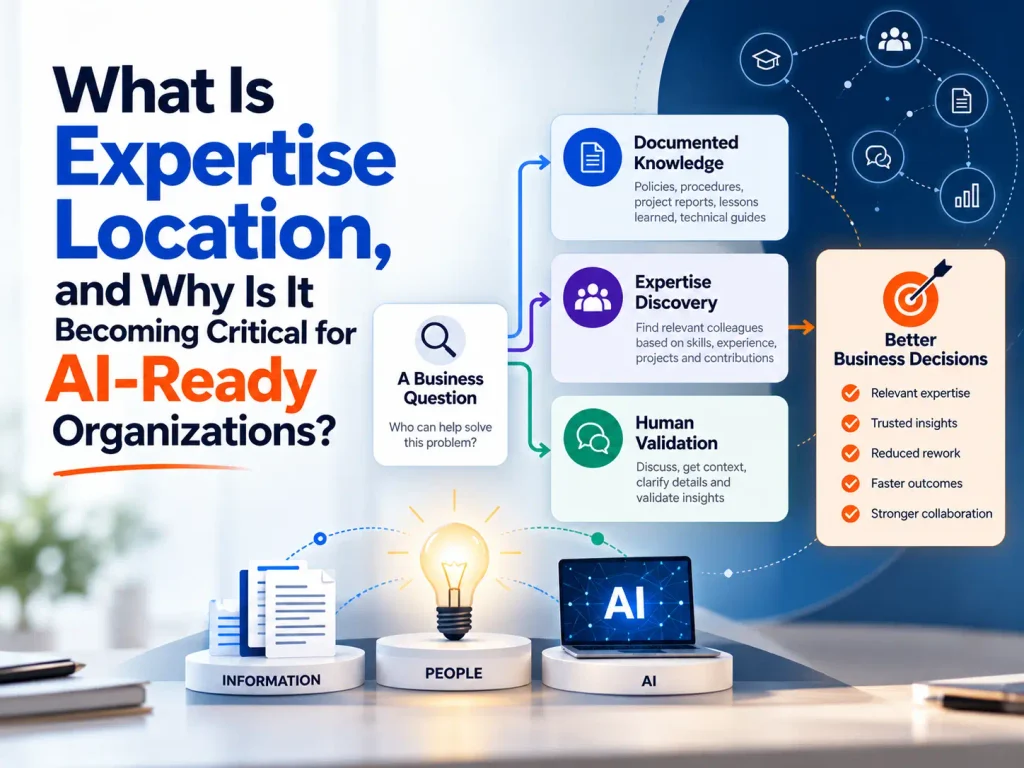
Table of Contents
What Is Expertise Location in Knowledge Management?
Expertise location is the process of identifying where relevant knowledge resides within an organization and helping employees connect with the people who possess it.
The expertise may come from formal qualifications, specialized training, professional experience, participation in projects, practical problem-solving, or a demonstrated ability to handle particular situations. An expert does not necessarily have the most senior job title or the largest collection of qualifications. The person who can resolve a specific problem may be a relatively junior employee who has worked extensively with the relevant system or process.
For example, an organization experiencing recurring customer onboarding delays may need someone who understands the entire onboarding process, not simply the employee with the title of onboarding manager. The most useful person might be a compliance specialist who knows where verification requests typically become stuck, a customer success manager who has handled difficult cases, or an operations analyst who has identified a recurring process bottleneck.
Expertise location helps the organization identify these individuals and make their knowledge accessible to colleagues who need it.
In practice, expertise location can involve employee profiles, skills directories, expert networks, communities of practice, internal discussion forums, project histories, knowledge-sharing platforms, and AI-assisted recommendations. These approaches differ in how they collect evidence of expertise and how employees use the resulting information.
A simple directory might allow employees to search for colleagues by name, department, or declared skill. A more sophisticated expertise location system might use project participation, published contributions, professional interests, and relevant work experience to recommend potential experts for a specific problem.
However, identifying a potential expert is only part of the process. Employees also need enough information to understand why that person might be suitable, whether the person is available to help, and how to initiate a useful conversation.
Effective expertise location does not merely tell employees who might know something. It helps them reach the right person with enough context to make the interaction productive.
Expertise Location vs. Employee Directories: Why the Difference Matters
Many organizations already have employee directories, organizational charts, and internal people-search functions. These tools are useful, but they do not necessarily provide a reliable way to discover expertise.
An employee directory usually answers questions such as who works in a particular department, who manages a team, or how to contact a colleague. It may also contain job titles, qualifications, and basic skill information. Expertise location addresses a different question: who is likely to have the knowledge needed to solve this particular problem?
Consider a company looking for experience with a failed enterprise software implementation. Searching for employees with IT job titles may produce hundreds of results. Searching for people who participated in previous implementations, contributed to technical discussions, resolved related incidents, or documented lessons learned could produce a much more useful shortlist.
The distinction becomes even more important when expertise crosses organizational boundaries. A product engineer may understand a technical limitation that affects customer support. A procurement specialist may know how a particular supplier relationship evolved. A regional sales manager may have experience with a customer segment that the central marketing team is trying to understand.
These connections are often difficult to identify through an organizational chart because reporting relationships do not necessarily reflect knowledge relationships.
Expertise location therefore requires a broader view of organizational capability. It considers not only where employees sit within the business but also what they know, how they have applied that knowledge, and how their experience might help others.
It should also distinguish between a person’s declared expertise and evidence of demonstrated experience. An employee may list cybersecurity as a skill, for example, but that label alone does not reveal whether the person has handled incident response, conducted security assessments, or worked on identity and access management.
A useful expertise location approach combines self-reported skills with appropriate evidence from work experience, contributions, projects, and professional interactions. This creates a more informative picture of expertise without assuming that a job title or profile description tells the whole story.
Why Expertise Location Is Becoming More Important for AI-Ready Organizations
AI readiness is often discussed in terms of data infrastructure, cloud platforms, governance frameworks, technical skills, and model selection. These are important considerations, but they do not fully describe an organization’s ability to use knowledge effectively.
AI systems can retrieve documents, recognize patterns, and generate responses. Yet many business problems require interpretation, judgment, and an understanding of circumstances that may not be fully represented in the available data. Employees need to know not only what information exists but also who can explain it, validate it, or provide missing context.
Expertise location helps address this gap in several important ways.
1. AI Can Retrieve Information, but People Often Understand the Context Behind It
An AI assistant may retrieve a project report describing why an implementation failed. The report could identify a technical problem, outline the corrective action, and document the eventual outcome. However, it may not capture every informal decision, disagreement, customer expectation, or operational constraint that influenced what happened.
An employee facing a similar problem may need to speak with someone who participated in the original project. That person might explain why a seemingly reasonable technical solution was rejected, why a workaround became necessary, or which conditions would make the previous solution unsuitable for the current situation.
This is particularly relevant when the written record is incomplete or when the circumstances surrounding a decision have changed.
Expertise location provides a way to connect AI-supported information retrieval with human interpretation. An AI assistant may identify relevant project documents and suggest people associated with the work. The employee can then review the evidence and consult a knowledgeable colleague when the answer requires additional context.
The distinction matters because information retrieval and knowledge application are not identical. A document may contain facts about what happened, while an experienced employee can explain why it happened and what those lessons mean for a new situation.
For AI-ready organizations, the objective should be to make both forms of knowledge accessible.
2. Expertise Location Helps Organizations Discover Knowledge That Has Not Been Documented
Every organization has knowledge gaps in its documentation. Some arise because employees have not had time to record what they know. Others exist because expertise develops through practice and is difficult to reduce to formal instructions.
A maintenance engineer may recognize an unusual equipment problem based on years of experience. A customer success specialist may know how to manage a difficult renewal conversation. A project manager may understand the informal dependencies that repeatedly delay a particular type of implementation.
AI systems cannot reliably retrieve expertise that is absent from their accessible sources. They may infer possibilities from related information, but inference is not the same as establishing that a particular employee has the experience needed to solve a problem.
Expertise location offers an alternative route to that knowledge. Rather than requiring every insight to be documented before it can be used, organizations can help employees identify people who have dealt with similar challenges.
This does not mean documentation is unnecessary. Recurring solutions, critical procedures, and lessons that need to be reused widely should still be captured wherever practical. But organizations should recognize that some knowledge is best accessed through a conversation, a demonstration, collaborative problem-solving, or a mentoring relationship.
A mature KM strategy supports both approaches. It makes documented knowledge easier to find while also helping employees discover the people who can provide knowledge that has not yet been fully codified.
3. Expertise Location Makes AI Recommendations More Useful
As AI assistants become more integrated into enterprise workflows, organizations can explore ways to connect search results with expertise recommendations.
Suppose an employee asks an internal AI assistant how to resolve a recurring problem with a customer integration. The system retrieves a troubleshooting guide and two related incident reports. It also identifies colleagues who contributed to those reports or worked on similar integrations.
Instead of returning only a list of documents, the assistant could help the employee identify the most relevant person to consult if the documented material does not resolve the issue.
This kind of capability could make enterprise AI more useful by connecting three elements: the question being asked, the information that may answer it, and the people who can provide additional knowledge.
However, these recommendations should be based on meaningful evidence. A person who appears frequently in documents about a subject is not automatically the best expert. They may have been mentioned in passing, reviewed a document without owning the work, or contributed to a project without developing deep expertise in the relevant area.
A responsible system should consider the nature of a person’s contribution, the relevance and recency of their experience, the context of the request, and the limitations of the available evidence. It should present recommendations as potential matches rather than definitive declarations of expertise.
When designed carefully, AI can help organizations discover knowledge relationships that would be difficult to identify through manual searches alone.
4. Expertise Location Reduces Dependence on Informal Networks
In many organizations, finding an expert still depends on knowing the right person to ask.
An experienced employee may know that a particular colleague is good at resolving database problems. That colleague knows someone in finance who understands a complicated reporting issue. Through a chain of personal introductions, the employee eventually finds the answer.
These informal networks are valuable. Trust, shared experience, and personal relationships often make knowledge sharing faster and more effective. The problem arises when access to expertise depends too heavily on an employee’s existing connections.
New hires, remote employees, contractors, and people working across business units may not know who the knowledgeable individuals are. Employees in smaller or less visible teams may also possess valuable expertise that rarely surfaces through established networks.
Expertise location can make these connections less dependent on personal familiarity. An employee should have a reasonable way to discover relevant colleagues even when they have never worked together or belong to different departments.
This is especially important for organizations operating across locations, business units, and time zones. A reliable expertise location approach broadens access to organizational knowledge without requiring employees to build an extensive personal network before they can find help.
The goal is not to eliminate informal relationships. It is to prevent those relationships from becoming the only practical route to expertise.
5. Expertise Location Supports Knowledge Retention and Business Continuity
When an experienced employee leaves an organization, the impact can extend well beyond the loss of their documented work. Colleagues may lose access to years of practical judgment, historical context, relationships, and an understanding of why certain processes operate as they do.
The risk is especially serious when a small number of employees hold knowledge that is difficult to replace. A person may be the only employee who understands a legacy system, a complex customer relationship, a specialized manufacturing process, or the history behind an important business decision.
Expertise location can help organizations identify these dependencies before they become urgent problems.
By mapping important knowledge areas and identifying the people associated with them, organizations can assess where expertise is concentrated and where additional knowledge transfer may be needed. If a critical process depends on one individual, the organization can prioritize documentation, mentoring, job shadowing, or cross-training.
An expertise directory alone will not preserve knowledge when someone leaves. It can, however, help reveal where that knowledge resides and provide a starting point for transferring it to others.
This makes expertise location relevant to workforce planning, succession planning, operational resilience, and the long-term sustainability of AI initiatives. An organization that cannot identify its critical expertise will struggle to protect it, develop it, or make it available when circumstances change.
The Biggest Challenge: Knowing Who Knows What
The concept of expertise location sounds straightforward until an organization attempts to implement it.
Employees have different skills, experiences, and levels of proficiency. Some have formal qualifications but limited practical experience. Others have developed valuable expertise through years of solving problems without receiving formal recognition. Some people are excellent at explaining complex subjects, while others possess deep technical knowledge but rarely participate in knowledge-sharing activities.
This creates a fundamental challenge: How can an organization identify expertise accurately without reducing people to a collection of skills, job titles, and keywords?
A basic employee profile can provide a starting point, but it cannot capture the full picture. Skills change, project experience accumulates, and employees develop new capabilities through their work. A profile that was accurate two years ago may no longer reflect what an employee knows today.
Organizations also need to distinguish between expertise that is claimed, expertise that is demonstrated, and expertise that is relevant to a particular problem. These are related but different concepts.
For example, an employee may have ten years of experience in enterprise software without having worked on a specific integration technology. Another employee may have only four years of experience but have led several successful implementations involving that technology. Depending on the problem, the second employee may be the more useful person to consult.
The answer is not to create a perfect database of everything every employee knows. Such a system would be difficult to maintain and would quickly become outdated.
A more practical approach is to combine several sources of evidence. Employee profiles can capture declared skills and interests. Project records can reveal where people have applied their knowledge. Internal articles and discussion forums can show contributions to particular subjects. Communities of practice can identify people who regularly help others solve problems.
These signals become more useful when combined with human judgment. A community leader, project manager, or knowledge manager may be able to confirm that an employee has relevant experience and is willing to share it.
Expertise location should therefore be treated as an ongoing organizational capability rather than a one-time exercise in collecting employee information.
How Can Organizations Build an Effective Expertise Location System?
Organizations do not necessarily need to purchase a dedicated expertise location platform to begin. Many can establish the foundations using existing employee profiles, collaboration tools, knowledge repositories, and professional communities.
The important decision is to design the approach around actual knowledge needs rather than starting with a technology purchase.
1. Identify the Knowledge That Employees Struggle to Find
Start by examining situations in which employees repeatedly need help from someone with specialized experience. These might include resolving complex customer issues, troubleshooting technical failures, interpreting regulatory requirements, managing unusual project risks, or understanding legacy business processes.
Interviews with employees, reviews of recurring support requests, and discussions with team leaders can reveal where expertise is difficult to locate.
The objective is to identify specific problems that expertise location should solve. A company struggling to identify specialists for cross-functional projects may need a different approach from a company that depends on a small number of experienced engineers to maintain critical systems.
Starting with defined use cases also makes it easier to evaluate whether an expertise location initiative delivers meaningful results.
2. Map Important Expertise Areas
Once the priority needs are clear, organizations should identify the knowledge areas associated with them.
A technology company might map expertise in cloud architecture, cybersecurity, data integration, product engineering, and incident response. A consulting organization might focus on industry experience, transformation methodologies, regulatory knowledge, and specialist client engagements.
The categories should reflect the organization’s actual work. A generic list of skills may be useful for recruitment or workforce planning, but expertise location often requires greater specificity.
For example, “data analytics” is a broad category. An employee looking for help with customer churn modelling may need someone who has worked with relevant datasets, developed predictive models, and evaluated their performance in a comparable business environment.
Organizations should also recognize that expertise can span several categories. An individual who understands both technical architecture and customer operations may be particularly valuable when a problem crosses those boundaries.
The resulting map does not need to describe every capability in the organization. It should make the expertise relevant to priority business needs easier to discover.
3. Combine Employee Profiles With Evidence of Experience
Employee profiles remain useful because they allow individuals to describe their skills, interests, qualifications, and professional experience. However, organizations should avoid treating profile completion as proof of expertise.
A stronger approach combines employee-provided information with relevant evidence from projects, technical contributions, internal publications, professional communities, and problem-solving activities.
For example, a profile might identify an employee’s interest in knowledge graph technology. Records of relevant projects, presentations, or technical discussions could provide additional evidence of practical experience.
Employees should also be able to update their profiles as their responsibilities and capabilities change. Managers and knowledge leaders can help identify important expertise gaps, but individuals should retain a meaningful role in describing and validating their own experience.
The system should explain why a person is recommended for a particular topic. This gives employees a basis for deciding whether to contact that person and provides an opportunity to correct incomplete or misleading information.
4. Connect Expertise Location With Knowledge-Sharing Practices
Identifying an expert is not the same as making their knowledge available.
An employee may find the right specialist but receive no response because that person is overloaded, unaware of the request, or uncertain about how much time they are expected to contribute. If expertise location consistently directs every difficult question to the same few people, the system can create a new operational bottleneck.
Organizations need to establish practical expectations for knowledge sharing. These might include office hours, internal discussion forums, communities of practice, mentoring arrangements, or designated contacts for particular knowledge areas.
They should also encourage employees to share reusable solutions when appropriate. If a specialist repeatedly answers the same question, documenting the answer may reduce future demand on that individual.
However, not every interaction should become a formal documentation task. Some problems require discussion, interpretation, or collaborative experimentation. The aim is to capture recurring and reusable knowledge without turning every expert interaction into an administrative exercise.
APQC’s guidance on transferring expert knowledge emphasizes the importance of making knowledge-sharing responsibilities manageable and drawing on a broader pool of knowledgeable employees rather than relying exclusively on a few senior specialists.
5. Use AI to Improve Discovery, Not to Declare Who Is an Expert
AI can help organizations identify possible relationships between employees, projects, skills, and knowledge topics. It may analyze internal contributions, extract skills from approved records, interpret natural-language questions, and recommend colleagues whose experience appears relevant.
For example, an employee could ask, “Who has experience migrating a legacy knowledge base to a cloud platform while preserving document permissions?” An AI-enabled system might identify colleagues associated with similar projects, relevant technical discussions, and implementation documentation.
This could be more effective than requiring the employee to search manually through profiles and project folders.
Nevertheless, recommendations should be explainable and appropriately qualified. The system should distinguish between someone who authored a technical solution, someone who participated in a project, and someone who was merely mentioned in a document.
Organizations should also consider whether the information used to infer expertise is accurate, current, and appropriate for this purpose. Internal communications and collaboration records may contain confidential information or personal details that employees did not expect to be used to assess their expertise.
AI-enabled expertise location should therefore operate within clear rules for data access, privacy, transparency, and human oversight. Employees should be able to review and correct their profiles, and recommendations should not be treated as definitive assessments of an individual’s capabilities.
The objective is to help people discover relevant colleagues more effectively, not to create an opaque system that ranks employees without sufficient context.
What Role Does Expertise Location Play in an AI-Ready Knowledge Management Strategy?
Expertise location is most valuable when it forms part of a broader Knowledge Management strategy.
KM is concerned with making knowledge available and usable throughout the organization. This includes documenting processes, preserving lessons learned, enabling knowledge sharing, connecting communities, supporting learning, and identifying knowledge that could be lost when employees leave.
Expertise location complements these activities by connecting employees with the people who possess relevant knowledge.
Consider an organization implementing an internal AI assistant. The assistant can retrieve approved policies, summarize project documents, and answer questions about established procedures. However, employees may also ask questions involving exceptions, historical decisions, or situations that do not fit documented guidance.
A well-designed knowledge environment should provide several possible routes to an answer.
The employee might find an authoritative document, discover a related case study, consult a community discussion, or contact a specialist who has handled a similar situation. These options should reinforce one another rather than operate as disconnected systems.
In practical terms, an AI-ready KM strategy should connect four elements.
Documented knowledge provides policies, procedures, technical documentation, lessons learned, and other reusable information.
Expertise location helps employees discover people who possess relevant knowledge and experience.
Knowledge-sharing practices provide ways for employees to exchange insights, explain context, and transfer practical know-how.
Read: Knowledge Management Practices That Actually Improve Productivity
Governance and validation help ensure that information is trustworthy, access is appropriate, and important knowledge remains current.
Together, these elements create a more complete approach to organizational knowledge discovery.
This is particularly important when AI systems are used to support decisions rather than simply retrieve documents. Employees need access to reliable information, but they also need a way to investigate uncertainty, challenge assumptions, and consult people with relevant experience.
Expertise location does not eliminate the limitations of AI. Instead, it provides another mechanism for connecting employees with knowledge when automated retrieval is insufficient.
Measuring Whether Expertise Location Is Actually Working
An expertise location system should not be judged solely by the number of employee profiles created or the number of people registered in a directory.
Those figures measure participation, not necessarily effectiveness.
A directory may contain thousands of profiles and still fail to help employees identify the right specialist. An AI system may generate many recommendations without producing useful connections. Conversely, a relatively small expert network may deliver substantial value if it consistently helps employees resolve important problems.
Organizations should therefore measure whether expertise location improves access to relevant knowledge and supports the work employees need to complete.
Useful indicators include the time required to identify a suitable expert, the proportion of requests that lead to a useful connection, employee satisfaction with the assistance received, and the frequency with which knowledge is reused across teams.
Organizations can also examine whether expertise location helps reduce repeated problem-solving, improves cross-functional collaboration, or identifies critical knowledge areas that depend on too few individuals.
These measures should be selected according to the purpose of the initiative. A system designed to support technical troubleshooting may require different indicators from one intended to support innovation or succession planning.
It is also important to collect feedback from both sides of the interaction. Employees seeking expertise can explain whether the recommended person was relevant and whether the connection helped resolve the problem. Experts can report whether requests were appropriate, whether the information used to recommend them was accurate, and whether the process created an unreasonable workload.
This feedback can improve both the quality of recommendations and the way the organization manages knowledge-sharing responsibilities.
APQC provides guidance on measuring expertise location through activity, efficiency, and effectiveness measures, reinforcing the importance of evaluating outcomes rather than relying exclusively on participation figures.
Ultimately, expertise location should make it easier for employees to obtain the knowledge they need, while helping the organization make better use of the experience it already possesses.
Common Mistakes Organizations Should Avoid
One common mistake is treating expertise location as a directory-building exercise. Collecting employee skills and qualifications can be useful, but a static directory will gradually become less accurate unless it is connected to ongoing work and maintained over time.
Another mistake is assuming that AI can identify experts reliably from whatever information happens to be available. A person’s name appearing frequently in documents does not establish the depth of their knowledge, the quality of their contributions, or their suitability for a particular request. AI recommendations should be evaluated against meaningful evidence and actual employee needs.
Organizations should also avoid concentrating every difficult question on a small group of recognized specialists. Expertise location should broaden access to knowledge, support emerging experts, and encourage knowledge transfer. Otherwise, it can make the organization more dependent on the very individuals whose time is already limited.
Finally, organizations should not overlook the human side of knowledge sharing. Employees may be reluctant to ask unfamiliar colleagues for help, and experts may be hesitant to share knowledge if doing so creates additional work without recognition or support. A technically capable system cannot resolve these problems on its own.
The strongest approach combines useful technology with clear expectations, supportive leadership, practical knowledge-sharing opportunities, and a culture in which asking for help is treated as a normal part of effective work.
Conclusion: AI-Ready Organizations Need to Know Where Their Human Expertise Resides
Organizations are investing in AI to help employees retrieve information, automate routine work, and make better decisions. Yet the value of these investments depends partly on whether employees can access the knowledge needed to interpret information, address exceptions, and solve problems that do not have straightforward documented answers.
Expertise location helps address this challenge by making organizational knowledge holders easier to discover. It connects people with colleagues who possess relevant experience, supports the transfer of tacit knowledge, and reduces dependence on informal networks that may exclude employees who are new to the organization or unfamiliar with its internal relationships.
AI can strengthen this capability by helping employees discover potential experts through relevant skills, project experience, and knowledge contributions. But technology must be supported by accurate information, appropriate governance, employee trust, and a practical approach to knowledge sharing.
For Knowledge Management leaders, the opportunity is to treat expertise location as part of the organization’s wider knowledge infrastructure rather than as an isolated employee directory or AI feature.
An organization becomes better prepared to use AI when it understands not only what information it has, but also where important expertise resides, how that expertise can be accessed, and how knowledge can be transferred when circumstances change.
The future of AI-enabled Knowledge Management will depend not only on how well organizations retrieve information, but also on how effectively they connect people who need knowledge with people who can provide it.
References and Further Reading
The following publications provide additional research and practical guidance on expertise location, expert-finding systems, and Knowledge Management.
- APQC. “Understanding Expertise Location” (2026). An overview of expertise location as a Knowledge Management practice and the principles involved in connecting employees with knowledgeable colleagues.
- APQC. “Why Organizations Need Expertise Location and How to Do It Right.” Guidance on the business need for expertise location and practices for designing and implementing effective approaches.
- Smith, H. A., & McKeen, J. D. (2006). “Developments in Practice XXII: Expertise Location and Management: Hope or Hype?” Communications of the Association for Information Systems, 18. Examines the opportunities and limitations of expertise location and the importance of integrating technology with human facilitation.
- “Expert Finding Systems: A Systematic Review” (2019). Applied Sciences, 9(20), 4250. Reviews research on expert-finding systems, including methods for identifying expertise and the contextual factors that affect expert discovery.
- APQC. “Key Measures for Expertise Location.” Practical guidance on activity, efficiency, and effectiveness measures for evaluating expertise location processes and systems.
- APQC. “How KM Gets Experts to Transfer Their Knowledge.” Explores ways to support expert knowledge transfer while managing the demands placed on subject matter experts.