
Most organizations already have knowledge. The real question is whether they are using it effectively. Teams generate insights every day through projects, customer interactions, and problem-solving, yet much of that knowledge remains trapped in emails, documents, or individual experience.
Table of Contents
This is why understanding the benefits of knowledge management is critical. Knowledge management is not about storing information. It is about ensuring the right knowledge reaches the right people at the right time so better decisions can be made.
Organizations that invest in knowledge management consistently outperform those that do not. Companies like Toyota and IBM have shown that structured knowledge practices lead to continuous improvement, innovation, and operational efficiency.
The benefits of knowledge management extend beyond productivity. They influence how organizations learn, adapt, and compete. This article breaks down the most important benefits and explains how they create measurable impact in real-world environments.
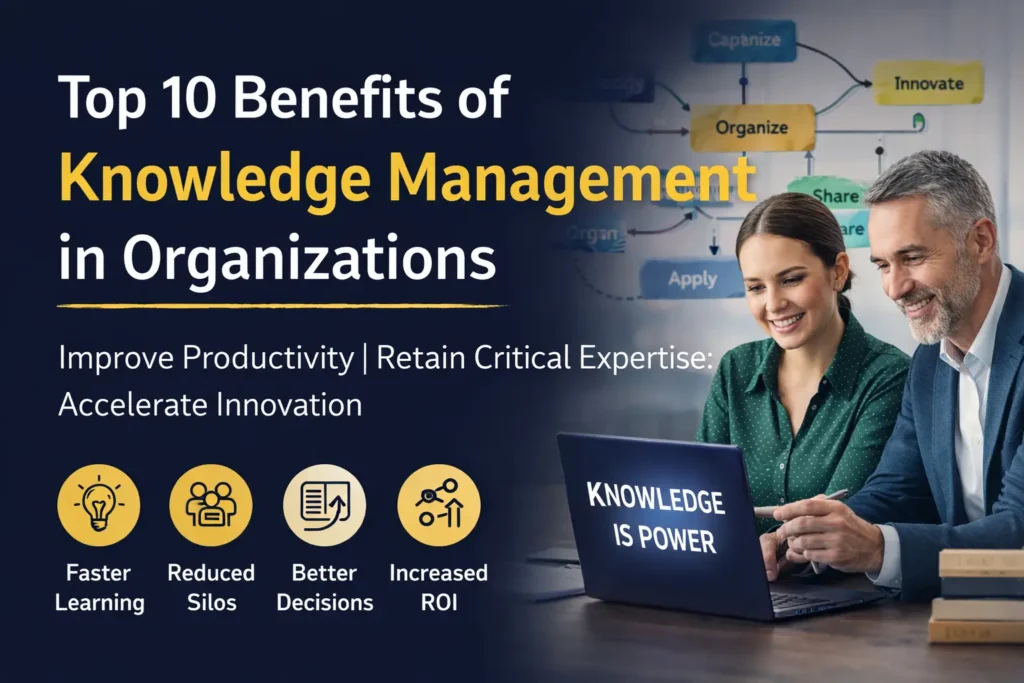
What Are the Benefits of Knowledge Management
The benefits of knowledge management refer to the measurable improvements organizations gain by effectively capturing, sharing, and applying knowledge. These benefits include faster decision-making, improved efficiency, reduced knowledge loss, and stronger organizational learning.
At a fundamental level, knowledge management connects experience with action. Instead of starting from scratch, teams build on what is already known. This reduces duplication, accelerates problem-solving, and improves consistency.
According to APQC, organizations with mature knowledge management practices experience significantly better performance in onboarding, innovation, and operational efficiency. The advantage is not just speed. It is the ability to continuously improve based on accumulated knowledge.
Understanding these benefits helps organizations move beyond viewing KM as a support function. It becomes a strategic capability that directly impacts business outcomes.
Benefit 1: Faster and Better Decision Making
One of the most immediate benefits of knowledge management is improved decision-making. When employees have access to relevant knowledge, they can make informed decisions quickly without relying solely on personal judgment.
In many organizations, decisions are delayed because information is scattered or difficult to access. Knowledge management eliminates this friction by organizing knowledge in a way that supports real-time use.
For example, consulting firms like Deloitte rely on knowledge repositories and past project insights to guide client decisions. Consultants can quickly reference similar cases and apply proven solutions.
Better decisions are not just faster. They are more consistent. When knowledge is shared across teams, organizations avoid conflicting approaches and improve overall quality.
Benefit 2: Increased Productivity and Efficiency
Employees spend a significant portion of their time searching for information. Without effective knowledge management, this effort increases, leading to wasted time and reduced productivity.
Knowledge management reduces this inefficiency by making information easily accessible and reusable. Instead of recreating documents or solving the same problems repeatedly, employees can build on existing knowledge.
Organizations like Microsoft have invested heavily in internal knowledge systems that allow employees to quickly find relevant information. This reduces duplication of work and improves output.
Efficiency gains from knowledge management are cumulative. Small time savings across tasks translate into significant productivity improvements at scale.
Benefit 3: Improved Organizational Learning
Organizational learning is the ability of an organization to learn from experience and apply that knowledge over time. Knowledge management is the foundation of this capability.
Without structured knowledge practices, learning remains individual. Employees gain experience, but that knowledge does not spread. Knowledge management transforms individual learning into organizational learning.
Companies like Toyota embed learning into their processes through practices like continuous improvement and knowledge sharing. Lessons from one team are applied across the organization.
This creates a cycle where knowledge is continuously refined and improved. Over time, organizations become more adaptive and resilient.
Benefit 4: Reduced Knowledge Loss
Knowledge loss is one of the most significant risks organizations face, especially with employee turnover. When experienced employees leave, they take valuable knowledge with them.
Knowledge management addresses this by capturing and preserving critical knowledge. Practices such as lessons learned, documentation, and mentorship ensure that expertise remains within the organization.
The NASA has implemented structured knowledge retention programs to capture insights from missions. This prevents the loss of critical knowledge and improves future performance.
Reducing knowledge loss is not just about continuity. It is about protecting the organization’s intellectual capital.
Benefit 5: Enhanced Innovation
Innovation depends on the ability to combine existing knowledge in new ways. Knowledge management creates the conditions for this by making knowledge accessible and shareable.
When employees can access diverse knowledge, they are more likely to generate new ideas and solutions. Knowledge management breaks down silos, allowing information to flow across teams and functions.
Organizations like Google encourage knowledge sharing to support innovation. Employees build on existing insights rather than starting from scratch.
Innovation is not always about breakthroughs. It often comes from incremental improvements driven by shared knowledge.
Benefit 6: Better Collaboration Across Teams
Collaboration becomes more effective when teams have access to shared knowledge. Without it, teams operate in isolation, leading to duplication and misalignment.
Knowledge management provides a common foundation for collaboration. Teams can access shared resources, understand previous work, and align their efforts.
Companies like Shell use communities of practice to connect employees across regions. This enables knowledge exchange and improves collaboration.
Better collaboration leads to faster problem-solving and more consistent outcomes.
Benefit 7: Faster Onboarding and Training
Onboarding new employees can be time-consuming, especially in complex organizations. Knowledge management accelerates this process by providing structured access to relevant knowledge.
New employees can quickly understand processes, access documentation, and learn from past experiences. This reduces the time required to become productive.
The World Bank uses knowledge sharing platforms to support onboarding and learning. Employees can access a wide range of knowledge resources from the start.
Faster onboarding reduces costs and improves employee experience.
Benefit 8: Consistent Processes and Quality
Consistency is critical for maintaining quality, especially in large organizations. Knowledge management ensures that best practices are documented and followed.
When knowledge is standardized, teams can apply consistent approaches across projects. This reduces variability and improves outcomes.
Organizations like Siemens use knowledge systems to maintain engineering standards and ensure consistent performance.
Consistency does not limit flexibility. It provides a foundation that teams can build on.
Benefit 9: Stronger Customer Experience
Customer experience improves when employees have access to accurate and timely information. Knowledge management ensures that customer-facing teams can quickly find answers and resolve issues.
Support teams, for example, rely on knowledge bases to provide consistent responses. This reduces response time and improves satisfaction.
Companies like Amazon use knowledge systems to support customer service operations, ensuring that information is readily available.
A better customer experience leads to higher retention and loyalty.
Benefit 10: Competitive Advantage and Business Growth
Ultimately, the benefits of knowledge management contribute to competitive advantage. Organizations that manage knowledge effectively can respond faster, innovate more, and operate more efficiently.
Knowledge becomes a strategic asset that supports growth and differentiation. Companies that leverage knowledge effectively are better positioned to adapt to changing markets.
Organizations like IBM have used knowledge management to drive long-term success by continuously evolving their capabilities.
Competitive advantage is not achieved through knowledge alone. It is achieved through how knowledge is used.
Knowledge Management Strategies That Improve Organizational Learning
CONCLUSION
The benefits of knowledge management extend far beyond efficiency improvements. They shape how organizations learn, collaborate, and compete. When knowledge is managed effectively, it becomes a driver of performance rather than a passive resource.
Organizations that recognize this shift move from reactive problem-solving to proactive improvement. They build systems where knowledge flows naturally, supporting better decisions and continuous learning.
The real opportunity lies in treating knowledge as a strategic asset. When that happens, the benefits are not temporary. They become embedded in how the organization operates and grows.
FAQ
What are the main benefits of knowledge management
The main benefits include improved decision-making, increased productivity, reduced knowledge loss, better collaboration, and stronger organizational learning. These outcomes help organizations perform more effectively.
Why is knowledge management important for organizations
Knowledge management ensures that valuable knowledge is captured and shared. Without it, organizations risk losing expertise and repeating mistakes. It supports efficiency, learning, and innovation.
How does knowledge management improve productivity
It reduces time spent searching for information and prevents duplication of work. Employees can reuse existing knowledge, allowing them to focus on higher-value tasks.
What industries benefit most from knowledge management
All industries benefit, but it is especially important in consulting, engineering, healthcare, and technology, where expertise and knowledge are critical to performance.
How can organizations start implementing knowledge management
Organizations can start by identifying critical knowledge, creating simple knowledge-sharing practices, and gradually building systems to capture and reuse knowledge. Leadership support and culture are key to success.
Stay informed on upcoming Smritex Knowledge Management sessions and workshops. Subscribe for updates.