
Most organizations assume they understand their knowledge landscape. In reality, very few do. Knowledge is scattered across systems, buried in documents, or locked inside people’s experience. Without a clear view of what exists, what is missing, and how knowledge flows, any knowledge management initiative becomes guesswork.
A knowledge management audit provides that clarity. It is a structured way to assess how knowledge is created, stored, shared, and used across the organization. More importantly, it reveals the gaps that directly impact performance, decision-making, and increasingly, AI effectiveness.
A knowledge management audit is not just a diagnostic exercise. It is a strategic tool. Organizations like IBM and the World Bank have used audits to align knowledge with business priorities and improve operational outcomes.
This article explains how to conduct a knowledge management audit step by step. By the end, you will understand how to map your knowledge landscape, identify critical gaps, and build a foundation for a more effective KM strategy.
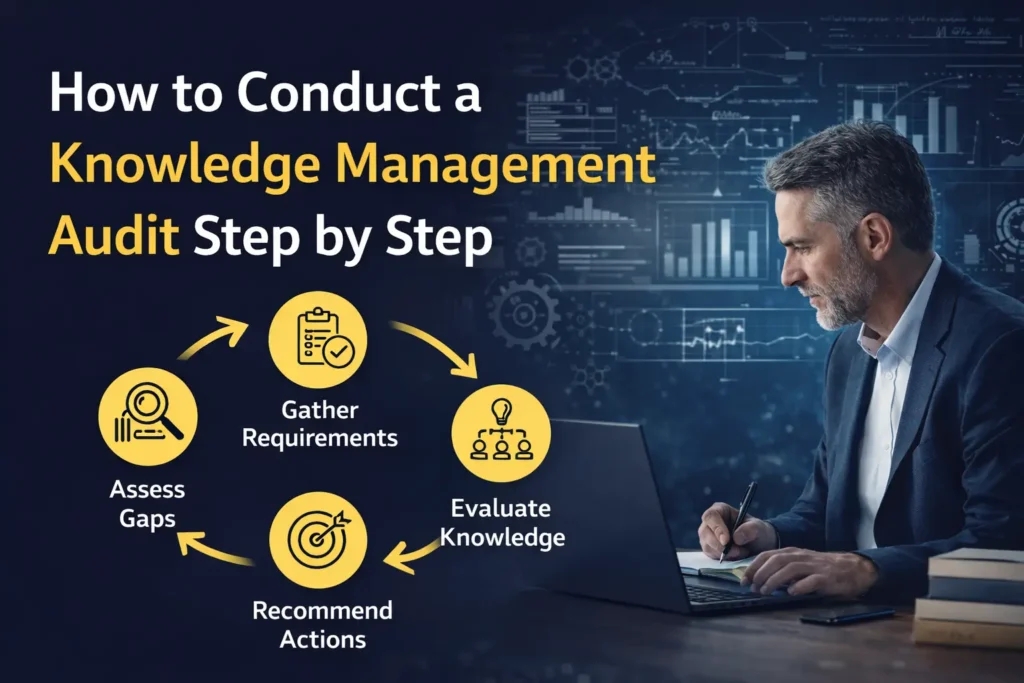
Table of Contents
What Is a Knowledge Management Audit
A knowledge management audit is a systematic evaluation of an organization’s knowledge assets, knowledge flows, systems, and practices. It identifies what knowledge exists, where it resides, how it is used, and where gaps or inefficiencies occur.
In simple terms, a knowledge management audit answers three critical questions. What do we know. Where is that knowledge located. How effectively is it being used.
This process goes beyond reviewing documents or systems. It includes understanding how employees access knowledge, how decisions are made, and how knowledge moves across teams.
A well-executed audit provides a clear picture of the current state of knowledge management. It highlights strengths that can be leveraged and weaknesses that need to be addressed.
According to APQC, organizations that regularly assess their knowledge practices are more likely to achieve higher levels of operational efficiency and innovation. The audit creates a baseline that allows organizations to measure progress over time.
Without this baseline, KM initiatives often lack direction and measurable impact.
Why a Knowledge Management Audit Matters Today
The importance of a knowledge management audit has increased significantly with the rise of AI and digital transformation.
AI systems depend on structured, accessible, and high-quality knowledge. If the underlying knowledge is fragmented or outdated, AI outputs become unreliable. A knowledge audit helps identify these issues before they impact AI performance.
Beyond AI, organizations face challenges such as knowledge loss due to employee turnover, duplication of work, and slow decision-making. These issues are often symptoms of poor knowledge visibility and flow.
A knowledge management audit exposes these hidden inefficiencies. It shows where knowledge is duplicated, where it is missing, and where it is not being used effectively.
It also supports strategic alignment. By linking knowledge assets to business objectives, organizations can ensure that critical knowledge is prioritized and managed properly.
In practice, the audit becomes a foundation for improving knowledge systems, strengthening governance, and building a culture of knowledge sharing.
Step 1: Define the Scope and Objectives
The first step in a knowledge management audit is defining what you want to achieve. Without clear objectives, the audit can become too broad and difficult to manage.
Start by identifying the business goals that the audit should support. This could include improving decision-making, supporting AI initiatives, reducing knowledge loss, or enhancing collaboration.
Next, define the scope. Decide which parts of the organization will be included. Some audits focus on specific departments, while others cover the entire enterprise.
Clarity at this stage ensures that the audit remains focused and actionable. It also helps in selecting the right methods and tools for data collection.
Engaging stakeholders early is critical. Leaders, managers, and subject matter experts should be involved in defining objectives. Their input ensures that the audit addresses real business needs rather than theoretical concerns.
A well-defined scope and objective set the direction for the entire audit process.
Step 2: Identify and Map Knowledge Assets
Once the scope is defined, the next step is to identify and map existing knowledge assets.
Knowledge assets include documents, databases, reports, processes, and expert knowledge held by employees. Both explicit and tacit knowledge should be considered.
Mapping these assets involves understanding where knowledge resides and how it is structured. This includes digital systems such as document repositories and intranets, as well as informal sources such as team discussions and individual expertise.
Knowledge mapping provides visibility. It shows how knowledge is distributed across the organization and highlights areas where knowledge is concentrated or missing.
This step often reveals duplication. The same information may exist in multiple locations, leading to confusion and inefficiency.
It also exposes gaps. Critical knowledge required for key processes may not be documented at all.
Organizations like Chevron have used knowledge mapping to improve operational efficiency by ensuring that critical knowledge is accessible where it is needed.
This step creates a foundation for understanding the current knowledge landscape.
Step 3: Analyze Knowledge Flows and Usage
Understanding where knowledge exists is only part of the picture. The next step is to analyze how knowledge moves and how it is used.
Knowledge flow refers to how information is created, shared, and applied across teams. This includes formal processes such as documentation and training, as well as informal interactions such as conversations and collaboration.
Analyzing knowledge flow helps identify bottlenecks. For example, knowledge may be created but not shared effectively, or it may be shared but not used in decision-making.
Usage analysis focuses on how employees access and apply knowledge. This can be assessed through interviews, surveys, and system usage data.
This step often reveals a disconnect between available knowledge and actual usage. Employees may rely on informal networks instead of official systems because those systems are difficult to use or outdated.
Organizations like Siemens have improved knowledge sharing by redesigning workflows based on insights from knowledge flow analysis.
Understanding flow and usage is critical for identifying barriers that prevent knowledge from delivering value.
Step 4: Identify Knowledge Gaps and Risks
With a clear view of assets and flows, the next step is to identify gaps and risks.
Knowledge gaps occur when critical information required for business processes is missing or incomplete. Risks arise when knowledge is concentrated in a few individuals or not documented properly.
Common gaps include lack of documented processes, missing lessons learned, and absence of expert knowledge in accessible systems.
Risks often relate to knowledge loss. When experienced employees leave, their knowledge may leave with them if it has not been captured.
This step requires careful analysis. It is not just about identifying missing information but understanding the impact of those gaps on business performance.
For example, a gap in customer knowledge may lead to poor service quality. A gap in technical knowledge may increase operational risk.
The audit should prioritize gaps based on their impact. Not all gaps are equally important.
Organizations that address high-impact gaps first see faster improvements in performance and decision-making.
Step 5: Evaluate KM Systems and Governance
Technology and governance play a central role in knowledge management. This step evaluates how well existing systems and processes support knowledge activities.
Assess the effectiveness of knowledge management systems such as intranets, document repositories, and enterprise search tools.
Key questions include whether these systems are easy to use, whether information is easy to find, and whether content is up to date.
Governance evaluation focuses on roles, responsibilities, and processes. It examines whether there is clear ownership of knowledge assets, whether review cycles are defined, and whether quality standards are enforced.
Weak governance often leads to outdated or inconsistent knowledge. Even the best systems fail without proper management.
Organizations like the World Bank have established strong governance frameworks to maintain the quality and relevance of their knowledge assets.
This step ensures that both technology and processes are aligned with knowledge management goals.
Step 6: Develop Recommendations and Action Plan
The final step is translating insights into action.
Based on the findings, develop clear recommendations for improving knowledge management. These should address identified gaps, improve knowledge flows, and strengthen systems and governance.
Recommendations should be practical and prioritized. Focus on actions that deliver the highest impact.
The action plan should include timelines, responsibilities, and success metrics. This ensures accountability and allows progress to be tracked.
It is important to communicate findings clearly to stakeholders. The value of the audit lies in its ability to drive change.
Organizations that treat the audit as a one-time exercise miss its potential. It should be part of an ongoing process of continuous improvement.
Regular audits help organizations adapt to changing needs and maintain effective knowledge systems over time.
7 Knowledge Retention Strategies That Prevent Expertise Loss
CONCLUSION
A knowledge management audit provides the clarity that most organizations lack. It reveals how knowledge is created, where it resides, and how effectively it supports business outcomes.
Without this understanding, knowledge initiatives remain unfocused and AI systems struggle to deliver value.
The step-by-step approach outlined here allows organizations to assess their knowledge landscape systematically and identify areas for improvement.
The real value of a knowledge management audit lies in what follows. It enables organizations to build stronger knowledge systems, improve decision-making, and support long-term growth.
If knowledge is a strategic asset, then auditing it is not optional. It is essential.
FAQ SECTION
What is the purpose of a knowledge management audit
A knowledge management audit helps organizations understand their knowledge assets, identify gaps, and improve how knowledge is shared and used.
How often should a knowledge management audit be conducted
Most organizations conduct audits annually or during major transformations such as digital initiatives or restructuring.
What tools are used in a knowledge management audit
Common tools include surveys, interviews, knowledge mapping techniques, and analytics from knowledge management systems.
Who should be involved in a knowledge management audit
Key stakeholders include leadership, managers, subject matter experts, and employees who use knowledge systems regularly.
How does a knowledge management audit support AI initiatives
A knowledge management audit ensures that knowledge is structured, accessible, and high quality, which is essential for AI systems to perform effectively.
Stay informed on upcoming Smritex Knowledge Management sessions and workshops. Subscribe for updates.