
Most organizations generate valuable knowledge every single day, yet much of it disappears by the end of the week. Teams solve problems, improve processes, handle customer issues, and make decisions that contain lessons others could use. But because that knowledge is rarely captured or structured, it stays trapped in conversations, inboxes, and individual memory.
This is where high-performing organizations separate themselves. They know that daily operations are not just execution engines. They are knowledge creation engines. The smartest companies systematically turn everyday work into reusable knowledge that can be applied again and again.
Reusable knowledge is information, insight, or experience captured in a way that others can easily find, understand, and apply. It reduces duplicated effort, speeds onboarding, improves decision-making, and strengthens resilience when employees leave.
This article explains how smart organizations build systems and habits that transform routine work into reusable knowledge. By the end, you will understand practical methods to capture value from everyday activity and turn operational experience into a strategic asset.
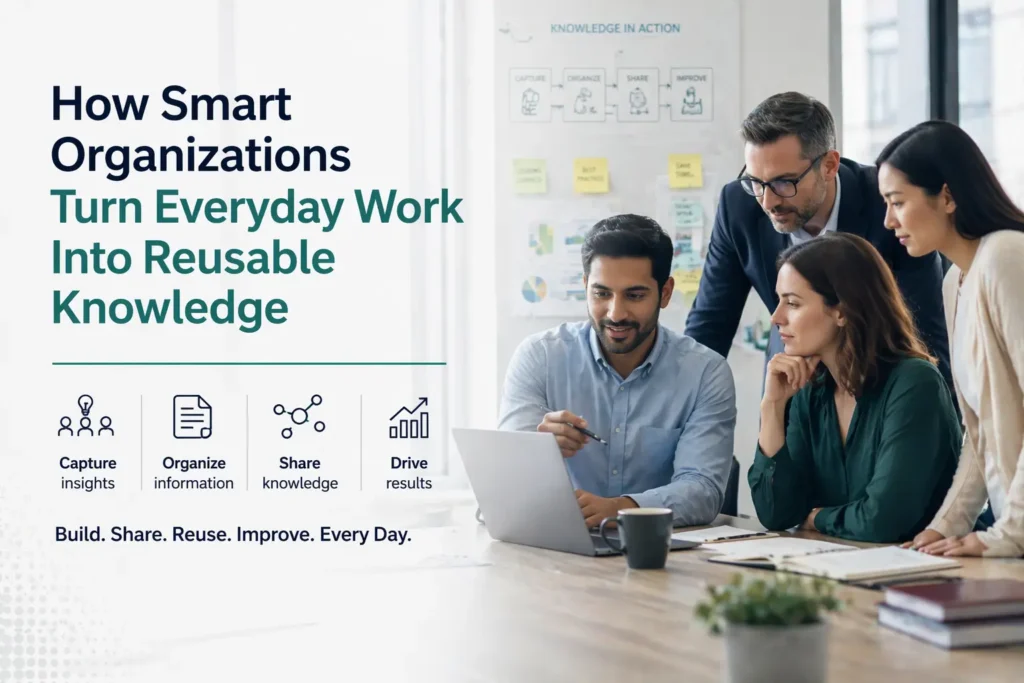
What Is Reusable Knowledge
Reusable knowledge is knowledge that has been documented, organized, and made accessible so it can be used beyond the original moment or team that created it.
In simple terms, it is what your organization learns once and benefits from many times.
Examples include resolved customer issues turned into support articles, project lessons converted into playbooks, successful sales approaches documented as repeatable methods, and technical fixes stored in searchable knowledge bases.
The key difference between ordinary knowledge and reusable knowledge is transferability. A useful insight held by one employee has limited value. The same insight structured so hundreds of employees can use it has multiplied value.
Organizations often underestimate how much knowledge is produced during routine work. Every meeting, process improvement, client interaction, and operational challenge creates signals worth preserving.
When captured effectively, this knowledge becomes a performance accelerator. It reduces friction, shortens learning curves, and allows teams to build on prior experience instead of starting from zero.
Why Most Organizations Waste Everyday Knowledge
Many organizations assume knowledge capture requires large formal programs. As a result, they ignore the small but constant stream of learning generated through normal work.
The first problem is pace. Teams move quickly from one task to the next. Once a problem is solved, attention shifts immediately to the next issue. Reflection is skipped.
The second problem is ownership. Employees often do not know whose responsibility it is to capture useful lessons. When ownership is unclear, nobody does it consistently.
The third problem is poor systems. If documenting knowledge takes too long or repositories are hard to search, people stop contributing.
The fourth problem is culture. Some organizations reward speed and output but not learning or sharing. Employees naturally focus on what gets recognized.
This leads to repeated mistakes, duplicated work, and unnecessary dependence on specific individuals. Valuable insights are recreated again and again rather than reused.
What looks like normal inefficiency is often a knowledge management failure. The organization is learning, but not retaining what it learns.
How Smart Organizations Capture Knowledge During Work
Leading organizations do not wait for annual reviews or end-of-project reports. They capture knowledge as part of the workflow itself.
This means embedding lightweight capture moments into routine operations. After resolving a recurring issue, a short note becomes a searchable article. After completing a project milestone, the team records what worked and what did not. After a sales win, the successful approach is summarized for future deals.
The principle is simple. Capture while the context is fresh.
Short, timely documentation is often more valuable than delayed, polished reports that never happen.
Companies like Toyota became known for continuous improvement partly because frontline learning was surfaced regularly and turned into operational improvements. Knowledge capture happened close to the work, not far away in a separate function.
Modern organizations can apply the same principle digitally. Integrate capture into project tools, CRM systems, service desks, and collaboration platforms.
When knowledge capture becomes part of work rather than extra work, contribution rates rise dramatically.
Turn Tacit Knowledge Into Reusable Assets
Some of the most valuable knowledge is tacit. It exists in judgment, experience, instincts, and know-how that experts use without always being able to explain immediately.
This includes how a senior engineer diagnoses subtle issues, how an account manager handles difficult clients, or how an operations leader spots risks early.
Smart organizations actively convert tacit knowledge into reusable forms. They do this through interviews, shadowing, peer learning sessions, retrospectives, and storytelling.
Instead of asking experts to “document everything,” they extract specific scenarios.
What signs told you this project was going off track?
How did you handle that customer escalation?
What shortcuts save time without reducing quality?
These answers can be turned into checklists, playbooks, FAQs, decision guides, or short training modules.
NASA and the US Army have long used after-action reviews to surface experiential knowledge quickly. The same concept works in business environments.
Tacit knowledge is often where competitive advantage lives. If it stays in people’s heads, it leaves with them.
Build Systems People Will Actually Use
Even strong knowledge capture fails when systems are frustrating. Reusable knowledge only creates value when employees can find and trust it.
That means searchability matters as much as content creation.
Organizations need clear taxonomy, intuitive tagging, strong search, and simple navigation. Employees should be able to find answers in seconds, not minutes.
Content also needs maintenance. Outdated knowledge reduces trust fast. Once employees encounter stale information repeatedly, they stop using the system.
High-performing organizations assign ownership for critical content. Articles have reviewers. Playbooks have owners. Core procedures have refresh cycles.
Microsoft, IBM, and many global consulting firms emphasize curated internal knowledge environments rather than unmanaged content dumps.
The lesson is clear. A repository is not a knowledge system. A usable, trusted, maintained environment is.
If people cannot quickly find relevant answers, reusable knowledge remains unused inventory.
Create Incentives for Knowledge Reuse Not Just Knowledge Creation
Many KM efforts focus heavily on contribution. While contribution matters, reuse is where business value is realized.
A hundred documents no one uses create little impact. One article used daily across teams can create major value.
Smart organizations measure both creation and reuse. They track search success, repeat usage, onboarding speed, reduced ticket volumes, faster project delivery, and lower rework.
They also recognize employees who improve shared knowledge, not only those who create new content. Sometimes refining existing assets creates more value than adding new ones.
Managers play a major role here. When leaders ask teams what prior knowledge was used before starting new work, reuse becomes expected behavior.
This changes organizational habits. Teams stop reinventing and start building on what already exists.
Reusable knowledge becomes part of execution discipline, not an optional side activity.
Real World Example How Consulting Firms Scale Expertise
Global consulting firms such as McKinsey and Deloitte operate in environments where expertise must be reused rapidly across clients and industries.
They cannot afford to start every engagement from scratch. So they invest heavily in capturing methodologies, case examples, frameworks, proposals, research, and lessons learned.
Consultants combine these reusable assets with fresh judgment for each client situation. This dramatically increases speed and consistency while preserving quality.
The value is not just efficiency. It allows junior professionals to access institutional expertise earlier in their careers and enables global teams to collaborate more effectively.
This model illustrates what many organizations miss. Reusable knowledge is not static bureaucracy. It is a force multiplier for expert work.
Even outside consulting, the same principle applies to operations, customer service, engineering, HR, and sales.
Practical Steps to Turn Everyday Work Into Reusable Knowledge
Start small and focus on high-friction areas where repeated questions or duplicated effort already exist.
Create simple templates for lessons learned, issue resolutions, process improvements, and customer insights. Keep them short and practical.
Embed capture prompts into existing workflows. After closing a ticket, ask whether a new knowledge article should be created. After project completion, record three lessons.
Assign owners for priority knowledge domains. Ownership improves quality and freshness.
Use analytics to identify what knowledge is most searched, most reused, and most missing.
Most importantly, make reuse visible. Show teams how shared knowledge saved time, improved outcomes, or prevented mistakes.
People support KM when they can see business value directly.
CONCLUSION
Everyday work generates more knowledge than most organizations realize. The difference between average organizations and smart ones is not whether learning happens. It is whether that learning is captured and reused.
Reusable knowledge turns routine activity into cumulative advantage. It reduces repeated mistakes, accelerates execution, strengthens onboarding, and preserves expertise.
Organizations do not need massive programs to begin. They need better habits, usable systems, and leadership attention.
If teams solve the same problems repeatedly, the opportunity is clear. Start converting daily work into reusable knowledge. Over time, that discipline compounds into real operational intelligence.
Knowledge Management Strategies That Improve Organizational Learning
Stay informed on upcoming Smritex Knowledge Management sessions and workshops. Subscribe for updates.