
Digital transformation is often described as a technology journey. New platforms are introduced, legacy systems are replaced, processes are automated, and dashboards promise sharper decisions. On paper, it looks like progress.
Yet inside many organizations, the lived reality is different.
Employees still struggle to find reliable information. Teams continue working in silos. Leaders make decisions with incomplete context. New tools are launched, but old habits remain. Millions may be invested in transformation programs while productivity gains stay modest and customer experience changes little.
This happens because many organizations focus on technology modernization while overlooking organizational intelligence.
Digital transformation is not only about systems. It is about how knowledge moves, how people learn, how expertise scales, and how decisions improve at speed. That is where Knowledge Management leaders become indispensable.
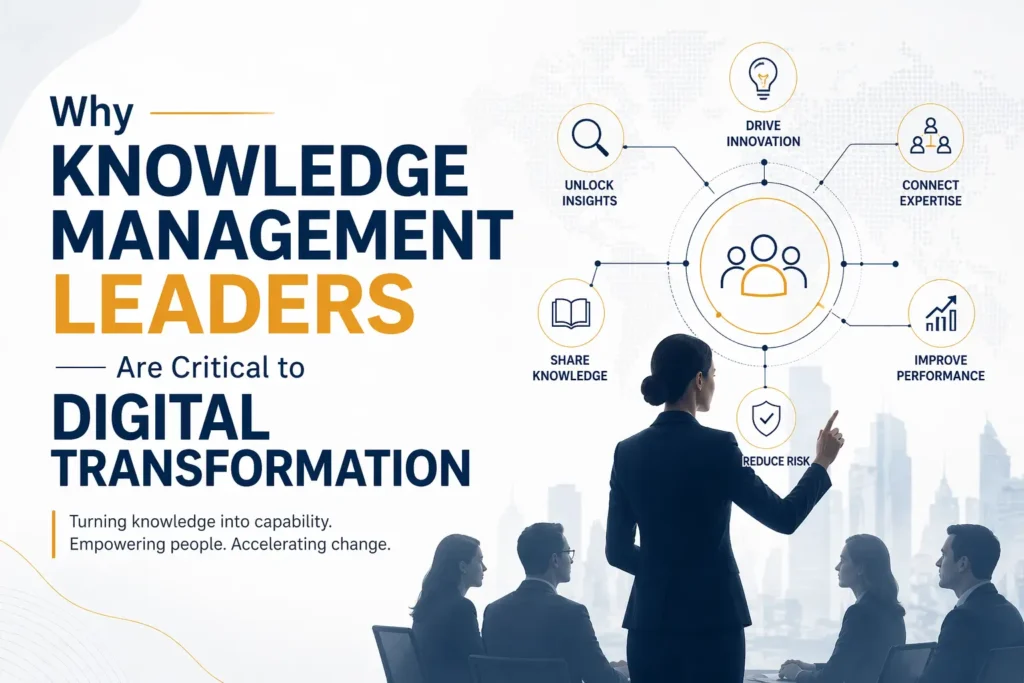
They do not simply manage content libraries or internal portals. Strong Knowledge Management leaders help organizations convert information into capability. They create the conditions where transformation can actually take root.
Without them, many digital programs become expensive upgrades.
With them, transformation becomes operational progress.
The Real Barrier to Transformation Is Often Invisible
When a transformation initiative stalls, the visible symptoms are easy to spot. Adoption rates are low. Projects run behind schedule. Employees create workarounds. Duplicate work increases. Customers receive inconsistent responses.
The hidden causes are harder to see.
Often, people do not trust the information available to them. They cannot find what they need when they need it. Important expertise sits with a few individuals. Lessons from past initiatives were never captured. Teams use different language for the same processes. New systems have been implemented, but shared understanding has not.
This is not a software failure.
It is a knowledge failure.
Many organizations underestimate how much performance depends on clarity, access, context, and learning. Technology can accelerate work, but only when people know how to use it, trust the information inside it, and can adapt together.
Knowledge Management leaders focus on these deeper operating conditions.
Why Technology Alone Rarely Delivers Transformation
A company can implement world-class software and still operate poorly.
That sounds counterintuitive, but it happens frequently. Organizations buy advanced tools expecting immediate efficiency. Instead, employees feel overwhelmed by another platform. Search returns irrelevant results. Documentation is outdated. Teams continue messaging colleagues for answers because the official system is slower than asking someone they trust.
The technology may be capable.
The organization is not yet ready to extract value from it.
This gap between technical capability and organizational capability is where many transformation budgets disappear. Leaders assume deployment equals adoption, and adoption equals impact.
Neither assumption is reliable.
Knowledge Management leaders close this gap by ensuring that tools are supported by trusted knowledge, clear guidance, governance, and practical learning pathways. They help technology become usable, not just available.
What Knowledge Management Leaders Actually Do
There is still a misconception that Knowledge Management is mainly about storing documents. That view is outdated and strategically limiting.
Modern Knowledge Management leadership is about improving how an enterprise learns, remembers, collaborates, and performs.
A capable KM leader examines how knowledge flows through the organization. They identify where work slows because information is fragmented, where decisions are delayed because expertise is inaccessible, and where repeated mistakes happen because lessons are not transferred.
They then build systems, practices, and behaviors that reduce those losses.
Sometimes that means redesigning enterprise search so employees can locate trusted answers quickly. Sometimes it means creating communities of practice so specialists across regions can solve recurring problems together. Sometimes it means capturing critical expertise before senior employees retire. Sometimes it means aligning content standards so AI tools can use internal knowledge more effectively.
The methods vary.
The purpose remains the same: turn scattered intelligence into repeatable organizational advantage.
They Reduce Friction Across the Business
Every large organization has invisible friction.
Employees spend time searching multiple systems for one answer. Different departments maintain conflicting versions of the same process. Teams recreate presentations that already exist somewhere else. Managers escalate routine decisions because no one is certain what guidance is current.
These issues rarely appear in board reports, yet they drain thousands of hours.
Knowledge Management leaders target this operational friction. They create clearer ownership of information, improve findability, establish trusted sources, and simplify how knowledge is shared. Over time, this reduces waste that many companies have normalized.
The value is substantial because friction compounds. Ten minutes lost by one employee is minor. Ten minutes lost by ten thousand employees, every week, is strategic.
They Make Change Easier to Absorb
Transformation often asks employees to change systems, workflows, metrics, and sometimes identity all at once. Leaders may underestimate the cognitive load this creates.
When people feel uncertain, they revert to familiar habits. They keep spreadsheets outside the new system. They rely on old approval paths. They ask colleagues instead of using official resources. Resistance is often less about attitude and more about overload.
Knowledge Management leaders help organizations absorb change more effectively.
They ensure people can access guidance at the moment of need. They translate strategy into usable operating knowledge. They identify recurring confusion early and correct it. They create feedback loops so frontline experience improves implementation rather than being ignored.
This is one reason some transformations gather momentum while others stall.
The difference is not always ambition. Often it is support.
They Protect Critical Expertise During Transition
Digital transformation frequently coincides with workforce change. Organizations restructure teams, outsource functions, hire new talent, and experience retirements or attrition.
That creates a major but often underestimated risk.
Critical know-how can leave faster than new systems arrive.
An experienced operations manager may know how to resolve supplier exceptions that no manual explains. A customer service lead may understand patterns that dashboards miss. A technical specialist may know why a process fails under certain conditions. If that knowledge leaves undocumented, transformation becomes more fragile.
Knowledge Management leaders build retention mechanisms before expertise disappears. They identify high-risk knowledge areas, capture practical know-how, connect successors to experts, and convert experience into reusable assets.
This work is rarely dramatic.
It is often decisive.
They Improve Decision Quality
Executives are surrounded by data, but data alone does not create judgment.
Leaders need to know what has been tried before, which teams solved similar issues, where assumptions may be weak, what customers are signaling, and which risks are emerging from the field.
That broader context is knowledge.
Knowledge Management leaders help organizations combine data with institutional memory, expert insight, and operational learning. They make it easier for decision-makers to access not just numbers, but meaning.
In fast-moving environments, better decisions often matter more than more data.
They Strengthen AI Readiness
Many companies now see Artificial Intelligence as the next phase of digital transformation. That ambition is understandable. AI can improve search, automate tasks, assist service teams, and accelerate analysis.
But AI depends heavily on the quality of enterprise knowledge.
If internal content is outdated, duplicated, contradictory, or poorly structured, AI systems will reflect those weaknesses. They may generate plausible but unreliable outputs, eroding trust quickly.
Knowledge Management leaders are essential to AI readiness because they improve the foundations AI requires. They strengthen taxonomy, governance, source quality, metadata discipline, lifecycle management, and ownership of critical knowledge domains.
In simple terms, they help ensure the organization feeds intelligence with intelligence.
The Business Outcomes Are Real
When Knowledge Management leadership is embedded into transformation efforts, results are tangible.
New employees reach productivity faster because learning pathways are clearer. Customer-facing teams respond more consistently because trusted answers are easier to access. Projects move quicker because teams can reuse proven assets instead of reinventing from scratch. Leaders decide faster because insight is easier to assemble. Operational risk decreases because fewer processes depend on undocumented expertise.
These gains may sound incremental when viewed separately.
Together, they create compounding advantage.
This is how mature organizations outperform competitors without always appearing louder or more innovative from the outside. They waste less energy internally.
What Executive Teams Often Get Wrong
Some leadership teams treat Knowledge Management as a downstream support function. They involve it late, after systems go live and confusion emerges. At that stage, KM is asked to clean up structural issues that should have been addressed in design.
That approach is costly.
Knowledge Management leaders should be present when transformation priorities are being shaped. They can identify where expertise dependencies exist, where language is inconsistent, where adoption barriers are likely, and where reuse opportunities can accelerate value.
Involving KM late is like bringing architects after construction has started.
What Smart Organizations Do Differently
Organizations that transform well usually share a quieter discipline. They respect knowledge as infrastructure.
They invest in search quality, governance, content standards, and expertise networks. They make contribution easier. They reward collaboration. They learn from implementation cycles rather than repeating mistakes. They understand that systems and human behavior must evolve together.
They do not assume people will simply adapt.
They design for adaptation.
That distinction matters.
The Strategic Role of KM Leadership
The next era of competition will not be won only by companies with the newest technology. Many tools are accessible to everyone. Advantage will come from how effectively organizations use collective intelligence.
Who learns faster. Who scales expertise better. Who reduces internal friction sooner. Who converts experience into repeatable performance.
These are Knowledge Management questions.
Digital transformation may begin with technology investment.
Its success depends on organizational capability.
And organizational capability is exactly where Knowledge Management leaders create their greatest value.
Knowledge Management Strategies That Improve Organizational Learning
Stay informed on upcoming Smritex Knowledge Management sessions and workshops. Subscribe for updates.