
Enterprise knowledge environments are no longer constrained by scarcity of information. The constraint has shifted to retrieval precision, contextual relevance, and cognitive efficiency. Most organizations have already invested in a knowledge management system, yet knowledge search remains persistently inefficient, fragmented, and often unreliable. This gap is not caused by lack of content, but by structural limitations in how knowledge is indexed, interpreted, and surfaced across systems.
The primary keyword for this article is knowledge search, and improving it requires more than tuning search algorithms. It demands a rethinking of how knowledge is structured, connected, and activated within enterprise ecosystems. Advanced organizations treat knowledge search as a core capability within enterprise knowledge management, not a feature embedded within tools.
This article explores seven advanced techniques that fundamentally improve knowledge search across enterprise systems, grounded in real-world practice and aligned with modern knowledge architecture principles.
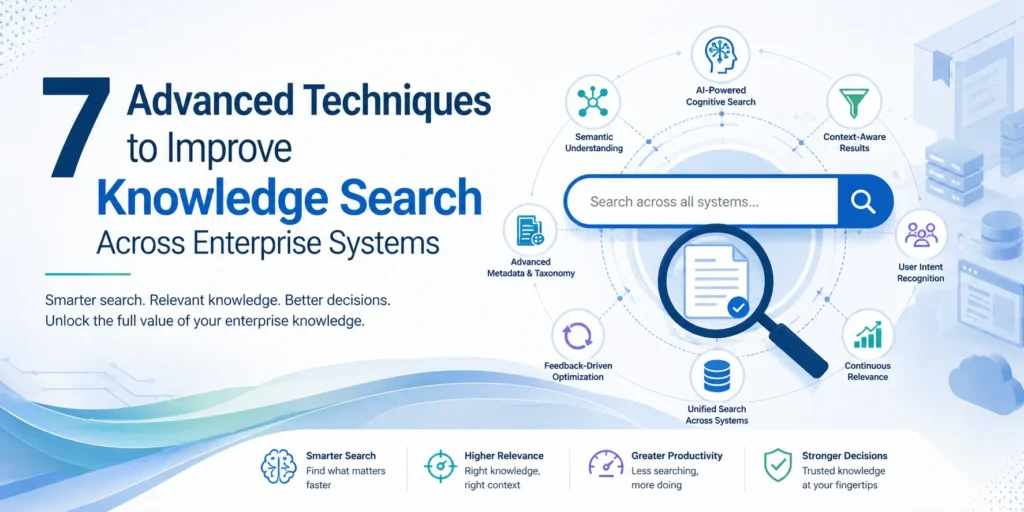
1. Semantic Layering Through Knowledge Graphs
Traditional enterprise search relies heavily on keyword matching, which inherently limits its ability to interpret meaning. A search query is reduced to lexical tokens, ignoring relationships, intent, and context. This is why users often receive either too many irrelevant results or miss critical knowledge entirely.
Semantic layering addresses this limitation by introducing a knowledge graph that connects entities, concepts, and relationships across the enterprise. Instead of indexing documents in isolation, the system understands how knowledge elements relate to each other.
A well-designed semantic layer enables:
- Concept-based retrieval rather than keyword matching
- Contextual disambiguation of terms
- Cross-domain knowledge discovery
For example, a search for “incident resolution protocol” can surface not only procedural documents but also related lessons learned, expert profiles, and historical case data. This transforms knowledge search from document retrieval into insight discovery.
Organizations implementing this approach often integrate ontology design with search infrastructure, ensuring that knowledge is structured for machine interpretability as well as human usability.
2. Context-Aware Search Driven by User Intent
Enterprise search systems frequently fail because they treat all users and queries as equal. In reality, knowledge needs vary significantly based on role, task, and context.
Context-aware search introduces dynamic filtering and ranking based on:
- User role and expertise level
- Current workflow or application context
- Historical interaction patterns
This technique reduces cognitive load by presenting only the most relevant knowledge. Instead of navigating large result sets, users receive targeted insights aligned with their immediate needs.
From a systems perspective, this requires integrating search with identity management, workflow systems, and usage analytics. The result is a shift from static retrieval to adaptive knowledge delivery.
This approach aligns with principles of decision intelligence, where the objective is not just to provide information but to support better decisions at the point of need.
3. Federated Search Across Distributed Knowledge Systems
One of the most persistent challenges in enterprise knowledge management is fragmentation. Knowledge resides across multiple systems such as document repositories, collaboration platforms, CRM systems, and specialized databases.
Federated search addresses this by enabling a unified search experience across distributed systems without requiring full data consolidation. It allows users to query multiple sources simultaneously and receive aggregated results.
However, effective federated search goes beyond simple aggregation. It requires:
- Normalization of metadata across systems
- Consistent relevance ranking
- Deduplication of results
Without these, federated search can overwhelm users with inconsistent and redundant information.
Advanced implementations incorporate semantic normalization, ensuring that knowledge from different systems can be interpreted and ranked coherently. This significantly improves the usability of enterprise search environments.
4. Continuous Relevance Optimization Through Feedback Loops
Search relevance is not static. It evolves based on how knowledge is used, interpreted, and refined over time. Yet many enterprise systems fail to incorporate feedback into search optimization.
Continuous relevance optimization introduces feedback loops that capture both explicit and implicit signals, including:
- Click-through rates and dwell time
- Query reformulation patterns
- User ratings and corrections
These signals provide insight into whether search results are meeting user needs. More importantly, they enable the system to adapt dynamically.
For instance, if users consistently bypass a top-ranked result in favor of another document, the system should adjust its ranking logic accordingly. This transforms knowledge search into a learning system rather than a fixed algorithm.
This technique is essential for maintaining a living knowledge base, where knowledge and its discoverability evolve together.
5. Embedding Knowledge Search Within Workflows
A critical limitation of many enterprise search systems is that they exist outside the flow of work. Users must actively leave their workflow to search for knowledge, creating friction and reducing adoption.
Embedding knowledge search within workflows addresses this issue by integrating search capabilities directly into operational systems. This includes:
- Contextual search within CRM or ERP platforms
- Inline recommendations within collaboration tools
- Automated knowledge prompts during task execution
When search is embedded, knowledge becomes a natural extension of work rather than an additional step. This significantly improves both usage and effectiveness.
This approach reflects a broader shift in knowledge management from repository-centric models to flow-centric models, where knowledge is delivered at the point of action.
6. Advanced Metadata and Taxonomy Engineering
Metadata is often treated as a secondary concern in knowledge management systems, but it plays a central role in search effectiveness. Poor metadata leads to poor discoverability, regardless of search technology.
Advanced metadata engineering involves:
- Designing taxonomies that reflect business domains and workflows
- Applying consistent tagging standards across systems
- Enabling automated metadata enrichment through AI
A key challenge is balancing structure with flexibility. Overly rigid taxonomies can become outdated, while overly loose structures reduce precision.
Leading organizations adopt hybrid approaches, combining controlled vocabularies with dynamic tagging mechanisms. This allows the system to maintain consistency while adapting to new knowledge domains.
From a search perspective, high-quality metadata improves indexing, filtering, and ranking, leading to more accurate and relevant results.
7. Leveraging AI for Cognitive Search Capabilities
AI has significantly advanced the capabilities of enterprise knowledge search, particularly through natural language processing and machine learning.
Cognitive search systems can:
- Interpret natural language queries
- Understand intent and context
- Generate summarized insights rather than just links
This represents a shift from retrieval-based search to answer-based search, where the system delivers synthesized knowledge.
However, the effectiveness of AI-driven search depends heavily on the quality of underlying knowledge structures. Without well-organized content and metadata, AI models produce unreliable or incomplete results.
Organizations such as Microsoft have advanced this approach through platforms like Microsoft Search and Azure Cognitive Search, where AI is used to enhance enterprise knowledge discovery. These systems integrate signals from across the Microsoft ecosystem, enabling more intelligent and context-aware search experiences.
The key insight is that AI amplifies existing knowledge management practices. It does not replace the need for strong knowledge architecture.
Building a Living Knowledge Base That Continuously Learns and Evolves
Integrating These Techniques Into a Cohesive Strategy
Each of these techniques provides value individually, but their true impact emerges when they are integrated into a cohesive strategy. Improving knowledge search across enterprise systems requires alignment across multiple dimensions:
- Knowledge architecture
- System integration
- User behavior
- Governance models
Organizations that treat these elements in isolation often struggle to achieve meaningful improvements. By contrast, those that adopt a systemic approach can transform knowledge search into a strategic capability.
This transformation is particularly important in complex enterprises, where decision-making depends on timely access to accurate knowledge. Poor search capabilities not only reduce productivity but also increase risk and limit innovation.
Strategic Perspective: Knowledge Search as an Enterprise Capability
The evolution of knowledge search reflects a broader shift in knowledge management. It is no longer sufficient to store and organize knowledge. The focus must be on enabling rapid, precise, and contextually relevant access.
A high-performing knowledge management system is defined not by the volume of knowledge it contains, but by how effectively that knowledge can be discovered and applied.
Improving knowledge search across enterprise systems is therefore not a technical optimization exercise. It is a strategic initiative that shapes how organizations learn, adapt, and compete.
The organizations that excel in this domain treat knowledge search as infrastructure for decision-making. They invest in semantic architectures, integrate search into workflows, and continuously refine relevance through feedback and AI.
As enterprise complexity continues to increase, the ability to surface the right knowledge at the right moment will become a defining capability. Knowledge search, when designed and executed at an advanced level, becomes the interface through which organizational intelligence is accessed and applied.
Stay informed on upcoming Smritex Knowledge Management sessions and workshops. Subscribe for updates.