
A knowledge management system becomes strategically relevant only when it stops behaving like a repository and starts operating as an adaptive, learning organism. The idea of a “living knowledge base” is not rhetorical. It reflects a structural shift from static documentation toward continuously evolving knowledge flows that respond to context, usage, and organizational change.
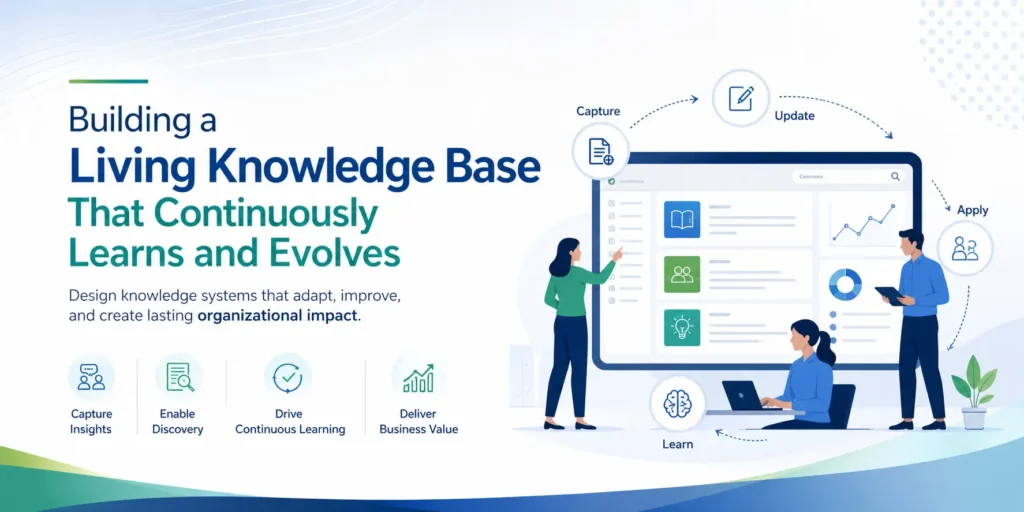
The primary keyword in this discussion is living knowledge base, and it is not interchangeable with traditional knowledge repositories. A living knowledge base is not defined by its content volume or taxonomy sophistication, but by its ability to learn from interactions, incorporate tacit signals, and dynamically reconfigure itself based on organizational needs.
This article examines how to build such a system, not through tooling alone, but through a deliberate integration of knowledge architecture, behavioral design, and feedback-driven intelligence.
Reframing the Knowledge Base as a Learning System
Most organizations still operate knowledge bases as structured storage systems. Documents are created, reviewed, and archived with a strong emphasis on governance, but very little attention is paid to how knowledge evolves after publication. This creates a fundamental disconnect between knowledge capture and knowledge relevance.
A living knowledge base, by contrast, treats knowledge as a continuously negotiated asset. Every interaction, search query, correction, and reuse becomes an input into the system’s evolution. This aligns closely with principles from organizational learning, where knowledge is not static but is refined through cycles of use, reflection, and adaptation.
The shift requires abandoning the assumption that knowledge is “complete” at the point of documentation. Instead, knowledge artifacts must be designed as provisional, open to iteration, and responsive to real-world application.
This perspective has deep implications for how knowledge management systems are architected. It requires embedding mechanisms for feedback capture, contextual updates, and signal amplification directly into the knowledge lifecycle.
The Structural Anatomy of a Living Knowledge Base
A living knowledge base is not a monolithic system. It is composed of interconnected layers that enable continuous learning and adaptation.
Knowledge Layer
This is where explicit knowledge resides, structured through taxonomies, ontologies, and metadata frameworks. However, in a living system, this layer is intentionally fluid. Content is modular, version-controlled, and designed for recombination rather than static consumption.
Semantic structuring becomes critical here. Instead of rigid hierarchies, knowledge is organized through relationships, enabling better discoverability and contextual relevance. This aligns with modern approaches in knowledge graph architecture, where connections matter more than categories.
Interaction Layer
This layer captures how users engage with knowledge. Every search query, click pattern, time spent, and feedback input generates behavioral data. In a traditional system, this data is often ignored. In a living knowledge base, it becomes the primary driver of evolution.
The interaction layer transforms passive consumption into active learning signals. It answers questions such as:
- Which knowledge is frequently accessed but poorly understood?
- Where do users abandon their search?
- Which content is repeatedly modified after use?
These signals provide insight into knowledge gaps, cognitive friction, and relevance decay.
Feedback and Adaptation Layer
This is where the system differentiates itself from static repositories. Feedback is not treated as optional commentary but as a core mechanism for knowledge refinement.
Feedback can be explicit, such as user ratings or comments, or implicit, such as repeated edits or workaround behaviors. The system must be designed to aggregate, interpret, and act on these signals.
This layer often integrates with decision intelligence frameworks, enabling the system to prioritize updates based on impact rather than frequency alone.
Governance Layer
Governance in a living knowledge base is fundamentally different from traditional models. It shifts from control to orchestration.
Instead of enforcing rigid approval workflows, governance focuses on:
- Ensuring knowledge integrity without slowing iteration
- Defining ownership models that encourage accountability
- Balancing openness with reliability
This requires a nuanced understanding of knowledge stewardship, where the goal is not to restrict change but to guide it effectively.
Continuous Learning Mechanisms in Knowledge Systems
A living knowledge base must embed mechanisms that allow it to learn continuously. Without these mechanisms, the system inevitably regresses into a static repository.
Feedback Loops as Core Infrastructure
Feedback loops are not supplementary features; they are the core infrastructure of a living system. They must operate at multiple levels:
- Micro-level: Immediate feedback on specific content pieces
- Meso-level: Patterns across teams or functions
- Macro-level: Organizational trends in knowledge usage
The challenge is not collecting feedback, but operationalizing it. Many organizations capture feedback but fail to integrate it into content evolution.
A well-designed living knowledge base ensures that feedback triggers action. This may involve automated updates, alerts to content owners, or AI-assisted recommendations for improvement.
Tacit Knowledge Integration
One of the most persistent failures in knowledge management systems is the inability to capture and integrate tacit knowledge. A living knowledge base addresses this by embedding knowledge capture into workflows rather than treating it as a separate activity.
For example, after-action reviews, collaborative editing, and contextual annotations allow tacit insights to be externalized in real time. Over time, these micro-contributions accumulate into a rich layer of experiential knowledge.
This aligns with Nonaka’s SECI model, particularly the externalization and combination phases, but extends it by making the process continuous rather than episodic.
Contextual Relevance and Dynamic Updating
Knowledge loses value when it becomes detached from context. A living knowledge base must continuously adjust content based on changing conditions.
This includes:
- Updating procedures based on new regulations or technologies
- Reprioritizing content based on usage patterns
- Highlighting context-specific knowledge for different user roles
Dynamic updating often leverages AI, but the effectiveness depends on the quality of underlying knowledge structures and feedback signals.
Real-World Application: How NASA Sustains a Living Knowledge Ecosystem
A compelling example of a living knowledge base in practice can be observed in NASA’s knowledge management approach. NASA operates in an environment where knowledge obsolescence can have catastrophic consequences, making continuous learning non-negotiable.
NASA’s Lessons Learned Information System (LLIS) is not merely a repository of past experiences. It functions as a living knowledge base by integrating lessons into ongoing missions, rather than archiving them as historical artifacts.
The system captures insights from missions, anomalies, and near-failures, but more importantly, it ensures that these insights are actively used. Engineers and mission planners engage with this knowledge during decision-making processes, and their interactions generate new layers of understanding.
What distinguishes NASA’s approach is the integration of tacit and explicit knowledge. Lessons are contextualized, annotated, and continuously refined based on new missions. The system evolves because it is embedded in operational workflows, not isolated from them.
This example highlights a critical principle: a living knowledge base cannot exist as a standalone system. It must be deeply integrated into the organization’s core processes.
The Role of AI in Enabling Living Knowledge Systems
AI is often positioned as the solution to knowledge management challenges, but its role in a living knowledge base is more nuanced. AI does not create a living system; it amplifies the system’s ability to learn.
Signal Detection and Pattern Recognition
AI excels at identifying patterns in large datasets. In a living knowledge base, this capability is used to detect:
- Emerging knowledge gaps
- Content that requires updating
- Patterns of user behavior that indicate friction
These insights enable proactive knowledge management, where the system evolves before issues become critical.
Automated Knowledge Curation
AI can assist in curating knowledge by suggesting updates, merging duplicate content, and recommending relevant resources. However, this must be carefully governed to avoid introducing inaccuracies.
The goal is not full automation, but augmentation. Human expertise remains essential for validating and contextualizing knowledge.
Personalization and Cognitive Load Management
A living knowledge base must manage cognitive load effectively. AI-driven personalization ensures that users receive relevant knowledge without being overwhelmed.
This involves tailoring content based on role, context, and past interactions. The result is a more efficient knowledge flow, where users can access what they need without navigating unnecessary complexity.
Behavioral Design and Knowledge Participation
Technology alone cannot sustain a living knowledge base. The system must be designed to encourage participation and continuous contribution.
Incentivizing Knowledge Contribution
Traditional incentive models often fail because they treat knowledge contribution as an additional task rather than an integral part of work.
A more effective approach is to embed knowledge capture into existing workflows, reducing friction and aligning incentives with outcomes. Recognition systems, peer validation, and visible impact can reinforce participation.
Reducing Contribution Friction
The effort required to contribute knowledge must be minimized. This involves:
- Simplifying interfaces
- Enabling real-time editing
- Integrating with tools that employees already use
When contribution becomes seamless, participation increases naturally.
Building Communities of Practice
Communities of practice play a critical role in sustaining a living knowledge base. They provide a social layer where knowledge is discussed, validated, and refined.
These communities act as knowledge amplifiers, ensuring that insights are not confined to individuals but shared across the organization.
Governance Without Stagnation
Governance is often the point where knowledge systems lose their dynamism. Excessive control slows down updates, while lack of governance leads to chaos.
A living knowledge base requires a different governance philosophy. It must balance reliability with adaptability.
This involves defining clear ownership models, where individuals or teams are responsible for maintaining specific knowledge domains. At the same time, the system must allow for distributed contributions, ensuring that knowledge evolves collaboratively.
Version control, audit trails, and validation mechanisms provide the necessary safeguards without restricting change.
Designing for Knowledge Flow Rather Than Storage
The most significant conceptual shift in building a living knowledge base is moving from storage-centric thinking to flow-centric thinking.
Knowledge does not create value when it is stored. It creates value when it flows through the organization, influencing decisions, actions, and outcomes.
A living knowledge base is designed to facilitate this flow. It ensures that knowledge is:
- Easily discoverable
- Contextually relevant
- Continuously updated
- Actively used
This requires aligning the knowledge management system with the organization’s operational rhythms. Knowledge must move with the work, not lag behind it.
How Smart Organizations Turn Everyday Work Into Reusable Knowledge
Strategic Implications for KM Leaders
For KM leaders, building a living knowledge base is not a technical initiative. It is a strategic transformation.
It requires rethinking:
- How knowledge is defined and valued
- How systems are designed and governed
- How people interact with knowledge in their daily work
The challenge is not implementing new tools, but orchestrating a system where knowledge continuously learns and evolves.
Organizations that succeed in this transformation gain a significant advantage. They do not just manage knowledge; they leverage it as a dynamic capability that adapts to change, supports innovation, and enhances decision-making.
The living knowledge base becomes more than a system. It becomes an integral part of the organization’s intelligence, shaping how it learns, adapts, and competes in an increasingly complex environment.
Stay informed on upcoming Smritex Knowledge Management sessions and workshops. Subscribe for updates.