
Large organizations rarely fail because they lack talent. They fail because what people know does not move fast enough. One division solves a recurring problem while another repeats it six months later. A senior expert retires and takes years of experience with them. A new employee spends weeks searching for answers that already exist somewhere inside the business.
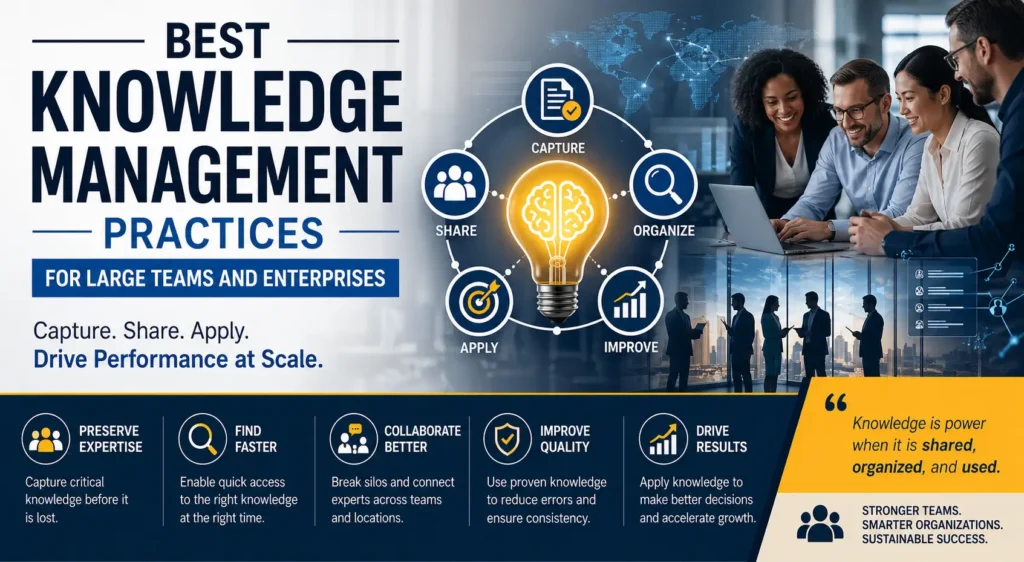
This is why strong knowledge management practices matter. In enterprises, scale creates complexity. Teams are distributed across locations, functions, systems, and time zones. Without clear methods for capturing, organizing, sharing, and applying knowledge, growth often creates friction instead of advantage.
The best knowledge management practices are not about building a document library and hoping people use it. They combine governance, leadership behavior, technology, culture, and operational discipline. They make knowledge usable in the flow of work.
By the end of this article, you will understand which practices consistently work in large teams and enterprises, how leading organizations approach them, and what separates successful KM programs from expensive internal portals that no one trusts.
Why Knowledge Management Becomes Critical at Enterprise Scale
Small teams often rely on informal communication. People ask a colleague, sit nearby, or know who has the answer. That model breaks once organizations expand.
As headcount rises, layers increase. Teams become specialized. Processes vary by region. Technology stacks multiply. New hires arrive continuously. Mergers bring duplicated systems and conflicting terminology. Suddenly, knowledge is everywhere and nowhere at the same time.
That is where disciplined knowledge management practices create business value. They reduce search time, improve onboarding, preserve expertise, standardize quality, and accelerate execution across the enterprise.
Organizations such as IBM, Microsoft, Shell, Toyota, and NASA have long recognized that knowledge is not a side topic. It is operating infrastructure.
Build a Single Source of Trusted Knowledge
One of the most important knowledge management practices for enterprises is creating a reliable source of truth. In many companies, policies live in one tool, procedures in another, project templates on shared drives, and tribal knowledge in chat messages. Employees waste time deciding which version is correct.
A trusted knowledge environment does not mean forcing everything into one platform. It means creating clear architecture so people know where official information lives, who owns it, and how it is maintained.
This requires taxonomy, metadata, version control, ownership rules, and content lifecycle management. Every critical knowledge asset should have an accountable owner. Every employee should know whether a page is current, obsolete, draft, or approved.
Microsoft has long emphasized structured collaboration environments where documentation, policies, and operational knowledge are easier to discover and maintain. That principle matters more than the tool itself.
When trust is low, employees bypass KM systems and ask around. When trust is high, adoption grows naturally.
Capture Tacit Knowledge Before It Walks Out the Door
Some of the most valuable enterprise knowledge is never written down. It exists in judgment, intuition, negotiation skill, troubleshooting logic, stakeholder management, and pattern recognition developed over years.
This is known as tacit knowledge, and protecting it is one of the most overlooked knowledge management practices.
Large organizations should identify high-risk roles where expertise concentration is dangerous. These often include senior engineers, operations leaders, regulatory specialists, relationship managers, and long-tenured technical staff.
Effective capture methods include structured interviews, shadowing, decision walkthroughs, storytelling sessions, recorded demonstrations, mentoring programs, and transition playbooks.
NASA became a leading example because it invested in lessons learned and expert knowledge transfer when experienced personnel retired. In high-stakes environments, losing know-how can create serious operational risk.
Most companies wait until resignation notices arrive. By then, it is late. Strong KM teams treat knowledge continuity as workforce planning.
Embed Knowledge Sharing Into Daily Workflows
A common reason KM programs fail is that sharing knowledge feels like extra work. Employees are asked to finish projects, hit targets, attend meetings, and then “contribute to the portal” in spare time.
That rarely works.
The best knowledge management practices integrate contribution into normal workflows. A completed project automatically triggers a retrospective. A resolved customer issue becomes a reusable article. A successful proposal updates the approved template library. A recurring technical fix enters the support knowledge base.
This operational integration reduces friction and improves freshness.
Toyota built a global reputation for embedding continuous learning into everyday work. Improvement was not separate from operations. It was part of operations.
That lesson applies across industries. If knowledge capture depends on goodwill alone, it will fade under pressure. If it is built into process design, it becomes sustainable.
Use Communities of Practice to Break Silos
Large enterprises often suffer from duplicated expertise. Similar specialists in different regions solve the same problems independently because they are not connected.
Communities of practice are one of the most effective knowledge management practices for solving this issue. These are structured networks of people who share a discipline, challenge, or functional domain.
Examples include cybersecurity communities, project management forums, sales enablement groups, data science circles, or procurement networks.
Done well, communities create faster problem-solving, reusable assets, peer learning, and stronger professional identity. They also reveal internal experts who may otherwise remain invisible.
IBM became well known for using communities of practice to connect specialists across a global workforce. This helped spread methods, tools, and client knowledge across regions.
Communities need facilitation, leadership sponsorship, cadence, and purpose. Without those, they become inactive chat groups.
Invest in Enterprise Search and Findability
Many companies already possess the knowledge they need. The problem is retrieval.
Employees search five systems, ask three colleagues, and still cannot find the answer. That hidden friction creates lost hours at scale. Across thousands of employees, the cost is significant.
This makes findability one of the highest-return knowledge management practices in enterprise settings.
Strong enterprise search includes indexing across systems, permission-aware access, smart ranking, metadata quality, synonym handling, and clean content design. Search analytics should reveal failed queries, content gaps, and user behavior patterns.
Microsoft and other digital leaders understand that discoverability is central to productivity. A brilliant knowledge base no one can navigate has limited value.
As generative AI tools become more common, poor findability becomes even more visible. AI assistants are only as useful as the underlying knowledge they can access.
Create Governance Without Bureaucracy
Many KM initiatives collapse at two extremes. Some have no governance, creating chaos. Others create heavy committees, slowing everything down.
The strongest knowledge management practices use practical governance. This means defining decision rights, standards, ownership, and measurement without suffocating participation.
A mature model often includes executive sponsorship, a KM lead or central function, domain content owners, community leaders, and business-unit champions. Roles should be clear. Escalation paths should be simple.
Governance should answer questions such as:
- Who approves critical content?
- Who archives outdated material?
- Who owns taxonomy changes?
- Which metrics matter?
- How are communities supported?
- How is sensitive knowledge protected?
Good governance increases confidence. Poor governance increases delay.
Measure What Matters
If knowledge management cannot show value, funding becomes fragile. That is why measurement is one of the most essential knowledge management practices for enterprises.
Vanity metrics such as page views alone are weak indicators. Better measures connect to business outcomes.
Useful indicators include reduced onboarding time, faster issue resolution, lower repeat incidents, proposal reuse rates, employee search time saved, expert response speed, community participation quality, and retirement-risk mitigation progress.
APQC and other KM authorities have long encouraged linking KM metrics to operational outcomes rather than activity counts.
Executives support what they can see. If KM shortens ramp-up time or improves service consistency, it becomes easier to sustain investment.
Build a Knowledge Sharing Culture
Technology can enable KM, but culture determines participation. In some organizations, people hoard knowledge because it feels like job security. In others, people share because collaboration is recognized and rewarded.
Culture-focused knowledge management practices include leadership role-modeling, recognition programs, peer appreciation, mentoring expectations, internal teaching opportunities, and performance systems that value contribution.
Managers are especially important. If managers only reward individual output, knowledge sharing declines. If managers reward team learning and reuse, behavior changes.
Shell has often been cited in KM circles for encouraging learning transfer across operations. That kind of behavior requires more than software. It requires norms.
Culture change is slower than tool rollout, but it produces deeper results.
Use AI Carefully to Strengthen KM
AI is reshaping enterprise KM, but many companies misunderstand the order of operations. They buy AI first and clean knowledge later.
The better sequence is the reverse.
AI performs best when supported by structured content, clear ownership, reliable metadata, and current source material. Otherwise, it amplifies confusion.
Smart AI-related knowledge management practices include semantic search, auto-tagging, summarization, expert recommendation, duplicate detection, conversational retrieval, and knowledge gap analysis.
However, governance remains critical. Sensitive data, hallucinations, outdated sources, and weak permissions can create serious risk.
AI can accelerate knowledge flow, but it cannot replace KM fundamentals.
Knowledge Management Examples from Top Companies That Drive Real Results
How Large Enterprises Should Start
Many organizations attempt enterprise-wide KM transformations and stall under complexity. A better path is phased execution.
Start with one high-value pain point. This could be slow onboarding in sales, repeated incidents in IT support, knowledge loss in engineering, or inconsistent proposals in consulting teams.
Solve one problem visibly. Measure results. Build credibility. Then expand.
The best knowledge management practices are often scaled from successful pilots, not imposed through grand launches.
CONCLUSION
The strongest enterprises do not merely hire smart people. They create systems where intelligence compounds. That is the real purpose of knowledge management practices.
When knowledge is trusted, searchable, shared, current, and embedded in work, teams move faster and repeat fewer mistakes. Expertise survives turnover. New hires ramp quicker. Decisions improve because people can build on what the organization already knows.
For large teams and enterprises, KM is no longer optional administration. It is performance architecture. Start where knowledge friction is costing you the most, solve it with discipline, and expand from evidence.
FAQ SECTION
What are the best knowledge management practices for large organizations?
The best practices include building a trusted source of truth, capturing expert knowledge, improving enterprise search, creating communities of practice, and measuring business outcomes. Strong governance and culture support are also essential. These practices help knowledge move across complex organizations.
Why do enterprises struggle with knowledge management?
They usually struggle because information is fragmented across systems, ownership is unclear, and sharing is not embedded into workflows. Rapid growth and siloed teams increase the problem. Many companies also underestimate cultural barriers.
How can large teams improve knowledge sharing?
Large teams improve sharing by making contribution easy, rewarding collaboration, using searchable platforms, and connecting experts through communities. Leadership behavior also matters. Employees follow what managers reinforce.
Is software enough for enterprise knowledge management?
No. Software is only one layer. Without governance, ownership, content quality, and participation habits, even expensive platforms underperform. KM succeeds when people, process, and technology work together.
How do you measure knowledge management success?
Measure outcomes such as onboarding speed, issue resolution time, reuse rates, reduced repeat errors, and time saved finding information. These metrics are stronger than raw page views. Business impact earns long-term support.
What is the first step to build KM in an enterprise?
Start by identifying one costly knowledge problem. Focused wins create momentum. Once leaders see measurable value, broader KM adoption becomes much easier.