
Every organization manages knowledge. The question is whether it does so deliberately, with architecture and intention, or accidentally, through whatever informal patterns its people have developed on their own. The gap between those two approaches is measurable in onboarding time, error rates, decision quality, and the organizational cost of losing a single experienced employee.
The textbook definition of knowledge management gets repeated constantly and understood rarely. This article goes past it.
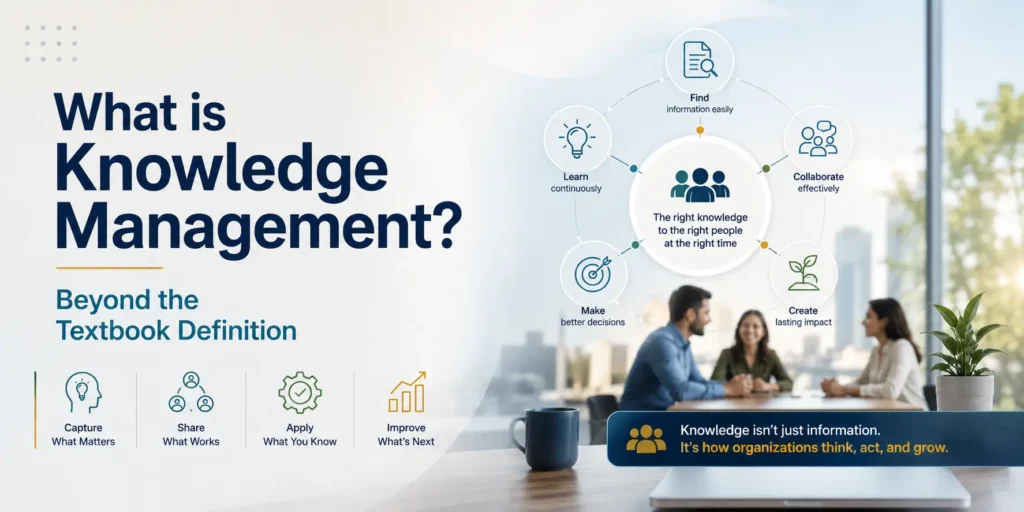
Table of Contents
The Definition That Practitioners Actually Use
Knowledge Management: A Working Definition
Knowledge management (KM) is the deliberate, systematic process by which an organization identifies, captures, organizes, shares, and applies its collective knowledge to improve performance, enable better decisions, and sustain capability over time regardless of personnel changes.
Three words in that definition carry most of the weight: deliberate, systematic, and collective.
Deliberate separates knowledge management from the informal knowledge sharing that happens in every organization. Conversations in hallways, email threads that explain how something really works, a senior engineer who always gets pulled in to troubleshoot the same class of problem. That is not knowledge management. It is knowledge dependency, and it is fragile.
Systematic means the process has structure, ownership, standards, and governance. Knowledge management without governance is a digital landfill, not a knowledge base.
Collective means the organization’s knowledge, not the individual’s. The moment knowledge lives only in one person’s head, the organization does not own it. That person does.
What the Textbooks Miss
The standard academic definition, the one that appears in SHRM certifications and MBA curricula, typically frames knowledge management as “a process of creating, sharing, using, and managing the knowledge and information of an organization.” That definition is not wrong. It is just insufficient for anyone who has to actually build a program.
What it misses: the cultural conditions that determine whether any of those processes work, the governance structures that maintain quality over time, the distinction between different types of knowledge that require entirely different management approaches, and the organizational politics that determine whether a KM initiative survives its second budget cycle.
Peter Drucker, who wrote about knowledge workers decades before the term became common parlance, understood the full picture. His observation that “the most valuable asset of a 21st-century institution will be its knowledge workers and their productivity” was not a statement about software. It was a statement about organizational design, incentives, and the conditions under which human expertise becomes organizational capability.
Where Knowledge Management Came From
The 1990s: A Field Finds Its Name
Knowledge management as a named discipline emerged in the early 1990s, though its roots reach further back into organizational learning theory and information science. The confluence of three factors gave it momentum: the rapid expansion of corporate intranets, the growing recognition that competitive advantage was shifting from physical assets to intellectual ones, and a wave of research that gave the field theoretical foundations it had previously lacked.
Consulting firms, particularly McKinsey and Ernst and Young, were early institutional adopters. Their business models depend entirely on knowledge: knowledge of industries, of solutions to recurring problems, of what worked and what failed with prior clients. The ability to capture and reuse that knowledge across thousands of consultants globally was not a nice-to-have. It was the operating model.
The publication of Ikujiro Nonaka and Hirotaka Takeuchi’s “The Knowledge-Creating Company” in 1995 gave the field its most enduring theoretical framework. Their argument was not merely that knowledge should be managed. It was that knowledge creation is the core organizational competency that determines competitive survival, and that understanding how knowledge is created and converted between forms is prerequisite to managing it intelligently.
Nonaka and Takeuchi: The Insight That Organized a Field
The SECI model, which Nonaka and Takeuchi introduced to describe four modes of knowledge conversion, remains the most referenced framework in KM literature three decades after its publication. Its durability reflects the accuracy of the underlying observation: knowledge moves through organizations in predictable ways, and organizations that understand those movements can design processes to accelerate and improve them.
The four modes are Socialization (tacit to tacit, knowledge transferred through shared experience), Externalization (tacit to explicit, expertise converted into documented form), Combination (explicit to explicit, synthesizing documented knowledge into new knowledge), and Internalization (explicit to tacit, documented knowledge absorbed through application until it becomes intuitive).
The practical implication that most organizations still miss: the most valuable knowledge conversion mode is Externalization, and it is the one organizations invest in least. Converting what an expert knows into something others can use requires time, skill, and incentive. Most organizations provide none of the three adequately.
From Intranet Projects to Strategic Discipline
The 2000s saw a significant maturation in how organizations understood KM. The first generation of enterprise KM initiatives, many of which were essentially intranet projects given a new name, produced mixed results and a degree of institutional skepticism that persists to this day.
The second generation, which began to take hold in organizations with serious KM functions, was characterized by much greater attention to the human and cultural dimensions of knowledge sharing. Technology was repositioned as an enabler of human knowledge behavior rather than a replacement for it. Communities of practice, peer assist processes, after-action reviews, and expertise location systems became recognized as core KM mechanisms alongside platform investments.
The third generation, which defines the current period, is shaped by artificial intelligence. The question is no longer whether AI will transform knowledge management. It already has. The question is whether organizations understand what AI requires of their knowledge infrastructure in order to deliver trustworthy, high-quality outputs.
The Three Types of Knowledge Every Organization Manages or Fails To
Tacit Knowledge: What People Know But Cannot Easily Say
Tacit knowledge is the most valuable and the most difficult to manage. It is the knowledge that lives in experience: the judgment a senior underwriter applies when a claim pattern looks suspicious but does not technically violate any threshold, the diagnostic intuition a master technician develops after years of working with specific equipment, the client management instincts that make one account executive dramatically more effective than another with the same technical skills.
Michael Polanyi, the philosopher and scientist who introduced the concept in 1958, described it with a formulation that remains instructive: “We can know more than we can tell.” The challenge for knowledge management is not to ignore this truth but to find mechanisms for making tacit knowledge accessible despite the difficulty of making it explicit.
The consequences of poorly managed tacit knowledge are concrete. In 2026, organizations across manufacturing, healthcare, engineering, and professional services face a workforce demographic shift that is transferring decades of tacit expertise out of the organization through retirement faster than it is being replaced. Organizations that have not invested in tacit knowledge capture and transfer mechanisms are absorbing the cost in productivity loss, error rates, and extended time-to-competency for successors.
Read: A Beginner’s Guide to Tacit and Explicit Knowledge
Explicit Knowledge: What Organizations Document
Explicit knowledge is what most people think of when they think of knowledge management: documented procedures, technical specifications, research reports, training materials, case studies, policies, and guidelines. It is codified, transmissible, and searchable.
Managing explicit knowledge well requires governance. Without it, explicit knowledge bases suffer four predictable failure modes. Content becomes outdated and no one is accountable for updating it. Contradictory versions of the same procedure coexist. Search quality degrades as volume increases without structural taxonomy. Users learn through experience that the system cannot be trusted, and they stop using it.
The governance disciplines required for well-managed explicit knowledge are content ownership (named individuals accountable for defined domains), review cycles (scheduled and trigger-based processes for updating content), quality standards (definitions of what publishable knowledge looks like), and retirement policies (criteria for removing content that is no longer applicable).
Embedded Knowledge: The Type Most Organizations Overlook
Embedded knowledge is organizational knowledge that lives in systems, processes, culture, and routines rather than in documents or in individual heads. It is the accumulated wisdom encoded in how work actually gets done: the sequence of steps that experienced practitioners follow without being able to fully articulate why, the informal networks that determine how problems really get solved, the organizational norms that govern collaboration behavior.
Embedded knowledge is the hardest to transfer when organizations change. Mergers and acquisitions routinely destroy embedded knowledge by disrupting the systems and routines that carried it. Reorganizations eliminate the informal networks that facilitated problem-solving outside official channels. Digital transformation initiatives sometimes replace embedded knowledge with new systems before anyone has mapped what the old processes contained.
Identifying and making embedded knowledge visible is one of the most sophisticated and highest-value activities in knowledge management. It requires process observation, conversation, and deliberate mapping rather than document capture or platform deployment.
What Knowledge Management Is Not
Clarity about what KM is not prevents the category errors that produce failed programs.
Not an IT Project
Knowledge management is an organizational capability that uses technology as an enabler. When IT owns the KM strategy, the result is a technically sophisticated platform that the organization does not use because the human and cultural dimensions were not addressed. The technology decision follows the strategy decision. It never precedes it.
Not a Document Management System
Document management is a component of knowledge management, not a synonym for it. A document management system organizes and versions files. Knowledge management determines which knowledge matters, ensures it is created and validated, makes it discoverable and contextually useful, and governs its quality over time. The distinction matters because organizations that confuse the two invest in storage when they need infrastructure.
Not an Intranet Redesign
The corporate intranet is one possible channel through which managed knowledge is delivered. It is not a knowledge management program. An organization can have a beautifully designed intranet containing outdated, ungoverned, undiscoverable content and have achieved nothing of strategic value from the investment.
Not a One-Time Initiative
Knowledge management does not have a go-live date after which the work is complete. It is operational infrastructure that requires ongoing investment in content quality, governance, technology evolution, cultural reinforcement, and measurement. Organizations that treat it as a project with a defined end date discover, predictably, that the knowledge base decays within 18 to 24 months and the investment produces no durable return.
Not Only Relevant for Large Organizations
The assumption that KM is a large-enterprise discipline misses how costly knowledge fragmentation is at every scale. A professional services firm of 40 people where each practitioner operates from their own undocumented approach, where no systematic client knowledge is captured, and where onboarding a new hire requires six months of informal osmosis, has a KM problem with measurable consequences. The tools and governance mechanisms scale down. The strategic principles do not change.
The Four Core Functions of Knowledge Management
A functional definition of knowledge management maps to four activities. The degree to which an organization performs each deliberately, with structure and governance, determines its position on the KM maturity continuum.
Knowledge Creation and Capture
Knowledge creation happens continuously in every organization: in client engagements, research projects, problem-solving sessions, post-mortems, and daily operational work. The question is whether that creation is captured or lost.
Capture mechanisms fall into two categories. Pull mechanisms are those that require active effort from the knowledge holder: documentation templates, after-action review processes, structured interview protocols. Push mechanisms are embedded in workflows so that capture happens as a byproduct of work rather than as an additional step: AI-assisted meeting transcription, automatic generation of project summaries, prompted reflection at defined project milestones.
The most effective KM programs design for push mechanisms wherever possible. Every additional step between completing work and capturing knowledge reduces the probability that capture occurs. At zero additional steps, capture becomes nearly universal.
Knowledge Organization and Storage
Captured knowledge without structure is retrievable only by those who know it exists. Organization is the process of making knowledge findable: through taxonomy (the classification logic that enables browsing and filtering), metadata (the attributes that enable search and filtering), and search architecture (the technical systems that match queries to content).
Taxonomy design is more consequential than most organizations realize. The most common error is building a taxonomy that reflects organizational structure rather than how practitioners think about their work. A practitioner searching for guidance on client complaint handling does not think in terms of which department owns the complaint process. Task-oriented taxonomies consistently outperform organizational-structure taxonomies in search success rates and user adoption.
Knowledge Sharing and Transfer
The sharing layer encompasses all the mechanisms through which knowledge moves from those who hold it to those who need it. Platforms are one mechanism. Research consistently shows they are not the most effective one.
Etienne Wenger’s research on communities of practice, formalized in his 1998 work “Communities of Practice: Learning, Meaning, and Identity,” identified that the most durable knowledge transfer happens through participation in communities of practitioners who share a domain, not through reading documents. The implication for KM design: communities of practice, peer networks, structured mentorship, and expert location systems are not supplementary to the platform investment. For tacit knowledge transfer specifically, they are primary.
The peer assist process, documented extensively by APQC as one of the highest-ROI KM practices, demonstrates this point. Before beginning a project or initiative, a peer assist brings in practitioners who have relevant prior experience to share what they know. The knowledge transfer happens through conversation, not through document access. The outcomes, faster project starts, fewer repeated mistakes, higher quality decision-making, are measurable.
Knowledge Application and Governance
Application is where knowledge creates value. All prior investment in creation, organization, and sharing is preparation for the moment when a practitioner, facing a real decision or problem, accesses relevant knowledge and uses it to produce a better outcome.
Application quality depends on three conditions. First, the search or discovery experience must deliver relevant, trustworthy results within two to three interactions. Users who do not find what they need quickly learn not to look. Second, content must be current and authoritative. If the practitioner finds a procedure but cannot determine whether it is the current version or who validated it, the knowledge system creates uncertainty rather than resolving it. Third, the knowledge must be contextually matched to the user’s situation. Generic guidance applied to specific situations requires the user to do the translation work. Systems that provide contextually relevant knowledge reduce that burden.
Governance is the mechanism that keeps the application layer functioning over time. Without governance, knowledge bases age and degrade. The most carefully built repository becomes an unreliable resource within two years if no one is accountable for maintaining its quality.
Why Knowledge Management Matters More in 2026 Than Ever Before
The AI Factor: Quality In, Quality Out
The deployment of enterprise AI tools has fundamentally changed the stakes of knowledge governance. When AI systems draw on organizational knowledge to generate responses, summarize content, answer queries, or support decisions, the quality of the knowledge base determines the quality of the AI output.
A well-governed knowledge base produces AI outputs that are trustworthy, contextually appropriate, and consistent with organizational standards. A poorly governed one, with outdated content, contradictory versions of procedures, and no clear authority signals, produces AI outputs that are confidently wrong. The damage from confidently wrong AI outputs at scale is substantially greater than the damage from individual practitioners accessing outdated documents.
In 2026, knowledge management has become the prerequisite infrastructure for enterprise AI. Organizations that had invested in KM governance before deploying AI tools had a significant advantage: their AI performed better from day one. Organizations that deployed AI on top of ungoverned knowledge bases are now running remediation programs that cost more than building governance correctly would have.
The Workforce Transition Factor
The demographic composition of the workforce in most developed economies means that an exceptional volume of organizational knowledge is in motion. Experienced practitioners are retiring at rates that organizations did not adequately plan for. Workforce flexibility models have increased the proportion of knowledge held by contractors and contingent workers who are not invested in contributing to organizational knowledge systems. Remote and hybrid work arrangements have reduced the informal knowledge transfer that happened through physical proximity.
These pressures create urgency that was not as acute a decade ago. The organizations watching most carefully know that they have a finite window to capture the tacit knowledge held by their most experienced practitioners before it exits permanently. The ones that manage this transition well will have a knowledge infrastructure advantage that compounds over the following decade.
The Complexity Factor
The decisions that organizations face in 2026 are not simpler than the decisions they faced in 2010. They are more complex, faster-moving, and higher-stakes. Regulatory environments have grown more intricate. Market dynamics shift more rapidly. Competitive intelligence has a shorter shelf life. Technology choices have more strategic consequence.
Better decisions require better knowledge infrastructure. The organizations that can consistently get the right knowledge to the right people at the right moment in a decision process outperform those that rely on whoever happens to be available or whatever happens to surface in a search.
What Knowledge Management Looks Like at Scale
In Professional Services
In a global consulting firm, knowledge management is the operating model. Methodologies developed for one client are refined and made reusable for the next. Case study libraries allow practitioners to reference precedent before proposing approaches. Expert location systems enable any practitioner to identify a colleague with relevant experience regardless of geography. Alumni networks extend the knowledge ecosystem beyond the firm’s boundaries.
The KM function in a mature professional services firm is not a support function. It is a core capability that directly affects the quality of client work and the efficiency with which experienced knowledge is leveraged across the practice. Firms that invest in KM outperform those that do not on proposal win rates, client satisfaction, and practitioner productivity.
In Healthcare
Clinical knowledge management is a patient safety function as much as it is an operational efficiency one. Ensuring that clinical staff have access to current, validated protocols at the point of care, that research findings are integrated into practice guidelines in a timely and reliable way, and that lessons from adverse events are captured and distributed, are knowledge management activities with direct patient outcome implications.
Healthcare organizations with mature KM programs demonstrate measurably better protocol adherence, faster integration of evidence-based updates, and lower rates of preventable errors attributable to knowledge gaps. In a sector where knowledge currency has life-or-death consequences, the governance disciplines that maintain knowledge quality are not overhead. They are safety infrastructure.
In Manufacturing
Manufacturing knowledge management centers on process knowledge: the operational expertise that keeps production lines efficient, safe, and adaptable. This knowledge is disproportionately tacit, concentrated in the experience of practitioners who have worked with specific equipment and processes over years or decades.
The KM challenge in manufacturing is acute because the knowledge most at risk is the hardest to capture. A master technician who can diagnose an equipment fault by sound cannot always explain the diagnostic logic in terms that a documentation template can capture. Video-based process documentation, structured mentorship programs, and communities of practice that connect practitioners across plants and shifts are the primary tools for managing knowledge that resists text-based capture.
The Difference Between Adequate and Excellent KM Programs
What Adequate Programs Do
Adequate KM programs have a platform, some documented content, a community or two, and a team that manages it all. They report activity metrics (pages published, searches executed, users active) and make a general case for their value. Leadership tolerates them. Practitioners use them when it is easy and ignore them when it is not.
Adequate is not a stable state. Without continuous governance investment and cultural reinforcement, adequate programs drift toward inactive ones. The knowledge base ages. Adoption declines. Budget justification becomes harder. Eventually the program is quietly reduced or absorbed into something else.
What Excellent Programs Do Differently
Excellent KM programs do six things that adequate programs do not.
They measure business outcomes rather than platform activity. The KM team at an excellent program can demonstrate that onboarding time for a specific role decreased from 90 days to 45 after the deployment of structured knowledge resources in that domain. They can show that error rates on a specific class of decision dropped after post-mortem learnings were captured and distributed. They speak finance’s language.
They design governance before content. Content quality standards, ownership assignments, and review cycles are established before the first piece of content is published. The architecture exists to maintain quality from the beginning, not retrospectively applied to a sprawling, ungoverned library.
They treat tacit knowledge as a strategic asset, not a nice-to-have. Structured programs for expert interviews, knowledge elicitation, communities of practice, and mentorship are designed and resourced. The program understands that its most valuable knowledge cannot be captured in a document and plans accordingly.
They have visible executive sponsorship. The most senior KM champion uses the system publicly, credits the knowledge they accessed in decisions, and discusses knowledge contribution in performance conversations. Behavior at the top determines behavior throughout.
They connect KM to AI strategy explicitly. The knowledge base is understood as the fuel for enterprise AI. Governance decisions are made with AI performance implications in mind. The KM function positions itself as the prerequisite for trustworthy AI, not as a separate function competing for budget.
They sustain investment. They are funded and resourced as operational infrastructure, not as projects. When budget pressure arrives, the case for continued investment is made in business outcome terms that leadership understands and accepts.
Frequently Asked Questions
What is knowledge management in simple terms?
Knowledge management is how an organization captures what it knows, organizes that knowledge so people can find it, shares it across the organization, and maintains its quality over time. The goal is to make sure that the right knowledge reaches the right people at the moment they need it, regardless of whether the person who originally held that knowledge is available.
What is an example of knowledge management?
A global engineering firm deploys a lessons-learned database linked to its project management system. At the close of each project, structured templates prompt project leaders to document what worked, what failed, and what should be done differently. Before beginning a new project with similar characteristics, the project team is required to search and review relevant past entries. Error rates on projects where this process is followed are measurably lower than on projects where it is not.
What is the difference between knowledge management and document management?
Document management is the storage, versioning, and retrieval of files. Knowledge management encompasses document management but includes tacit knowledge transfer, expertise location, community learning, governance processes that maintain content quality, and the cultural and behavioral conditions that enable knowledge sharing. Every knowledge management program requires document management capabilities. Not every document management system is a knowledge management program.
Who invented knowledge management?
No single individual invented knowledge management, but several contributed foundational ideas that shaped the discipline. Peter Drucker’s work on knowledge workers in the 1960s established the strategic importance of intellectual capital. Ikujiro Nonaka and Hirotaka Takeuchi’s SECI model (1995) provided the most widely adopted theoretical framework. Etienne Wenger’s research on communities of practice (1998) shaped how organizations think about social learning. Karl Wiig, who used the term “knowledge management” in its modern sense at a 1986 United Nations conference, is often credited with naming the field.
Is knowledge management still relevant in the age of AI?
More relevant than it has ever been. AI systems in enterprise contexts perform in direct proportion to the quality, currency, and governance of the knowledge they draw on. An organization with a well-governed, high-quality knowledge base gets dramatically better results from enterprise AI than an organization with fragmented, ungoverned content. Knowledge management is the infrastructure prerequisite for trustworthy AI. Its relevance has not declined with AI adoption. It has increased.
What does a knowledge manager do?
A knowledge manager is responsible for designing, implementing, and operating the systems and processes through which an organization captures, organizes, shares, and governs its knowledge. This includes taxonomy design, governance framework development, content quality oversight, community facilitation, platform management, user adoption programs, and measurement of knowledge management outcomes. In mature programs, knowledge managers specialize: some focus on content curation, others on communities, others on technology and AI integration.
What is the relationship between knowledge management and organizational learning?
Organizational learning is the capacity of an organization to detect errors, correct them, and adapt over time. Knowledge management provides the infrastructure through which that learning is captured, shared, and applied. Without KM infrastructure, organizational learning is episodic, dependent on specific individuals, and lost when those individuals leave. With mature KM, organizational learning becomes systematic and institutional. The disciplines are related but distinct: organizational learning theory describes what organizations do, and knowledge management provides the architecture through which they do it consistently.
The Foundation Beneath Everything Else
Understanding what knowledge management actually is, stripped of vendor marketing language and oversimplified frameworks, is the prerequisite for building programs that last and produce measurable value.
Knowledge management is not software. It is not a project. It is not a repository. It is the deliberate, systematic, ongoing work of making an organization’s collective knowledge available, reliable, and useful to the people who need it, at the moment they need it, regardless of whether the original knowledge holder is in the building.
Organizations that understand this build programs that compound in value over time. Their knowledge base improves as it grows. Their AI performs better as governance matures. Their new employees reach competency faster. Their experienced practitioners spend less time rediscovering what the organization already knows.
The ones that treat knowledge management as a technology project will keep buying platforms and wondering why adoption is low.
Related reading: