
Here is the number that clarifies everything: according to McKinsey’s 2025 State of AI report, nearly 79% of organizations report using generative AI in at least one business function. Only 5.5% are seeing real financial returns from that investment.
The gap between those two figures is not a technology problem. It is a knowledge infrastructure problem. And until organizations understand that distinction, AI adoption will continue to produce impressive demonstrations and disappointing outcomes.
Knowledge management sits at the center of this gap. The organizations closing it are not those with the most sophisticated AI models. They are the ones that built governed, structured, high-quality knowledge foundations before asking AI to work on top of them. The ones still stuck are running powerful models on fragmented, outdated, ungoverned content and wondering why the outputs cannot be trusted.
This is the real state of AI-powered knowledge management in 2026.
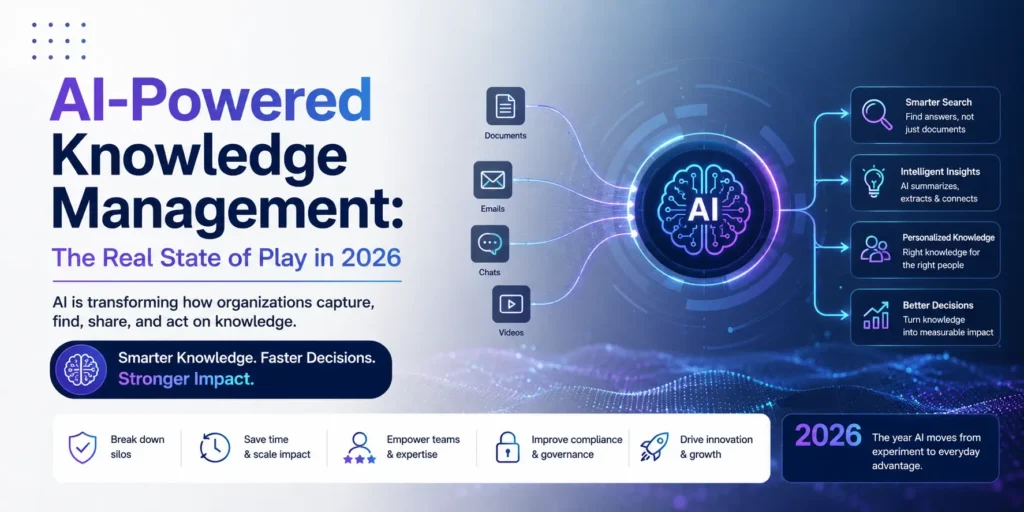
Table of Contents
What AI-Powered Knowledge Management Actually Means
The Working Definition
AI-powered knowledge management is the integration of artificial intelligence capabilities, including semantic search, natural language processing, generative AI, and machine learning, into the processes by which an organization captures, organizes, surfaces, and governs its knowledge. The goal is not to automate knowledge management. It is to remove friction from every stage of the knowledge lifecycle so that the right knowledge reaches the right people faster, and with higher relevance, than human-mediated systems can deliver alone.
The distinction between AI as automation and AI as friction reduction is not semantic. Organizations that approach AI as a replacement for KM processes typically find that they have automated the wrong things and preserved the bottlenecks that matter. Organizations that approach AI as an accelerant of well-designed KM processes typically find measurable improvements within the first year.
What Changed Between 2023 and 2026
Three years ago, AI-powered knowledge management was primarily a semantic search upgrade story. Better search, smarter recommendations, automated tagging. Genuinely useful, but incremental.
The period from 2024 through 2026 saw a qualitative shift driven by three developments. Large language models reached production-grade reliability for enterprise deployment. Retrieval-Augmented Generation (RAG) matured from an experimental architecture to the reference architecture for enterprise knowledge systems. And agentic AI moved from research papers to live deployments, with McKinsey’s 2025 survey confirming that agent use is most commonly reported in IT and knowledge management among all business functions.
The result is that AI-powered KM in 2026 is a fundamentally different discipline from what existed in 2023. The tools are more capable, the architectures are more mature, and the organizational demands on knowledge infrastructure are significantly more rigorous.
The Technology Layer: What Is Running in Production
Retrieval-Augmented Generation
RAG is now the default architecture for enterprise knowledge assistants, with deepened investments from mid-to-large organizations across every sector. To understand why it dominates, the problem it solves must be understood first.
Large language models are trained on static datasets with a defined cutoff. They cannot access current internal documents, updated regulatory guidance, or proprietary operational knowledge. When asked questions that require this knowledge, they hallucinate: generating fluent, confident responses that are factually wrong. In enterprise contexts, confidently wrong outputs are not a nuisance. They are a risk.
RAG addresses this by separating retrieval from generation. When a user submits a query, the system retrieves relevant content from a defined knowledge base, passes that content as context to the language model, and the model generates a response grounded in what was retrieved rather than what was in its training data. The outputs are anchored to the organization’s actual knowledge, and the sources can be cited.
The RAG market reflects how quickly this architecture has moved from experiment to infrastructure. The global RAG market reached approximately $1.94 billion in 2025 and is projected to expand to $9.86 billion by 2030, growing at a CAGR of 38.4%. Enterprise search represents the largest application segment, which is precisely the knowledge management use case.
What RAG requires of knowledge management teams is more demanding than most organizations anticipated when they began deployment: a well-organized, metadata-rich, governed knowledge base where content is current, clearly attributed, and structured for machine readability. The quality of the retrieval component determines the quality of the generation component. There is no workaround.
Knowledge Graphs and Semantic Search
Traditional keyword search returns documents that contain matching terms. Semantic search returns knowledge that is relevant to what the user is trying to accomplish, even when their query does not use the exact language the document uses. The architectural component that makes semantic search possible is the knowledge graph.
A knowledge graph is a structured representation of concepts, entities, and the relationships between them within a specific domain. When a practitioner searches for “how to handle a client escalation in the EMEA region,” a knowledge graph-enabled system understands that this query is related to escalation procedures, regional compliance requirements, client relationship protocols, and communication standards, even if those terms do not appear in the query. It surfaces relevant knowledge across those connected domains.
Gartner has placed knowledge graphs on the Slope of Enlightenment in its Hype Cycle for AI, indicating that more enterprises are recognizing their benefits and moving from pilot projects to production deployment. APQC data from 2025 confirms that 38% of KM teams are using AI to recommend content or knowledge assets, which in most cases is powered by semantic graph architectures.
GraphRAG, which incorporates knowledge graph relationships into the RAG retrieval process, represents the current leading edge. Research published in the proceedings of the 59th Hawaii International Conference on System Sciences in 2026 confirms that GraphRAG produces substantially more contextually accurate outputs than standard RAG for complex knowledge queries, particularly those that require connecting information across multiple domains.
Agentic AI in Knowledge Workflows
The shift from AI as a query-response tool to AI as a workflow operator is the most significant development in the current period. AI agents do not wait to be asked a question. They monitor workflows, identify knowledge needs, retrieve or generate relevant content, and act: updating documents, routing information to relevant practitioners, flagging outdated content for review, and escalating ambiguous cases to human experts.
Gartner’s maturity path for enterprise AI agents maps this evolution precisely: assistants handling conversational queries in 2025, task-specific agents operating within defined workflows in 2026, collaborative multi-agent systems in 2027, and cross-application ecosystems by 2028. By 2029, Gartner projects that half of knowledge workers will be building and managing agents as a core part of their role.
In knowledge management specifically, the highest-value early agentic deployments are in three areas. Post-interaction knowledge capture, where agents automatically extract and structure knowledge from customer support interactions, project post-mortems, and expert consultations. Knowledge quality monitoring, where agents continuously scan the knowledge base for content that has exceeded its review window, contradicts more recent content, or generates low-confidence AI responses. And proactive knowledge delivery, where agents surface relevant knowledge to practitioners before they have to search for it, based on what they are working on.
AI-Assisted Knowledge Capture Tools
The capture bottleneck, where knowledge is generated in conversations, meetings, and expert judgment but never documented, is the oldest unsolved problem in knowledge management. AI tools in 2026 have made substantial progress against it.
Meeting transcription and summarization tools now produce structured summaries with decision logs, action items, and identified knowledge items from recorded conversations. AI writing assistants reduce the friction of translating tacit expertise into documented form. Intelligent capture templates prompt practitioners at relevant moments with the specific questions most likely to surface transferable knowledge. One of the most significant developments, as noted in CoLab’s 2025 research on engineering knowledge management, is the automatic capture of expert feedback alongside the specific context it references, turning previously ephemeral expertise into structured, reusable knowledge.
The capture quality gap has not fully closed. AI capture tools are excellent at structuring what was said. They are less reliable at identifying what was important and contextualizing it for a practitioner who was not present. Human editorial judgment remains essential for transforming captured content into authoritative knowledge.
Five Genuine Improvements AI Brings to Knowledge Management
Semantic Search Replaces Keyword Matching
The productivity cost of inadequate search is substantial and well-documented. IDC research reports that employees spend an average of 2.5 hours per day searching for information. 69% of workers waste time duplicating work because existing knowledge is hard to find. Poor knowledge access costs large organizations between $2.5 million and $5 million annually in productivity losses.
Semantic search directly addresses this cost. By understanding intent rather than matching terms, semantic search surfaces relevant knowledge even when the user does not know the precise terminology the document uses. For organizations with large, mature knowledge bases, the shift from keyword to semantic search typically produces a 40 to 60% improvement in first-query success rates. Users find what they need, the first time, far more often.
The secondary effect is equally important: when search works, practitioners trust the knowledge base. Trust drives usage. Usage drives the contribution behavior that keeps the knowledge base growing and current. Semantic search is not merely a search improvement. It is a trust infrastructure investment.
Read: How to Improve Knowledge Discoverability Using AI and Semantic Structure
Automated Knowledge Capture at Scale
The average enterprise generates enormous volumes of knowledge-bearing content that is never captured: meeting recordings, client interaction transcripts, internal messaging threads, design review comments, support ticket resolutions. AI tools can process this content at scale, extract structured knowledge, and surface it for editorial review and publication.
This does not eliminate the need for human curation. It eliminates the bottleneck of human transcription and initial structuring, which has historically been the rate-limiting step in knowledge capture at scale. A knowledge team that previously could capture and publish 20 knowledge articles per week can now capture and curate 200, with AI handling the structuring work and humans handling the quality validation and contextual enrichment.
Synthesis Across Large Knowledge Corpora
One of the most practically valuable AI capabilities in knowledge management is synthesis: the ability to read across hundreds or thousands of documents and produce a coherent, attributed summary of what the organization knows about a specific topic. Previously, this synthesis happened when a subject matter expert had the time and inclination to produce a landscape review. With AI synthesis tools, it happens on demand.
For organizations with large project archives, the ability to synthesize lessons learned across years of projects before beginning a new one is transformative. For professional services firms, the ability to synthesize prior client work relevant to a new engagement changes the economics of proposal development. For legal teams, the ability to synthesize regulatory guidance across jurisdictions on demand changes how compliance work gets done.
The accuracy caveat: AI synthesis is only as reliable as the source knowledge. Synthesis across well-governed, current, authoritative content produces highly reliable outputs. Synthesis across ungoverned, fragmented content produces fluent fabrications.
Personalized Knowledge Delivery
Static knowledge bases deliver the same content to everyone who finds it. AI-powered systems deliver knowledge that is personalized to role, experience level, current task, geographic context, and behavioral history.
A new hire receives onboarding guidance calibrated to their role and location. A senior practitioner receives advanced references and peer network connections rather than foundational content they already know. A practitioner working on a specific type of client engagement receives proactive surfacing of relevant precedents and methodology references.
Personalization increases relevance, reduces search time, and significantly improves the probability that practitioners find and use knowledge rather than defaulting to asking a colleague or proceeding without it.
Proactive Knowledge Surfacing
The shift from reactive to proactive knowledge delivery is among the highest-value changes AI enables. Reactive knowledge management requires the practitioner to know they need knowledge and to search for it. Proactive knowledge management delivers relevant knowledge before the practitioner has to ask.
In practice, this means a project manager starting a new project receives an automatically compiled briefing on relevant past projects and lessons. A customer support agent handling a complex query receives the most relevant resolution guidance before they have typed their response. A compliance officer reviewing a new contract receives a summary of relevant regulatory considerations for that contract type and jurisdiction.
The behavioral implication of proactive surfacing is significant: it captures value from practitioners who would never voluntarily search the knowledge base, which in most organizations represents the majority of the workforce.
The Governance Problem AI Cannot Solve
The Quality Amplification Effect
The most important thing to understand about AI in knowledge management is that AI amplifies what exists in the knowledge base. High-quality, current, governed content produces high-quality AI outputs. Outdated, contradictory, ungoverned content produces confidently wrong AI outputs.
This is not a hypothetical risk. It is the primary operational problem that enterprises deploying AI on top of legacy knowledge bases are encountering in 2026. The pattern is consistent: AI deployment proceeds, early outputs impress, practitioners begin relying on AI responses for decisions, and then errors surface. The source of the errors is not the model. It is the knowledge base the model drew on.
62% of companies cite data governance as a top challenge when using AI in knowledge management. That figure understates the problem because it only reflects organizations that have recognized governance as a challenge. Many have not yet diagnosed why their AI outputs are unreliable.
What Ungoverned Knowledge Does to AI Performance
Three specific knowledge quality problems produce the most severe AI performance degradation.
Outdated content without clear dating or authority signals causes AI systems to present historical information as current. In regulated industries, this is a compliance risk. In operational contexts, it is a safety risk. In customer-facing applications, it is a trust risk.
Contradictory versions of the same knowledge cause AI systems to produce inconsistent outputs depending on which source document is retrieved. Practitioners who receive different answers to the same question from the same AI system rapidly lose trust in both the system and the knowledge base.
Unattributed content without clear ownership signals makes it impossible for AI systems to assess authority or for practitioners to evaluate source credibility. In domains where the source of knowledge matters as much as the knowledge itself (legal, medical, compliance), anonymous knowledge is functionally unusable.
What AI-Ready Knowledge Infrastructure Looks Like
Organizations that have successfully deployed AI-powered KM share a set of knowledge infrastructure characteristics that distinguishes them from those still struggling.
Content is current by design, with systematic review cycles and governance accountability. Metadata is rich and consistent: every knowledge item carries clear attribution, applicable context, creation and review dates, and domain classification. Taxonomy is structured for machine readability as well as human navigation. Contradictory or superseded content is actively managed and retired rather than left to accumulate. And the governance framework is treated as infrastructure investment, not administrative overhead.
Building this infrastructure after committing to an AI deployment timeline produces the worst possible outcome: pressure to surface AI capabilities before the knowledge quality can support them, resulting in outputs that damage practitioner trust before the system has demonstrated its value.
What AI Has Not Changed
Strategic Decisions Still Require Judgment
AI systems surface options, synthesize precedents, and model scenarios. They do not make strategic decisions. The judgment required to weigh incommensurable values, navigate organizational politics, assess trust in relationships, and take accountability for outcomes under uncertainty is not a capability that current AI systems possess. Knowledge management strategy, including decisions about which knowledge domains to prioritize, which governance standards to enforce, and which AI capabilities to deploy and how, requires human strategic judgment.
Culture Does Not Automate
The cultural conditions that enable knowledge sharing, psychological safety, reciprocity norms, visible leadership modeling, and time permission for contribution, are not affected by AI capability. An organization where employees do not contribute to knowledge systems for cultural reasons will not contribute more because the platform has an AI layer. The cultural work and the AI work must proceed in parallel, but neither substitutes for the other.
Governance Cannot Be Delegated to the Model
A common aspiration among AI-enthusiastic executives is that AI will maintain knowledge quality automatically: flagging outdated content, resolving contradictions, and ensuring accuracy without human oversight. In 2026, this is not the capability that exists. AI tools can identify content that may be outdated based on date signals, flag potential contradictions based on semantic similarity, and surface low-confidence responses that suggest knowledge gaps. They cannot make authoritative judgments about what is accurate in domain-specific contexts without human validation.
Governance accountability remains with humans. AI tools make governance more efficient. They do not replace its requirement.
The Human-in-the-Loop Requirement in 2026
Where Human Judgment Is Non-Negotiable
The organizations performing best with AI-powered KM are those that have been precise about which decisions require human judgment and designed their systems accordingly. The categories where human validation is non-negotiable in 2026 are:
Safety-critical and regulated knowledge: In healthcare, legal, financial services, and regulated manufacturing, knowledge errors have compliance and safety consequences. AI outputs in these domains require human validation before being presented as authoritative.
Novel situations: AI systems retrieve and synthesize precedent. In situations that have no close precedent, the retrieved context may be misleading. Human judgment about what is genuinely applicable to a novel situation is necessary.
High-stakes decisions: Where the cost of an error is significant, the investment in human validation is clearly justified. AI systems can structure the analysis. Humans should own the decision.
Ethical judgment: Questions involving competing values, fairness assessments, and decisions with differential impacts on stakeholders require human ethical judgment that AI systems cannot reliably replicate.
New Roles the AI Era Is Creating
APQC’s 2026 knowledge management predictions identify specific role evolution that the AI-KM intersection is driving. Knowledge Curators, who organize and maintain key knowledge assets with AI assistance, are becoming distinct from knowledge managers focused on strategy and governance. AI Knowledge Ethicists, who ensure responsible and ethical use of AI within KM systems, are emerging as a specialized role in regulated industries.
The knowledge manager of 2026 works differently than the knowledge manager of 2022. The volume of content they can manage has expanded dramatically because AI handles structuring and tagging. The work has shifted toward validation, contextual enrichment, governance oversight, and the strategic questions about what the AI system should and should not do. This is more skilled work, not less. It demands stronger domain expertise, sharper editorial judgment, and a working understanding of AI system behavior.
How Leading Organizations Are Actually Deploying AI in KM
Assessment Before Automation
The most consistent characteristic of successful AI-KM deployments is what happened before the technology was selected: a rigorous audit of knowledge infrastructure quality. Leading organizations assessed their content governance maturity, identified the domains where quality was sufficient to support AI deployment, and sequenced their rollout to begin with those domains.
This approach produces a counterintuitive result: the organizations that took longer to deploy AI-powered KM have, on average, better outcomes within 18 months than those that deployed faster on unaudited knowledge bases. The investment in pre-deployment governance work pays for itself in avoided remediation costs and, more importantly, in sustained practitioner trust that does not have to be rebuilt after early failures.
High-Value, High-Volume Use Cases First
Rather than attempting to AI-power the entire knowledge ecosystem simultaneously, leading organizations identify the two or three use cases where AI will produce the most visible value in the shortest time and concentrate initial deployment there.
The use cases that have delivered the highest early ROI in 2026 deployments: customer support knowledge delivery, where AI surfaces resolution guidance in real time and reduces average handling time; new employee onboarding, where AI provides personalized guidance that accelerates time to competency; and regulatory compliance support, where AI synthesizes applicable requirements for specific contexts and reduces the manual research burden on compliance teams.
These use cases share three characteristics: the volume of queries is high, the value of reducing response time is measurable, and the knowledge base for that domain was already in reasonable governance health before AI was deployed.
The Feedback Loop Architecture
The deployments that sustain performance over time are those that built feedback mechanisms into the system from the beginning. Practitioners can rate the relevance of AI-surfaced knowledge. The AI system tracks which responses led to knowledge base navigation and which did not. Low-confidence responses are automatically flagged for governance review. Search queries that return poor results are logged and reviewed weekly.
This feedback architecture closes the loop between AI performance and knowledge quality: poor AI outputs generate governance actions that improve knowledge quality, which improves AI outputs, which builds practitioner trust, which increases usage, which generates more feedback signal. Without this loop, AI performance degrades over time as the knowledge base ages and the system has no mechanism for identifying the gaps.
The Risks That Are Not Discussed Enough
AI Confidence Without Accuracy
Large language models generate responses with consistent fluency regardless of whether the underlying knowledge is reliable. The practitioner reading an AI-generated answer has no reliable signal from the response itself about whether the answer is trustworthy. This is qualitatively different from the risk profile of human-mediated knowledge systems, where uncertainty is typically visible in the response.
The governance implication: AI-powered KM systems require confidence indicators and source attribution to be surfaced alongside every response. Practitioners need to see where the knowledge came from and how recently it was validated. Systems that present AI responses as authoritative outputs without these signals are creating risk, not managing it.
Knowledge Monoculture Risk
As organizations consolidate around AI systems that surface the same high-confidence knowledge to everyone, there is a structural risk of knowledge convergence. When all practitioners in a domain receive the same AI-curated perspective on an issue, the organization’s capacity for genuinely diverse thinking about that issue may atrophy.
This is not a theoretical concern. It is a structural property of recommendation systems that optimize for high-confidence, high-engagement content. The organizations that will manage this risk best are those that explicitly design for knowledge diversity: maintaining communities of practice where dissenting and emerging perspectives are surfaced, ensuring that AI systems do not suppress minority views in expert consensus domains, and cultivating the human networks through which genuinely novel knowledge enters the organization.
Skill Atrophy in Knowledge Work
When AI systems routinely synthesize, summarize, and structure knowledge for practitioners, the question of what happens to the underlying cognitive skills involved in those activities is legitimate and underexamined. The practitioners who develop their analytical and synthesis capabilities by doing the hard work of reading across large bodies of knowledge and constructing coherent interpretations are building skills that make them better at everything downstream of that work.
Organizations that deploy AI synthesis tools without thinking about what happens to practitioners’ own capabilities over time may find, five to ten years hence, that they have created a workforce that is efficient at consuming AI outputs and less capable of challenging them. This is not an argument against AI synthesis tools. It is an argument for intentional design of how they are used and what human cognitive investment is maintained alongside them.
What Separates AI High Performers in KM from Everyone Else
McKinsey’s 2025 AI research consistently identifies a small group of organizations producing real business value from AI while the majority are not. In knowledge management specifically, the behaviors that separate AI high performers from everyone else are observable and replicable.
High performers treated knowledge governance as AI infrastructure investment, not administrative overhead. They began governing their knowledge base before selecting AI tools, not after experiencing AI failures.
High performers measured AI-KM outcomes in business terms from the beginning. Not AI adoption rates or platform usage metrics. Time to competency for new roles. Error rate reduction on knowledge-dependent processes. Customer resolution time in AI-assisted support. Decision cycle time for knowledge-intensive decisions. They built measurement infrastructure before deployment so they had baseline data to compare against.
High performers maintained human expertise investment alongside AI deployment. They did not reduce their KM team budgets when AI was deployed. They redirected those teams from lower-value structuring and tagging work toward higher-value validation, governance, and strategic curation work.
High performers established clear accountability for AI output quality. A named individual or team is responsible for the performance of the AI-KM system, owns the governance processes that sustain it, and is evaluated on business outcome metrics. Where accountability is diffuse, performance degrades without anyone responsible for addressing it.
Frequently Asked Questions
What is AI-powered knowledge management?
AI-powered knowledge management is the integration of artificial intelligence capabilities into the processes by which an organization captures, organizes, surfaces, and governs its knowledge. It includes semantic search, automated capture and structuring of knowledge, AI-assisted synthesis, personalized knowledge delivery, and proactive surfacing of relevant knowledge based on user context. The goal is to reduce friction in every stage of the knowledge lifecycle and improve the speed, relevance, and reliability with which practitioners can access the knowledge they need.
What is RAG and why does it matter for knowledge management?
Retrieval-Augmented Generation (RAG) is the architecture that combines a retrieval system with a generative AI model. When a user submits a query, the system retrieves relevant content from a defined knowledge base and passes that content to the language model as context. The model generates a response grounded in what was retrieved. This prevents the hallucinations that occur when language models are asked to answer questions they were not trained on. For knowledge management, RAG is significant because it connects the organization’s actual knowledge base to AI outputs, making those outputs trustworthy and attributable. The RAG market is projected to grow from $1.94 billion in 2025 to $9.86 billion by 2030.
Does AI replace knowledge managers?
No. AI changes what knowledge managers spend their time on, not whether they are needed. AI handles high-volume structuring, tagging, summarization, and retrieval work that previously consumed most of a knowledge team’s capacity. This frees knowledge professionals for the higher-value work that AI cannot do: validating content accuracy in complex domains, making governance decisions, managing stakeholder relationships, designing knowledge architecture, and providing the editorial judgment that determines whether AI outputs are safe to present as authoritative. In 2026, the organizations reducing their KM teams because of AI deployment are creating the governance gaps that will damage their AI performance within 18 to 24 months.
Why do most AI knowledge management deployments underperform?
The root cause is almost always knowledge infrastructure quality. AI systems amplify what is in the knowledge base. Deploying AI on top of outdated, ungoverned, fragmented content produces confidently wrong outputs that damage practitioner trust. Organizations that fail to audit and remediate their knowledge quality before deploying AI face this outcome regardless of which AI platform they chose. McKinsey’s data showing that only 5.5% of organizations are realizing real ROI from AI reflects, in large part, the proportion of organizations that invested in knowledge infrastructure before AI deployment.
What is the most important investment an organization can make before deploying AI in knowledge management?
Knowledge governance. Before selecting an AI platform, defining which knowledge domains are priority, auditing the current quality of knowledge in those domains, establishing content ownership and review processes, and building the metadata architecture that enables reliable retrieval. Organizations that complete this work before AI deployment typically see positive ROI within the first year. Those that deploy AI first and attempt to fix governance problems afterward typically spend their first two years remediating quality problems rather than generating value.
What does AI-powered KM look like in five years?
Gartner’s maturity path suggests a progression from task-specific agents in 2026 to collaborative multi-agent systems in 2027 and cross-application knowledge ecosystems by 2028. By 2029, Gartner projects that half of knowledge workers will be building and managing AI agents as part of their role. The convergence of agentic AI, knowledge graphs, and improved multimodal capture tools, including video and voice, will make the current version of AI-powered KM look primitive. The organizations best positioned to benefit from that evolution are those building the knowledge governance foundations now that will enable more sophisticated AI to function reliably when it arrives.
The Productive Frame for 2026
The organizations treating AI as a technology project to be implemented are producing technology implementations that do not generate value. The organizations treating AI as an accelerant of disciplined knowledge management are producing compounding competitive advantage.
The distinction is this: AI requires knowledge infrastructure to be trustworthy. Knowledge infrastructure requires governance to remain high-quality over time. Governance requires organizational accountability and sustained investment to function. None of this is automated. All of it is prerequisite.
The market pressure to deploy AI is intense, and 2026 is not the year to be a visible laggard. But deploying AI without the knowledge infrastructure to support it is not faster. It is more expensive, because the remediation required after a failed or trust-damaging deployment costs more than building correctly from the beginning.
The real state of play in 2026 is that AI-powered knowledge management is both more capable and more demanding than most organizations were prepared for. The capability is genuine. The demands are non-negotiable.