
Knowledge discoverability has become one of the most critical yet overlooked challenges in modern organizations. Despite the explosion of content, systems, and collaboration tools, employees still struggle to find relevant knowledge when it matters most. The issue is not scarcity. It is fragmentation and lack of meaning. Information exists in abundance, but without structure and intelligence, it remains inaccessible in practice.
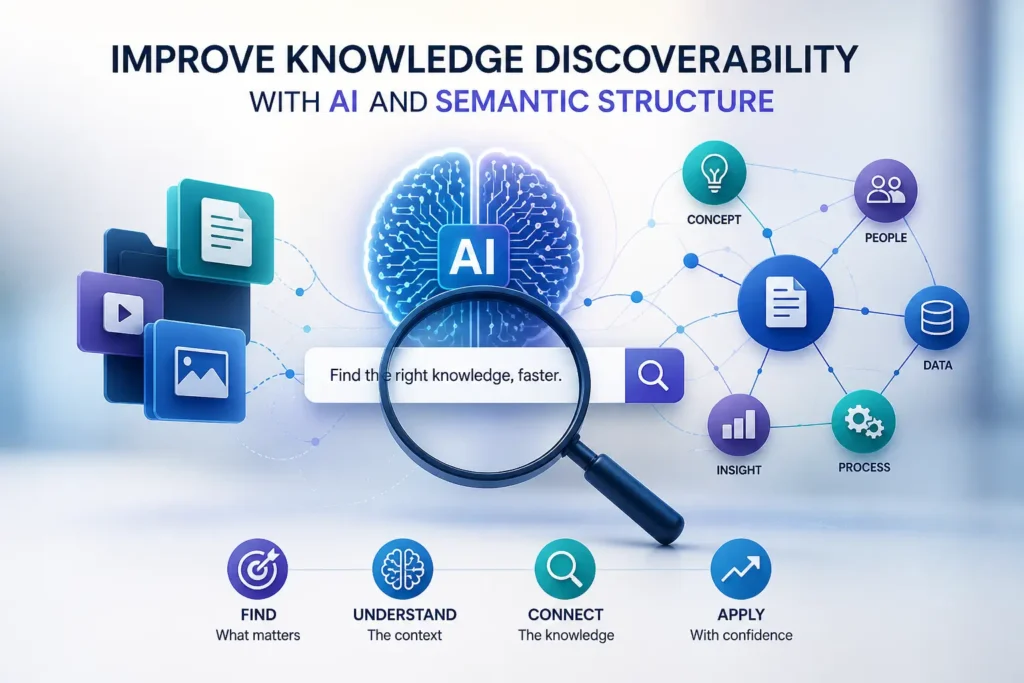
This is where the combination of AI and semantic structures fundamentally reshapes how organizations approach knowledge. Discoverability is no longer about indexing documents or improving keyword search. It is about enabling systems to understand intent, context, and relationships so that knowledge can be surfaced precisely when it is needed.
The shift is subtle but powerful. Organizations are moving from storing knowledge to making knowledge intelligently discoverable.
The Real Problem Behind Poor Knowledge Discoverability
Most organizations assume that discoverability problems can be solved by improving search. This assumption leads to investments in better interfaces or faster indexing, yet the underlying issue persists. The limitation is not in search technology alone, but in how knowledge itself is structured and understood.
In many environments, knowledge is created for immediate use rather than long-term reuse. Documents are written to solve a specific problem, stored in isolated systems, and rarely revisited. Over time, this creates a landscape where knowledge is technically available but practically invisible.
Another challenge is inconsistency. Different teams use different terminology, formats, and classification methods. What one team calls a “solution,” another may label as a “case” or “process.” Traditional systems cannot reconcile these variations effectively. As a result, even well-documented knowledge remains difficult to locate.
There is also a deeper issue related to context. Knowledge without context is rarely actionable. A document may describe a solution, but without understanding when and why it should be used, its value is limited. Discoverability is not just about finding content. It is about finding content that is relevant and usable in a specific situation.
These challenges collectively create an environment where employees rely more on personal networks than formal systems. While this may work in smaller teams, it does not scale. As organizations grow, the absence of effective knowledge discoverability becomes a structural limitation.
Rethinking Knowledge Discoverability as a System Capability
To improve knowledge discoverability, organizations need to move beyond treating search as a standalone function. Discoverability must be approached as a system-level capability that connects how knowledge is created, structured, and delivered.
Three factors define whether knowledge is truly discoverable. Knowledge must be structured around meaning rather than isolated content. Systems need to interpret user intent instead of relying on exact keyword matches. Knowledge must also be delivered within the flow of work, rather than requiring users to search for it separately.
This shift moves organizations away from static repositories toward dynamic knowledge environments. In these environments, knowledge is continuously connected, interpreted, and surfaced based on real needs. AI and semantic structures play a central role in enabling this transformation.
How AI Transforms Knowledge Discoverability
Artificial intelligence changes the nature of discoverability by introducing the ability to interpret meaning. Traditional systems operate on surface-level matching. AI operates on contextual understanding.
When a user searches for information, AI does not simply match keywords. It analyzes the intent behind the query, the user’s role, and the context in which the query is made. This allows it to surface knowledge that may not contain the exact search terms but is highly relevant to the underlying need.
This shift is particularly important in complex environments where knowledge is distributed across multiple domains. For example, a query related to customer issues may require insights from support, product development, and operations. AI can connect these domains and present a cohesive set of knowledge, reducing the need for manual exploration.
Another significant contribution of AI is its ability to anticipate needs. Instead of waiting for users to search, AI systems can proactively recommend knowledge based on ongoing activities. This transforms discoverability from a reactive process into a proactive one.
The impact extends beyond search. AI enables knowledge to be summarized, contextualized, and presented in formats that are easier to consume. This reduces the cognitive effort required to interpret information and increases the likelihood that knowledge will be applied effectively.
However, AI does not operate in isolation. Its effectiveness depends heavily on the quality and structure of the underlying knowledge. This is where semantic structures become essential.
The Role of Semantic Structures in Making Knowledge Understandable
Semantic structures provide the foundation that allows systems to understand knowledge at a deeper level. Instead of treating content as isolated pieces of information, semantic structures organize knowledge based on meaning and relationships.
This involves identifying key entities such as concepts, processes, and roles, and defining how they are connected. For example, a customer issue can be linked to specific products, known solutions, and related cases. These connections create a network of knowledge that reflects how information is used in real-world contexts.
One of the most effective implementations of semantic structure is the knowledge graph. A knowledge graph represents information as a network of interconnected nodes, where each node represents an entity and each connection represents a relationship. This allows systems to navigate knowledge in a way that mirrors human understanding.
Organizations such as Google have demonstrated the power of this approach in search systems, where results are enriched by contextual understanding rather than simple keyword matching.
In enterprise environments, semantic structures enable knowledge to be discovered through relationships rather than just direct queries. This significantly enhances discoverability, especially in complex and dynamic domains.
Another critical component of semantic structure is the use of taxonomy and ontology. Taxonomy provides a hierarchical classification of knowledge, while ontology defines the relationships between different categories. Together, they create a consistent framework that supports both human navigation and machine interpretation.
Without semantic structures, knowledge remains fragmented and difficult to interpret. With them, knowledge becomes connected, contextual, and accessible.
Integrating AI and Semantic Structures for Maximum Impact
The real value emerges when AI and semantic structures are combined into a unified system. Semantic structures organize knowledge in a meaningful way, and AI leverages that structure to deliver intelligent discovery.
This integration enables systems to move beyond simple retrieval and toward knowledge reasoning. Instead of returning a list of documents, systems can provide insights, recommendations, and contextual guidance.
For example, when addressing a complex problem, an employee may receive not only relevant documents but also related cases, expert contacts, and suggested actions. This reduces the time required to understand and resolve issues, while also improving the quality of outcomes.
Organizations like Microsoft are increasingly embedding these capabilities into their platforms, ensuring that knowledge is not only stored but actively used within workflows.
This integration also supports continuous improvement. As knowledge is used, systems can learn from interactions, refine relationships, and improve recommendations. Discoverability becomes a dynamic capability that evolves over time.
Designing for Discoverability in Real Organizational Environments
Improving knowledge discoverability requires deliberate design choices. It begins with how knowledge is created. Content must be written with reuse in mind, including clear context, purpose, and applicability. This ensures that knowledge can be understood beyond its original use case.
Structure is equally important. Organizations must establish consistent frameworks for categorizing and connecting knowledge. This includes defining taxonomies, applying metadata, and building semantic relationships. Without this foundation, even advanced AI systems struggle to deliver accurate results.
Integration plays a critical role. Knowledge must be accessible within the systems employees use daily. When knowledge is embedded into workflows, it becomes part of execution rather than an additional task.
Continuous refinement is also essential. Discoverability improves when systems learn from usage patterns, identify gaps, and adapt accordingly. This requires mechanisms for feedback and analytics that inform ongoing improvements.
Avoiding Common Pitfalls
Many organizations attempt to improve discoverability by focusing solely on technology. While AI tools are powerful, they cannot compensate for poorly structured knowledge. Without semantic clarity, AI outputs become inconsistent and unreliable.
Another common mistake is overcomplicating structure. While semantic systems require organization, excessive complexity can reduce usability. The goal is to create structures that are both meaningful and practical.
There is also a tendency to treat discoverability as a one-time initiative. In reality, it is an ongoing capability that must evolve with the organization. Knowledge changes, and systems must adapt to reflect those changes.
The Strategic Impact of Improved Discoverability
When knowledge discoverability is designed effectively, the impact extends across the organization. Employees spend less time searching and more time executing. Decisions are made with better context and greater confidence. Knowledge is reused consistently, reducing duplication and improving efficiency.
More importantly, discoverability enables organizations to scale expertise. Knowledge is no longer limited to individuals or teams. It becomes a shared asset that supports collective performance.
This has a direct effect on innovation. When knowledge is easily accessible, employees can build on existing insights rather than starting from scratch. This accelerates problem-solving and opens new possibilities.
Final Perspective
Improving knowledge discoverability is not about adding more content or deploying new tools in isolation. It is about transforming how knowledge is understood, connected, and delivered.
AI provides the intelligence to interpret and recommend. Semantic structures provide the foundation that makes this possible. Together, they create systems where knowledge is not just available, but truly discoverable.
Organizations that invest in this combination move beyond managing information. They build environments
Stay informed on upcoming Smritex Knowledge Management sessions and workshops. Subscribe for updates.