
Introduction
A personal knowledge management system has quietly become one of the most critical capabilities for modern professionals. The challenge is no longer access to information. It is the ability to process, structure, and reuse that information effectively. Most professionals consume far more than they can retain, and without a system, valuable insights dissolve into fragmented notes, forgotten documents, and disconnected ideas.
The real problem is not overload. It is the absence of a structured approach to thinking. A personal knowledge management system addresses this gap by turning raw inputs into organized, connected, and usable knowledge. When designed correctly, it becomes a cognitive infrastructure that supports clarity, improves decision-making, and increases productivity in a measurable way.
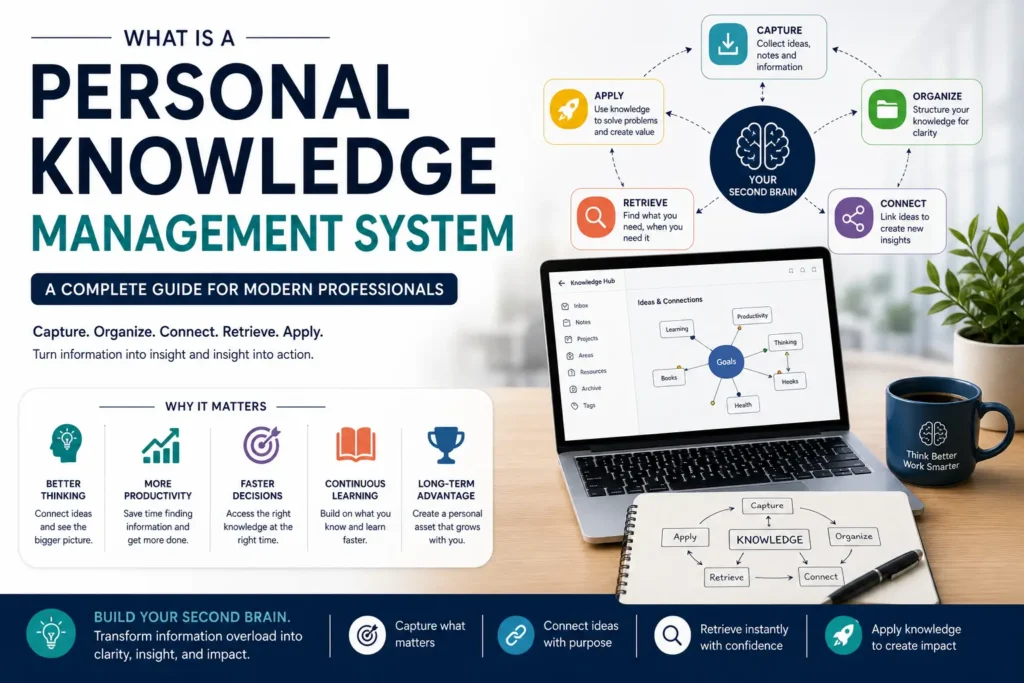
What Is a Personal Knowledge Management System
A personal knowledge management system is a structured method for capturing, organizing, connecting, and applying knowledge to improve thinking, learning, and productivity.
At a deeper level, it functions as a personal knowledge architecture. It is not just a collection of notes or tools. It is a system that transforms scattered information into a coherent network of ideas that can be retrieved and reused when needed. The emphasis is not on storage, but on usability.
Most people already engage in informal knowledge management through note-taking, bookmarking, or saving documents. However, without structure, these activities produce accumulation without insight. A personal knowledge management system introduces intentional design into this process.
Read: How to Design a Personal Knowledge Management System (PKM) for Better Thinking and Productivity
The Shift from Information Storage to Knowledge Systems
Traditional approaches to managing information focused on storage. Documents were saved in folders, emails were archived, and notes were written in isolation. This approach assumes that information will be useful simply because it exists.
In practice, stored information is rarely reused unless it is easy to find and contextually relevant. Modern knowledge work requires more than storage. It requires connection, interpretation, and application.
A personal knowledge management system reflects this shift. It prioritizes:
- Structuring knowledge for retrieval
- Linking ideas across contexts
- Preserving insights rather than raw information
- Supporting ongoing thinking processes
This shift aligns closely with how the human brain operates. Knowledge is not stored in rigid categories. It is formed through associations. A well-designed system mirrors this behavior.
Core Components of a Personal Knowledge Management System
A high-functioning personal knowledge management system operates through a set of interconnected components that reflect the knowledge lifecycle. These components are not linear steps. They reinforce each other continuously.
Knowledge Capture
Capture is the entry point. It determines the quality of everything that follows. Effective capture is selective. It focuses on insights, patterns, and ideas that carry long-term value.
Capturing entire articles or documents without processing them leads to noise. The goal is to extract meaning. This includes summarizing key ideas, noting personal interpretations, and recording context. Capture should be frictionless, but not mindless.
Knowledge Organization
Once captured, knowledge must be structured in a way that supports retrieval. Traditional folder-based systems often fail because they impose rigid hierarchies on dynamic information.
Modern personal knowledge management systems rely on more flexible structures. These include tags, linked notes, and thematic groupings. The objective is not perfect categorization. It is accessibility.
A single idea should be reachable through multiple pathways. This improves discoverability and reduces dependency on memory.
Knowledge Connection
Connection is where knowledge becomes valuable. Isolated notes have limited utility. When ideas are linked, patterns emerge, and understanding deepens.
Connecting knowledge involves identifying relationships between concepts, linking related notes, and building thematic clusters. Over time, this creates a network of insights that reflects how knowledge evolves.
This stage is closely tied to the development of tacit knowledge. By repeatedly engaging with connections, individuals internalize patterns and improve their ability to think critically.
Knowledge Retrieval
A system that cannot retrieve knowledge efficiently is fundamentally broken. Retrieval depends on structure, naming clarity, and the quality of connections within the system.
Effective retrieval allows professionals to access relevant knowledge at the right moment. This is particularly important in decision-making scenarios, where speed and accuracy matter.
Searchability is not only technical. It is also conceptual. The way knowledge is labeled and connected determines how easily it can be found.
Knowledge Application
Application is where knowledge translates into outcomes. Many systems fail because they stop at organization. True value is realized when knowledge is used to inform decisions, create content, solve problems, and guide actions.
Application also reinforces learning. When knowledge is used, it becomes more deeply embedded and easier to recall in the future.
Personal Knowledge Management vs Organizational Knowledge Management
A personal knowledge management system operates at the individual level, while knowledge management systems operate at the organizational level. The two are distinct but interconnected.
Personal systems focus on:
- Individual thinking
- Personal productivity
- Learning and insight development
Organizational systems focus on:
- Knowledge sharing
- Standardization
- Institutional memory
- Cross-team collaboration
The relationship between the two is critical. Organizations are ultimately composed of individuals. When individuals manage knowledge effectively, the quality of organizational knowledge improves.
This connection is often overlooked. Many organizations invest heavily in enterprise systems but neglect individual knowledge practices. As a result, valuable knowledge remains trapped at the personal level.
Why Personal Knowledge Management Matters for Modern Professionals
The importance of a personal knowledge management system has increased significantly with the rise of digital work environments. Professionals are expected to process large volumes of information, adapt quickly, and make informed decisions under pressure.
Without a system, this leads to cognitive overload. With a system, it leads to enhanced performance.
A well-designed personal knowledge management system improves thinking by externalizing information. This reduces the burden on memory and allows individuals to focus on analysis and synthesis.
It also improves productivity by reducing the time spent searching for information or recreating knowledge. Instead of starting from scratch, professionals can build on existing insights.
Learning becomes cumulative. Each new piece of knowledge connects to what already exists, creating a compounding effect over time.
Common Mistakes in Personal Knowledge Management
Many professionals attempt to build a personal knowledge management system but fail to achieve meaningful results. The reasons are consistent.
One of the most common mistakes is over-collection. Saving large amounts of information without processing it creates clutter. The system becomes overwhelming and difficult to navigate.
Another issue is over-structuring. Attempting to create a perfect taxonomy often leads to rigidity. Knowledge is dynamic, and systems must accommodate change.
Tool dependency is also a frequent problem. Many users focus on selecting the right application instead of designing the right system. Tools enable systems, but they do not define them.
Lack of connection between ideas is another limitation. Without linking knowledge, the system remains a storage repository rather than a thinking tool.
Finally, inconsistency undermines effectiveness. A personal knowledge management system requires regular interaction. Sporadic use breaks continuity and reduces value.
How a Personal Knowledge Management System Improves Thinking and Productivity
The primary benefit of a personal knowledge management system lies in its ability to enhance cognitive processes. By externalizing knowledge, individuals create a reliable reference point for thinking.
This enables more structured reasoning. Instead of relying on fragmented memory, professionals can analyze interconnected ideas. This improves the quality of decisions and reduces cognitive bias.
Productivity improves as well. Access to organized knowledge reduces time spent searching for information. It also accelerates content creation, problem-solving, and planning.
The system acts as a multiplier. Each piece of knowledge increases the value of existing knowledge. Over time, this leads to exponential growth in intellectual capability.
The Role of Tools in Personal Knowledge Management
Tools play an important role, but they are often misunderstood. The effectiveness of a personal knowledge management system is determined by its design, not the tool used to implement it.
Modern tools support features such as:
- Note linking
- Tagging and metadata
- Search functionality
- Knowledge graph visualization
However, these features are only useful when aligned with a clear system.
Professionals should select tools that support flexibility, scalability, and ease of use. The goal is to reduce friction and enable consistent engagement.
How Personal Knowledge Management Connects to Organizational Value
Personal knowledge management is not isolated from organizational outcomes. It directly influences how knowledge flows within teams and across the enterprise.
When individuals maintain structured knowledge systems, they contribute higher-quality inputs to organizational knowledge bases. Insights are clearer, better documented, and easier to share.
This improves knowledge reuse, reduces duplication of effort, and strengthens institutional memory.
In high-performing organizations, there is alignment between personal and organizational knowledge practices. Individuals capture and refine knowledge, and organizations provide platforms for scaling it.
Future Outlook for Personal Knowledge Management Systems
The future of personal knowledge management systems will be shaped by advances in artificial intelligence and semantic technologies.
AI will increasingly assist with:
- Summarizing information
- Suggesting connections between ideas
- Enhancing search capabilities
- Automating knowledge organization
Semantic search will improve retrieval by understanding context and meaning rather than relying solely on keywords.
Knowledge graphs will become more accessible, allowing individuals to visualize relationships between ideas in more sophisticated ways.
These developments will further strengthen the role of personal knowledge management systems as cognitive tools.
Conclusion
A personal knowledge management system is not just a productivity technique. It is a strategic capability that defines how effectively a professional can think, learn, and perform in a knowledge-driven environment.
The value of such a system lies in its ability to transform information into insight, and insight into action. It creates a structured foundation for continuous learning, better decision-making, and sustained productivity.
Professionals who invest in designing a personal knowledge management system are not simply organizing their notes. They are building a long-term intellectual advantage.
Call to Action
If your current approach to managing information feels fragmented or inefficient, the next step is not to adopt a new tool. It is to design a personal knowledge management system that aligns with how you think, work, and make decisions. The impact of this shift compounds over time and directly influences your professional effectiveness.
FAQ Section
What is a personal knowledge management system
A personal knowledge management system is a structured approach to capturing, organizing, and using knowledge to improve thinking, learning, and productivity.
Why is a personal knowledge management system important
It helps manage information overload, improves decision-making, and enables faster retrieval and reuse of knowledge.
How does a personal knowledge management system work
It works by capturing meaningful information, organizing it for easy access, connecting related ideas, and applying knowledge in real-world tasks.
What tools are used for personal knowledge management
Tools include note-taking applications, knowledge graph platforms, and digital knowledge systems that support tagging, linking, and search.
What is the difference between PKM and knowledge management
PKM focuses on individual knowledge practices, while knowledge management focuses on organizational knowledge sharing and governance.
Stay informed on upcoming Smritex Knowledge Management sessions and workshops. Subscribe for updates.