
Introduction
A well-designed personal knowledge management system (PKM) is no longer optional for professionals dealing with constant information overload. The volume of content consumed daily, from meetings to research to digital communication, exceeds what the human brain can reliably retain or structure on its own. Without a deliberate system, knowledge fragments remain disconnected, decisions become reactive, and productivity suffers.
Designing a personal knowledge management system is not about collecting more information. It is about transforming scattered inputs into structured, retrievable, and reusable knowledge that enhances thinking quality. When implemented correctly, such a system becomes an extension of cognition, supporting clarity, creativity, and faster decision-making.
This article breaks down how to design a personal knowledge management system that works in real-world conditions, not theoretical models. It focuses on structure, usability, and long-term sustainability.
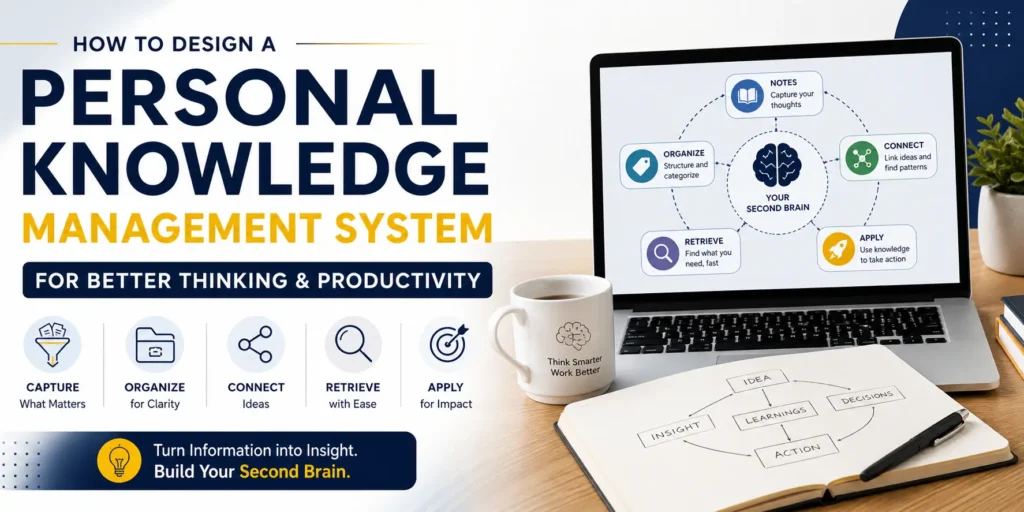
Table of Contents
Foundational Definition
A personal knowledge management system is a structured approach to capturing, organizing, connecting, and applying knowledge to improve thinking, learning, and productivity.
In simple terms, it is how an individual builds and maintains a reliable “second brain” that supports work and decision-making.
The Evolution of Personal Knowledge Management
Personal knowledge management has evolved alongside the tools and environments people work in. Early forms were manual, notebooks, journals, and physical filing systems. These methods relied heavily on discipline and memory.
With the rise of digital tools, information storage became easier, but structure did not improve automatically. Many professionals now suffer from “digital clutter,” where notes exist but are not usable.
The shift today is toward connected knowledge systems, influenced by disciplines such as cognitive science, information architecture, and knowledge management. Modern approaches emphasize:
- Linking ideas rather than storing documents
- Capturing insights, not just information
- Designing for retrieval, not accumulation
- Supporting thinking, not just archiving
The result is a more intelligent, adaptive personal knowledge management system.
Core Framework for Designing a Personal Knowledge Management System
A high-functioning personal knowledge management system is built on a set of integrated components rather than isolated practices. Each component addresses a critical stage in the knowledge lifecycle.
1. Knowledge Capture: Moving Beyond Passive Collection
Most systems fail at the capture stage because they focus on volume instead of relevance. Effective capture is selective and intentional.
Capture should focus on:
- Insights from reading or conversations
- Ideas worth revisiting
- Patterns or recurring themes
- Decisions and their context
Avoid saving entire documents without processing them. Raw information has low long-term value unless it is distilled.
A strong capture approach ensures that only meaningful knowledge enters the system.
2. Knowledge Structuring: Building a Usable Architecture
Once captured, knowledge must be structured in a way that supports retrieval and reuse. This is where concepts like taxonomy and metadata become important.
Instead of rigid folders, modern personal knowledge management systems rely on flexible structures such as:
- Tags or labels
- Linked notes
- Topic clusters
- Concept maps
The goal is not to categorize everything perfectly, but to create multiple access points. A single piece of knowledge should be discoverable through different contexts.
This improves searchability and supports associative thinking.
3. Knowledge Connection: Turning Information into Insight
The real value of a personal knowledge management system emerges when connections are made between ideas.
Connecting knowledge involves:
- Linking related notes
- Identifying cause-and-effect relationships
- Grouping ideas into themes
- Building conceptual frameworks
This is where tacit knowledge begins to form. By connecting explicit knowledge elements, the system enables deeper understanding.
Over time, this creates a network of insights rather than isolated notes.
4. Knowledge Retrieval: Designing for Discoverability
A system is only as useful as its ability to surface relevant knowledge when needed.
Effective retrieval depends on:
- Clear naming conventions
- Consistent tagging
- Strong search capabilities
- Contextual linking
When a personal knowledge management system is designed well, retrieval becomes intuitive. The system “suggests” relevant knowledge through connections and structure.
This directly impacts productivity by reducing time spent searching.
5. Knowledge Application: Closing the Loop
Many systems fail because they stop at organization. The final step is applying knowledge to real work.
Application includes:
- Using stored insights in decision-making
- Referencing notes during writing or planning
- Revisiting past learnings to solve new problems
- Converting knowledge into outputs
This is where knowledge becomes a performance asset rather than a storage activity.
6. Continuous Refinement: Keeping the System Alive
A personal knowledge management system is not static. It evolves with changing goals, roles, and contexts.
Regular refinement includes:
- Updating outdated knowledge
- Merging duplicate ideas
- Reorganizing structures
- Improving clarity of notes
This ensures the system remains relevant and efficient over time.
Strategic Benefits of a Personal Knowledge Management System
When designed effectively, a personal knowledge management system delivers measurable advantages.
Improved Thinking Quality
Structured knowledge allows for clearer reasoning. Instead of relying on memory, individuals can analyze interconnected ideas, leading to better decisions.
Faster Decision-Making
Access to past insights reduces the need to start from scratch. Decisions are informed by accumulated experience.
Enhanced Learning Retention
Capturing and connecting knowledge reinforces understanding. Learning becomes cumulative rather than fragmented.
Increased Productivity
Less time is spent searching for information or recreating work. Knowledge reuse accelerates output.
Stronger Creativity
Connections between ideas often lead to new perspectives. Creativity improves when knowledge is networked.
Common Mistakes That Break Personal Knowledge Management Systems
Despite good intentions, many systems fail due to predictable issues.
Over-Collection of Information
Saving everything leads to noise. Without filtering, the system becomes overwhelming.
Lack of Structure
Unorganized notes reduce usability. Information exists but cannot be effectively retrieved.
Tool Dependency Instead of System Thinking
Many users focus on tools rather than design. Tools support systems, but they do not replace them.
No Connection Between Ideas
Disconnected notes limit insight generation. Knowledge remains static.
Inconsistent Usage
Irregular use breaks continuity. A personal knowledge management system requires habitual engagement.
Modern Trends Shaping Personal Knowledge Management
The design of personal knowledge management systems is increasingly influenced by emerging technologies and practices.
AI-Assisted Knowledge Capture
AI tools can summarize content, extract key insights, and suggest connections. This reduces manual effort while improving quality.
Semantic Search
Modern systems leverage semantic understanding to retrieve knowledge based on meaning, not just keywords. This aligns closely with how humans think.
Knowledge Graphs
Personal knowledge graphs represent relationships between ideas. They enable advanced navigation and discovery.
Integration with Digital Workflows
Knowledge systems are being embedded into daily workflows such as project management and communication tools.
Focus on Cognitive Augmentation
The goal is shifting from storage to enhancing thinking capabilities. Systems are designed to complement human cognition.
Real-World Scenario
Consider a product manager working across multiple projects. Without a personal knowledge management system, insights from past projects are often lost or underutilized.
With a structured system:
- Meeting notes are captured and linked to project themes
- Customer feedback is categorized and connected to product decisions
- Lessons learned are stored and revisited during planning
When a new project begins, the manager can quickly access relevant knowledge, reducing onboarding time and improving outcomes.
This demonstrates how a personal knowledge management system directly impacts performance.
Future Outlook for Personal Knowledge Management Systems
Over the next three to five years, personal knowledge management systems will become more intelligent and integrated.
Key developments include:
- AI-driven knowledge organization
- Real-time contextual recommendations
- Deeper integration with enterprise systems
- Advanced personalization based on user behavior
- Increased focus on decision intelligence
The boundary between personal and organizational knowledge systems will continue to blur.
Conclusion
Designing a personal knowledge management system requires more than choosing the right tool. It involves building a structured, connected, and evolving system that supports how you think and work.
The most effective systems are not complex. They are intentional. They focus on capturing meaningful insights, organizing them for discoverability, connecting ideas for deeper understanding, and applying knowledge in real-world contexts.
When done correctly, a personal knowledge management system becomes a strategic asset. It enhances thinking, accelerates productivity, and enables continuous learning in a way that scales with your professional growth.
Read: Knowledge Management: The Complete Guide for Modern Organizations
FAQ Section
What is a personal knowledge management system?
A personal knowledge management system is a structured method for capturing, organizing, and using knowledge to improve thinking and productivity.
Why is a personal knowledge management system important?
It helps manage information overload, improves decision-making, and enhances learning retention.
How do you start building a personal knowledge management system?
Start by capturing meaningful insights, organizing them with simple structures, and gradually connecting related ideas.
What tools are used for personal knowledge management systems?
Common tools include note-taking apps, knowledge graph platforms, and digital notebooks, though the system design matters more than the tool.
How does a personal knowledge management system improve productivity?
It reduces time spent searching for information and enables faster reuse of existing knowledge.
What is the difference between information and knowledge in PKM?
Information is raw data, while knowledge is processed, contextualized, and usable for decision-making.
Stay informed on upcoming Smritex Knowledge Management sessions and workshops. Subscribe for updates.