
Knowledge management has moved from being a support function to a defining capability in how modern organizations operate. At its core, knowledge management determines how effectively an organization captures what it knows, shares that knowledge across teams, and applies it to drive decisions, execution, and innovation. In environments where speed and accuracy matter, the ability to manage knowledge is no longer optional. It directly influences performance.
Most organizations are not lacking information. They are overwhelmed by it. Data exists across systems, documents accumulate in repositories, and expertise sits with individuals who may or may not be accessible when needed. Without structured knowledge management, this abundance creates friction. Teams spend time searching instead of acting. Work gets duplicated. Critical insights are lost when employees move on.
This is where knowledge management becomes essential. It brings structure to how knowledge is created, organized, and used. More importantly, it ensures that knowledge flows to the right people at the right time, in a form they can apply immediately. High-performing organizations treat knowledge management as an operational system, not a documentation exercise.
The urgency has increased with the rise of distributed work and digital transformation. Teams operate across locations, functions, and time zones. Decisions must be made quickly, often with incomplete information. In this context, knowledge management acts as the connective layer that aligns people, processes, and systems. It reduces dependency on individual expertise and builds a more resilient organization.
There is also a growing link between knowledge management and artificial intelligence. AI systems rely on structured, high-quality knowledge to deliver accurate outputs. Organizations that invest in strong knowledge management are better positioned to adopt AI effectively. Those that do not often struggle with unreliable insights and fragmented systems.
This guide takes a practical approach to knowledge management. It moves beyond definitions to examine how it works inside organizations, what makes it succeed, and where it breaks down. The focus is on real execution, not theory. By the end, it will be clear that knowledge management is not about managing information alone. It is about enabling organizations to learn faster, operate smarter, and scale expertise in a consistent way.
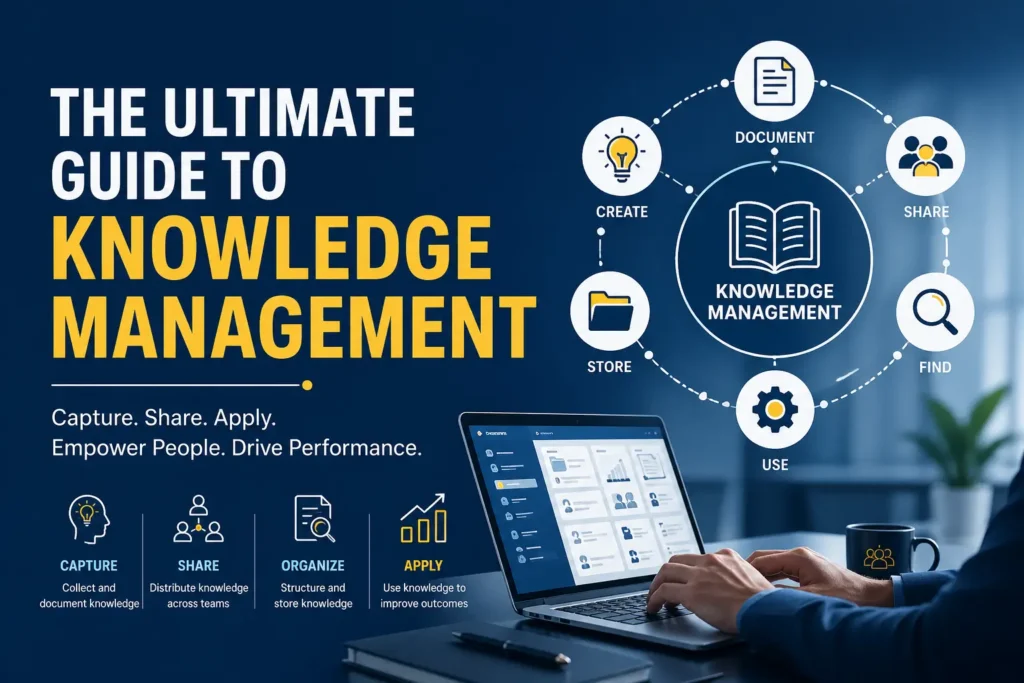
Table of Contents
What Is Knowledge Management in Practice
In practice, knowledge management is not a static system or a single platform. It is an operational capability that determines how knowledge is created, structured, shared, and applied across everyday work. The difference becomes clear when observing how high-performing organizations function. They do not pause work to “manage knowledge.” Knowledge management is embedded directly into how work gets done.
A product team documenting a solution, a consultant reusing a proven framework, or an engineer referencing past incident resolutions are all examples of knowledge management in action. In each case, knowledge is not just stored, it is actively reused to improve speed, consistency, and decision quality.
To understand this clearly, it is important to distinguish between data, information, and knowledge.
Data is raw and unprocessed. It consists of numbers, logs, or isolated facts without context. Information is structured data that provides meaning, such as reports, dashboards, or summarized outputs. Knowledge goes a step further. It includes interpretation, experience, and the ability to apply information in a specific context. Knowledge answers not just what happened, but why it matters and how to act on it.
This distinction is where many organizations struggle. They invest heavily in data systems and reporting tools but fail to convert that information into usable knowledge. Without this conversion, decision-making remains slow and inconsistent.
Within knowledge itself, there are two critical forms that shape how knowledge management operates.
Explicit knowledge is formalized and documented. It includes policies, manuals, playbooks, and standard operating procedures. This type of knowledge is easier to capture and distribute, making it the foundation of most knowledge management systems.
Tacit knowledge, on the other hand, is experiential. It exists in people’s insights, judgment, and problem-solving approaches. It is often difficult to articulate and even harder to capture. Yet, it is frequently the most valuable form of knowledge within an organization.
Effective knowledge management connects these two. It finds ways to convert tacit knowledge into explicit forms where possible, while also enabling direct knowledge transfer through collaboration, mentorship, and expert networks.
In real organizational environments, knowledge management operates across multiple layers simultaneously.
At the team level, it supports day-to-day execution. Teams rely on shared knowledge to avoid repeating mistakes and to maintain consistency in how work is delivered.
At the cross-functional level, it enables coordination. Marketing, engineering, operations, and support teams must align their understanding to execute effectively. Knowledge management ensures that shared context exists across these boundaries.
At the organizational level, it builds institutional memory. Lessons learned from past projects, customer interactions, and strategic initiatives are retained and reused rather than lost over time.
Technology plays a role in enabling this, but it is not the defining factor. Knowledge bases, collaboration tools, and search systems provide infrastructure, yet the real impact comes from how knowledge is integrated into workflows. When knowledge is accessible at the moment of need, it becomes actionable. When it is disconnected from work, it becomes unused.
In practice, knowledge management succeeds when it shifts from being a repository to becoming a flow. Knowledge is continuously created, refined through use, and redistributed across the organization. This dynamic movement is what allows organizations to learn faster, respond more effectively, and scale expertise beyond individuals.
Why Knowledge Management Matters for Modern Organizations
The value of knowledge management becomes visible when it is connected directly to business outcomes. Organizations that implement knowledge management effectively do not treat it as an internal initiative. They experience measurable improvements in how decisions are made, how work is executed, and how quickly teams adapt to change.
One of the most immediate impacts of knowledge management is on decision-making. In many organizations, decisions are delayed because teams spend excessive time searching for relevant information or validating assumptions. When knowledge management is structured properly, decision-makers have access to prior insights, proven approaches, and contextual knowledge. This reduces uncertainty and enables faster, more confident decisions. Over time, this speed becomes a competitive advantage.
Another critical benefit is the reduction of duplicated effort. Without strong knowledge management, teams often solve the same problems repeatedly in different parts of the organization. This duplication is rarely visible at the leadership level, but it consumes significant time and resources. Effective knowledge management ensures that solutions, lessons, and best practices are captured and reused. This shifts effort from rework to progress.
Knowledge management also plays a central role in onboarding and capability development. New employees typically rely on informal guidance, scattered documents, or trial-and-error to become productive. This slows down integration and creates inconsistency in how work is performed. With well-designed knowledge management systems, onboarding becomes structured and efficient. New hires can access relevant knowledge quickly, understand context, and contribute sooner. This not only improves productivity but also enhances employee experience.
Knowledge retention is another area where knowledge management has a direct impact. Organizations frequently lose critical expertise when experienced employees leave or transition roles. Without mechanisms to capture and transfer that knowledge, institutional memory erodes over time. Knowledge management addresses this by preserving both explicit and tacit knowledge, ensuring that valuable insights remain accessible even as the workforce evolves.
The importance of knowledge management becomes even more pronounced in the context of digital transformation. As organizations adopt new technologies and processes, the volume and complexity of knowledge increase significantly. Systems alone cannot solve this challenge. Knowledge management provides the structure needed to integrate information across platforms and make it usable in real workflows. It acts as the connective layer that aligns systems, processes, and people.
There is also a growing dependency between knowledge management and artificial intelligence. AI systems rely on high-quality, structured knowledge to deliver accurate and relevant outputs. Organizations with mature knowledge management practices are better positioned to implement AI successfully because their knowledge is organized, accessible, and continuously updated. In contrast, organizations with weak knowledge management often struggle with inconsistent or unreliable AI results.
Ultimately, knowledge management matters because it influences how effectively an organization learns. It determines whether knowledge remains fragmented or becomes a shared asset. Organizations that invest in knowledge management are able to operate with greater clarity, consistency, and speed. Those that do not continue to face inefficiencies that compound over time.
Core Components of a Knowledge Management System
A knowledge management system is not defined by a single tool or platform. It is shaped by how effectively an organization aligns people, processes, and technology to enable knowledge to move, evolve, and create value. When one of these components is weak or disconnected, knowledge management becomes fragmented and unreliable. When all three are aligned, knowledge management becomes a scalable operational capability.
People: Culture, Incentives, and Collaboration Behavior
The success of knowledge management begins with people. No system can function if individuals are unwilling or unmotivated to contribute, share, and reuse knowledge.
In many organizations, knowledge remains siloed because expertise is treated as a source of control. Employees may hesitate to share insights if there is no clear benefit or recognition. In some cases, knowledge sharing is seen as extra work rather than an integral part of delivering results.
High-performing organizations address this by embedding knowledge management into their culture. Sharing knowledge is not optional. It is expected. Teams are encouraged to document what they learn, contribute to shared systems, and collaborate across boundaries.
Incentives play a critical role. When performance evaluations include contributions to knowledge management, behavior shifts. Employees begin to see knowledge sharing as part of their responsibility, not an additional task.
Collaboration behavior also matters. Knowledge management thrives in environments where teams actively exchange ideas, challenge assumptions, and learn from each other. This often takes the form of communities of practice, cross-functional forums, and structured knowledge-sharing sessions.
Without the right cultural foundation, even the most advanced knowledge management systems remain underutilized.
Process: How Knowledge Is Captured, Validated, and Reused
Processes define how knowledge management operates in practice. Without clear processes, knowledge becomes inconsistent, outdated, and difficult to trust.
Effective knowledge management systems establish structured approaches for capturing knowledge during work. This ensures that insights are documented when they are most relevant, rather than after the fact when context is lost.
Validation is equally important. Not all knowledge is accurate or applicable across situations. Organizations must define how knowledge is reviewed, approved, and updated. This builds trust in the system and encourages reuse.
Reuse is where knowledge management delivers its true value. Captured knowledge must be easy to find and apply. This requires consistent formatting, clear context, and alignment with real workflows. When knowledge is reusable, teams can build on existing insights instead of starting from scratch.
Organizations such as Deloitte integrate these processes into their delivery models, ensuring that every project contributes to and benefits from shared knowledge.
Without structured processes, knowledge management becomes a collection of disconnected documents rather than a functioning system.
Technology: Enabling Access, Discovery, and Integration
Technology provides the infrastructure that allows knowledge management to scale. However, it is often misunderstood as the solution rather than an enabler.
Modern knowledge management systems rely on a combination of tools, including knowledge bases, search platforms, and collaboration systems. These tools make knowledge accessible, searchable, and integrated into daily work.
Search capabilities are particularly critical. If users cannot quickly find relevant knowledge, they will not rely on the system. Advanced search, often enhanced by AI, improves discovery by understanding context and intent rather than relying solely on keywords.
Integration is another key factor. Knowledge management tools must connect with the systems employees use every day. When knowledge is embedded within workflows, it becomes part of execution rather than a separate activity.
Organizations like Microsoft demonstrate this approach by integrating knowledge sharing into platforms such as Teams and SharePoint, allowing knowledge to surface within the flow of work.
Why Alignment Across All Three Components Matters
Many knowledge management initiatives fail because they focus too heavily on one component while neglecting the others. Implementing advanced technology without addressing culture leads to low adoption. Establishing processes without supporting tools creates friction. Encouraging collaboration without structure results in inconsistency.
Effective knowledge management requires alignment across people, process, and technology. When these components work together, knowledge is not only captured but continuously used, improved, and shared.
This alignment is what transforms knowledge management from a static system into a dynamic capability that supports how organizations learn, adapt, and perform.
The Knowledge Management Lifecycle
Knowledge management functions as a continuous cycle rather than a one-time process. Organizations do not simply create knowledge and store it. Knowledge evolves through usage, feedback, and changing business contexts. Understanding this lifecycle is critical because it reveals how knowledge management actually operates in day-to-day environments.
At a practical level, the knowledge management lifecycle consists of six interconnected stages: creation, capture, organization, sharing, application, and refinement. Each stage builds on the previous one, and gaps in any stage weaken the entire system.
Knowledge Creation
Knowledge creation begins where work happens. It emerges from problem-solving, decision-making, customer interactions, and innovation efforts. Teams generate new insights while executing tasks, not in isolation.
In high-performing organizations, knowledge creation is intentional. Employees are encouraged to articulate what they learn, whether it is a new approach, a resolved issue, or a refined process. Without this step, valuable insights remain locked within individuals and never enter the broader system.
Knowledge Capture
Once knowledge is created, it must be captured in a structured way. This is where many organizations struggle. Knowledge is often lost because it is not documented at the right time or in the right format.
Effective knowledge management systems integrate capture into workflows. For example, project teams document key decisions and lessons as part of delivery, rather than attempting to reconstruct them later. This preserves context and accuracy.
The goal is not to capture everything, but to capture what is reusable and valuable for others.
Knowledge Organization
Captured knowledge must be organized so that it can be found and understood. Without organization, knowledge quickly becomes fragmented and difficult to navigate.
This stage involves:
- Categorizing content using a clear taxonomy
- Applying metadata to improve discoverability
- Structuring information in a consistent format
Well-organized knowledge allows users to locate relevant insights quickly and understand how they apply to specific situations.
Knowledge Sharing
Knowledge sharing is the stage where knowledge begins to create value across the organization. It involves distributing knowledge to the right people at the right time.
In practice, this happens through:
- Knowledge bases and internal platforms
- Collaboration tools and communication channels
- Communities of practice and expert networks
Effective knowledge sharing is not passive. It is designed to ensure that knowledge reaches users within the context of their work, rather than requiring them to search for it separately.
Knowledge Application
Application is where knowledge management delivers measurable impact. Knowledge that is not used has no operational value.
At this stage, employees apply knowledge to solve problems, make decisions, and execute tasks. The quality of knowledge management becomes visible here. If knowledge is clear, relevant, and accessible, it accelerates execution. If not, teams revert to trial-and-error or recreate solutions.
Application also tests the validity of knowledge. It reveals whether content is accurate, complete, and adaptable to different contexts.
Knowledge Refinement
The final stage closes the loop. Knowledge must be refined based on real-world use. As teams apply knowledge, they identify gaps, improvements, and new insights.
Refinement involves:
- Updating existing knowledge with new information
- Removing outdated or irrelevant content
- Enhancing clarity and usability
This stage ensures that knowledge remains current and reliable. It also feeds back into knowledge creation, continuing the cycle.
How Knowledge Evolves Over Time
The knowledge management lifecycle is dynamic. Knowledge does not remain static after being captured. It evolves as it is used across different contexts and environments.
For example, a solution developed for one project may be adapted and improved in another. Over time, it becomes more robust and widely applicable. This evolution transforms individual insights into organizational capabilities.
Organizations that manage this lifecycle effectively build a form of institutional intelligence. Knowledge accumulates, improves, and becomes easier to apply. Those that do not manage it properly experience knowledge decay, where content becomes outdated and less useful over time.
From Process to Capability
The knowledge management lifecycle should not be treated as a rigid framework. It is a practical model that reflects how knowledge flows within organizations.
When all stages are functioning effectively, knowledge moves continuously from creation to application and back into refinement. This flow enables organizations to learn faster, reduce inefficiencies, and scale expertise across teams.
The strength of knowledge management lies not in any single stage, but in how seamlessly these stages connect and reinforce each other.
Types of Knowledge Management Systems
Knowledge management systems are often grouped together as a single category, but in practice, they serve very different purposes. The effectiveness of knowledge management depends on selecting and combining the right systems based on how knowledge is created, used, and shared within the organization.
Rather than viewing these systems as interchangeable, it is more useful to understand when each type is used and how they complement each other.
Enterprise Knowledge Base
An enterprise knowledge base is designed to provide centralized, structured knowledge that can be easily accessed and reused across the organization.
This system is typically used when:
- Teams need quick access to standardized information
- Processes must be consistent across departments
- Knowledge needs to be searchable and continuously updated
Common use cases include:
- Internal FAQs and support documentation
- Process guidelines and operational playbooks
- Product or service knowledge for customer-facing teams
In practice, an enterprise knowledge base becomes the default reference point for employees. For example, support teams rely on it to resolve recurring issues, while onboarding employees use it to understand workflows and policies.
Organizations like Microsoft embed knowledge bases within daily tools so that knowledge is accessible without disrupting work.
Document Management Systems
Document management systems focus on storing, organizing, and controlling access to formal documents.
They are most useful when:
- Organizations handle large volumes of structured documents
- Compliance, version control, and auditability are critical
- Documents need controlled access and lifecycle management
Typical scenarios include:
- Legal contracts and compliance documentation
- Policy documents requiring version tracking
- Financial and operational records
Unlike a knowledge base, a document management system is not optimized for quick learning or reuse. It is designed for control, accuracy, and governance.
For example, a legal team may rely on a document management system to ensure that only the latest approved contract templates are used, while maintaining a full history of revisions.
Learning Systems
Learning systems are built to develop skills and capabilities across the organization, rather than simply store or retrieve knowledge.
They are used when:
- Employees need structured learning paths
- Organizations are focused on training and upskilling
- Knowledge must be delivered progressively, not all at once
Common applications include:
- Employee onboarding programs
- Certification and compliance training
- Continuous professional development
These systems go beyond static knowledge sharing. They guide users through content in a way that builds understanding over time.
In large organizations such as IBM, learning systems are integrated with knowledge management to ensure that employees not only access knowledge but also develop the ability to apply it effectively.
Expert Networks
Expert networks enable direct access to tacit knowledge held by individuals, which is often not fully captured in systems.
They are most valuable when:
- Problems are complex and context-specific
- Knowledge cannot be easily documented
- Real-time guidance is required
Typical use cases include:
- Consulting environments where specialized expertise is needed
- Technical troubleshooting that requires experience-based judgment
- Strategic decision-making involving nuanced insights
Instead of relying solely on stored knowledge, employees can connect with subject matter experts who provide context, interpretation, and guidance.
Organizations like McKinsey & Company combine structured knowledge repositories with expert networks, ensuring that both explicit and tacit knowledge are accessible.
How These Systems Work Together
No single system can support all aspects of knowledge management. Each system addresses a different dimension of how knowledge is used.
- Knowledge bases support quick access and reuse
- Document systems ensure control and compliance
- Learning systems build capability and understanding
- Expert networks provide context and judgment
High-performing organizations integrate these systems into a cohesive environment. Knowledge flows between them, rather than remaining isolated.
For example, a documented solution in a knowledge base may originate from an expert interaction, be formalized into a document, and later incorporated into a learning module. This interconnected approach ensures that knowledge management is both structured and adaptable.
Choosing the Right System for Your Organization
The choice of systems should be driven by how knowledge is used within the organization.
Organizations that prioritize speed and reuse will rely heavily on knowledge bases. Those operating in regulated environments will emphasize document management systems. Companies focused on capability development will invest in learning systems. Complex, expertise-driven environments will depend on expert networks.
The goal is not to choose one system over another, but to design a knowledge management ecosystem where each system supports a specific function while contributing to a unified flow of knowledge.
Knowledge Sharing as the Core of Knowledge Management
At the center of every effective knowledge management system is knowledge sharing. Without it, even the most well-structured systems fail to deliver value. Organizations may capture and store large volumes of knowledge, but if that knowledge does not move across teams and get applied in real work, it remains unused.
This is why knowledge sharing is not a supporting activity within knowledge management. It is the engine that activates the entire system.
Knowledge Sharing Turns Knowledge into Action
Knowledge management creates structure. Knowledge sharing creates impact.
A knowledge base filled with well-documented insights has no real value unless employees actively use that knowledge to solve problems, make decisions, and improve execution. Knowledge sharing ensures that knowledge reaches the right people at the right time, in a form they can apply.
In high-performing organizations, knowledge sharing is embedded into workflows. Teams do not search for knowledge as a separate task. Relevant insights are surfaced within the context of their work, making knowledge immediately actionable.
This shift from passive access to active delivery is what distinguishes effective knowledge management from systems that exist but are rarely used.
Knowledge Flow vs Knowledge Storage
A critical distinction in knowledge management is between knowledge storage and knowledge flow.
Knowledge storage focuses on accumulating content. Organizations invest in repositories, documentation, and systems that store information. While necessary, storage alone does not guarantee usage.
Knowledge flow focuses on movement. It ensures that knowledge:
- Moves across teams and functions
- Evolves through usage and feedback
- Is delivered when and where it is needed
Most organizations overinvest in storage and underinvest in flow. The result is familiar. Large volumes of content exist, but employees struggle to find relevant knowledge or choose not to rely on it.
Effective knowledge sharing shifts the focus toward flow. It connects people, systems, and context so that knowledge becomes part of execution rather than a separate resource.
How Poor Knowledge Sharing Breaks Knowledge Management
When knowledge sharing is weak, the entire knowledge management system begins to degrade, regardless of how advanced the tools or processes may be.
One common issue is duplication of work. Teams solve similar problems independently because they are unaware of existing solutions. This leads to wasted effort and inconsistent outcomes.
Another issue is low trust in knowledge systems. When employees cannot find relevant or up-to-date knowledge, they stop relying on the system altogether. Over time, knowledge management becomes a repository that is maintained but not used.
Knowledge silos are another consequence. Information remains confined within teams or individuals, limiting its value to the broader organization.
These problems are not caused by a lack of knowledge. They are caused by a lack of effective knowledge sharing.
How Leading Organizations Design Knowledge Sharing
Organizations that succeed in knowledge management design knowledge sharing deliberately.
At Google, internal systems are built to make knowledge accessible across teams with minimal friction. Documentation is open by default, and employees are encouraged to contribute and reuse knowledge.
At Microsoft, knowledge sharing is integrated into collaboration platforms, allowing knowledge to surface within conversations and workflows rather than requiring separate searches.
At McKinsey & Company, knowledge sharing combines structured repositories with expert networks. Consultants can access documented insights while also connecting with subject matter experts for deeper context.
In each case, the emphasis is on ensuring that knowledge moves efficiently across the organization.
Making Knowledge Sharing Work in Practice
Effective knowledge sharing is not achieved through policy alone. It requires alignment across multiple dimensions.
Knowledge must be structured so that it can be easily understood and reused. This includes clear context, consistent formatting, and relevance to real work scenarios.
Systems must support discovery and delivery. Search, recommendations, and integration with daily tools all contribute to making knowledge accessible at the right moment.
Most importantly, knowledge sharing must be part of how work is performed. When teams naturally capture and share insights as part of execution, knowledge management becomes a continuous, self-improving system.
The Role of Knowledge Sharing in Scaling Expertise
As organizations grow, scaling expertise becomes a critical challenge. It is not possible for a small group of experts to support every decision or solve every problem.
Knowledge sharing addresses this by distributing expertise across the organization. Insights that were once limited to individuals become accessible to teams. Over time, this builds a broader base of capability and reduces dependency on specific people.
This is where knowledge management delivers its full value. It transforms knowledge from an individual asset into an organizational capability.
Final Insight
Knowledge management without knowledge sharing is incomplete. It creates structure without impact.
When knowledge sharing is strong, knowledge flows continuously across the organization, improving decisions, accelerating execution, and enabling teams to learn from each other.
This is what turns knowledge management from a system into a competitive advantage.
Common Challenges in Knowledge Management
Most organizations recognize the importance of knowledge management, yet many struggle to make it work consistently. The challenge is rarely about awareness or intent. It is about execution. Knowledge management fails when underlying structural issues are not addressed, even if the right tools are in place.
Understanding these challenges requires going beyond surface-level symptoms and examining why they occur.
Knowledge Silos
Knowledge silos emerge when information remains confined within teams, departments, or individuals instead of flowing across the organization.
This happens for several reasons. Organizational structures often reinforce separation. Teams are measured based on their own performance, not on how effectively they share knowledge with others. Over time, this creates localized expertise that is not easily accessible outside the team.
Another factor is the absence of shared systems or standards. When teams use different tools or document knowledge in inconsistent ways, integration becomes difficult. Even when knowledge exists, it cannot be easily discovered or understood by others.
There is also a behavioral dimension. In some environments, knowledge is treated as a form of control or job security. Employees may hesitate to share insights if they believe it reduces their individual value.
The result is fragmentation. Similar problems are solved repeatedly in different parts of the organization, and opportunities for reuse are lost.
Low Adoption of Knowledge Management Systems
Many organizations invest in knowledge management platforms but see limited usage. The issue is not the availability of tools, but the lack of alignment with how people actually work.
One common reason is friction. If contributing or accessing knowledge requires additional steps outside normal workflows, employees are unlikely to adopt the system. Over time, knowledge management becomes an optional activity rather than a natural part of execution.
Another reason is perceived value. Employees will only use knowledge management systems if they consistently find relevant, high-quality information. If early experiences involve outdated or incomplete content, trust declines quickly.
Incentives also play a role. When performance metrics focus solely on output, knowledge sharing is deprioritized. Employees concentrate on completing tasks rather than contributing to shared knowledge.
Low adoption is often a signal that knowledge management has not been integrated into the operational fabric of the organization.
Outdated and Irrelevant Content
Knowledge loses value when it is not maintained. Outdated content is one of the most common and damaging issues in knowledge management.
This typically happens due to unclear ownership. When no individual or team is responsible for maintaining specific knowledge areas, content remains unchanged even as processes evolve.
Another factor is the lack of feedback loops. If systems do not capture how knowledge is used or whether it remains relevant, there is no mechanism to trigger updates.
In fast-moving environments, knowledge can become obsolete quickly. Without continuous refinement, repositories fill with content that is technically available but practically unusable.
Over time, this erodes trust. Employees begin to question the reliability of the system and may stop using it altogether.
Poor Search and Discoverability
A knowledge management system is only as effective as its ability to help users find what they need. Poor search experience is a major barrier to adoption.
This issue often stems from weak structure. Without clear taxonomy, metadata, and consistent formatting, knowledge becomes difficult to navigate. Search results may return large volumes of content without clear relevance.
Traditional keyword-based search further limits usability. Users may not know the exact terms used in documentation, leading to missed results even when relevant knowledge exists.
Another challenge is lack of context. Even when content is found, it may not clearly indicate when or how it should be used. This reduces confidence and slows decision-making.
Organizations that invest in advanced search capabilities, including context-aware and AI-driven systems, significantly improve knowledge accessibility. However, these systems still depend on well-structured underlying content.
Lack of Ownership and Governance
Knowledge management requires clear accountability. Without defined ownership, systems become fragmented and difficult to maintain.
Ownership gaps occur when responsibility for knowledge is not formally assigned. Teams may create content, but no one is accountable for updating or validating it over time.
Governance is equally important. Organizations need defined standards for how knowledge is created, reviewed, and maintained. Without these standards, content varies in quality and format, making it harder to trust and reuse.
This challenge is often overlooked because knowledge management is seen as a shared responsibility. While collaboration is important, lack of accountability leads to inconsistency and decline in quality.
Strong governance does not restrict knowledge sharing. It ensures that knowledge remains reliable, relevant, and usable.
Cultural Resistance to Knowledge Sharing
Culture is one of the most complex challenges in knowledge management. Even well-designed systems fail if the organizational culture does not support knowledge sharing.
Resistance can take subtle forms. Employees may prioritize speed over documentation, viewing knowledge sharing as secondary. In some cases, past experiences with ineffective systems create skepticism toward new initiatives.
There is also a perception issue. If knowledge management is positioned as administrative work rather than a value-creating activity, it will not gain traction.
Leadership behavior significantly influences culture. When leaders actively share knowledge, encourage collaboration, and recognize contributions, adoption improves. When they do not, knowledge management remains peripheral.
Cultural change takes time, but it is essential. Without it, knowledge management cannot scale effectively.
Why These Challenges Persist
These challenges are interconnected. Knowledge silos reduce visibility, which affects searchability. Poor search leads to low adoption. Low adoption results in outdated content. Lack of ownership reinforces all of these issues.
Addressing them requires a systemic approach. Organizations must align structure, behavior, and technology rather than attempting isolated fixes.
Knowledge management does not fail because of a single issue. It fails when these challenges accumulate and reinforce each other. Recognizing this interconnected nature is the first step toward building a system that works consistently.
How to Build a Knowledge Management Strategy
Building an effective knowledge management strategy requires more than selecting tools or launching an initiative. It involves designing a system that aligns with how the organization operates, makes decisions, and delivers value. The difference between successful and failed knowledge management efforts is often found in how well the strategy connects business goals with execution on the ground.
A strong knowledge management strategy is not built in isolation. It is shaped by real operational needs, existing workflows, and the way knowledge already flows within the organization, both formally and informally.
Defining Business Objectives
The starting point for any knowledge management strategy is clarity on why it exists.
Organizations often make the mistake of positioning knowledge management as a general improvement initiative. This leads to vague goals and limited impact. Instead, knowledge management must be tied to specific business outcomes.
For example, an organization may aim to:
- Reduce time required to resolve customer issues
- Improve consistency in project delivery
- Accelerate onboarding of new employees
- Support AI-driven decision systems
Each of these objectives requires a different approach to knowledge management. Without this alignment, efforts remain fragmented and difficult to measure.
In practice, this means engaging with business leaders and operational teams to identify where knowledge gaps are directly affecting performance.
Identifying Knowledge Gaps
Once objectives are defined, the next step is to identify where knowledge is missing, inaccessible, or underutilized.
This is not simply an audit of existing content. It requires understanding how work actually happens.
Key questions include:
- Where do teams spend time searching for information
- Which decisions rely heavily on individual expertise
- Where does duplication of work occur
- What knowledge is lost when employees leave or change roles
These gaps often reveal patterns. For example, recurring issues in customer support may indicate missing or poorly structured knowledge. Delays in project execution may point to lack of reusable frameworks.
Organizations like Accenture approach this by analyzing workflows and identifying points where knowledge should exist but does not.
The goal is to focus knowledge management efforts where they will have the greatest impact.
Designing Knowledge Workflows
Knowledge management becomes effective when it is embedded into workflows rather than treated as a separate activity.
This means designing how knowledge is:
- Captured during work
- Validated for accuracy
- Shared across relevant teams
- Updated based on usage
For example, in a project-based environment, knowledge capture can be integrated into delivery milestones. Teams document key decisions, challenges, and solutions as part of their workflow, not after the project is completed.
Similarly, feedback loops can be built into usage. When employees apply knowledge, they can flag gaps or improvements, ensuring that content evolves continuously.
Organizations such as Deloitte embed these workflows into their delivery processes, ensuring that knowledge management is a natural extension of execution.
Selecting the Right Tools
Technology plays a critical role in enabling knowledge management, but it should be selected based on strategy, not the other way around.
The focus should be on how tools support:
- Easy knowledge capture
- Fast and relevant search
- Integration with daily workflows
- Collaboration and knowledge sharing
Organizations often overinvest in complex platforms without addressing usability. If tools create friction, adoption will remain low regardless of functionality.
A more effective approach is to prioritize simplicity and integration. Tools should fit naturally into how employees already work.
Companies like Microsoft demonstrate this by integrating knowledge management into widely used platforms, ensuring that knowledge is accessible within everyday workflows.
Establishing Governance Models
Governance is essential for maintaining quality, consistency, and trust in knowledge management systems.
Without governance, knowledge becomes fragmented and outdated. With overly rigid governance, knowledge sharing slows down.
The balance lies in defining:
- Ownership of knowledge domains
- Standards for content creation and structure
- Processes for review and updates
Ownership ensures accountability. Each area of knowledge should have clearly defined responsibility for maintaining accuracy and relevance.
Standards ensure consistency. When knowledge follows a common structure, it becomes easier to understand and reuse.
Governance should not be seen as control. It is a mechanism to ensure that knowledge remains reliable and usable over time.
Measuring Success
A knowledge management strategy must be evaluated based on outcomes, not activity.
Traditional metrics such as number of documents created or platform usage provide limited insight. More meaningful indicators focus on how knowledge management impacts performance.
These include:
- Reduction in time to resolve recurring issues
- Decrease in duplicated work
- Faster onboarding and time to productivity
- Improved decision-making speed and quality
Measurement should be continuous. Insights from these metrics can guide improvements and help refine the strategy over time.
Organizations that treat knowledge management as a measurable capability are better able to demonstrate its value and sustain long-term investment.
From Strategy to Execution
A knowledge management strategy becomes effective only when it is translated into consistent execution.
This requires:
- Alignment with business priorities
- Integration into workflows
- Support from leadership
- Continuous refinement based on real-world use
Organizations that succeed do not treat knowledge management as a one-time project. They build it as an evolving system that adapts to changing needs.
When designed and implemented effectively, knowledge management becomes a foundational capability that supports how organizations operate, learn, and scale.
Real-World Knowledge Management Examples
Understanding knowledge management becomes clearer when examined through how leading organizations actually operate. The difference is not in whether they invest in knowledge management, but in how deeply it is embedded into their workflows, systems, and decision-making processes.
What stands out across high-performing organizations is consistency. Knowledge management is not treated as a side initiative. It is integrated into how work is executed at scale.
IBM: Structured Knowledge at Enterprise Scale
IBM has long treated knowledge management as a core capability, particularly in consulting and services delivery.
In practice, IBM operates with highly structured knowledge systems that capture insights from client engagements and convert them into reusable assets. These assets are not just documents. They are organized frameworks, methodologies, and solution patterns that can be applied across different industries and use cases.
A key aspect of IBM’s approach is standardization. Knowledge is documented using consistent formats, making it easier to understand and reuse. This reduces the cognitive load on teams who need to apply knowledge in new contexts.
Another important element is integration with delivery workflows. Consultants are expected to contribute knowledge as part of project execution. This ensures that knowledge management is continuous rather than retrospective.
What makes this effective is not the volume of knowledge, but its usability. Teams can quickly access structured insights that are directly relevant to their work, improving both speed and consistency.
Google: Open Knowledge and Frictionless Access
Google approaches knowledge management with a strong emphasis on accessibility and transparency.
Internally, documentation is widely accessible by default. Employees can search across systems to find project details, technical documentation, and internal discussions. This openness reduces dependency on specific individuals and allows knowledge to flow freely across teams.
Google also emphasizes documentation as part of engineering culture. Engineers are expected to document systems, decisions, and processes as they build them. This ensures that knowledge is created in real time rather than reconstructed later.
Search plays a critical role in Google’s knowledge management. Advanced internal search systems allow employees to find relevant information quickly, even across large and complex datasets.
What makes Google’s approach effective is the reduction of friction. Knowledge is easy to access, easy to contribute, and embedded into everyday work. This creates an environment where knowledge sharing happens naturally rather than being enforced.
Microsoft: Knowledge in the Flow of Work
Microsoft’s knowledge management strategy is centered on integration.
Rather than relying on standalone systems, Microsoft embeds knowledge sharing directly into collaboration tools such as Teams and SharePoint. This allows knowledge to surface within conversations, meetings, and workflows.
For example, when teams collaborate on a project, relevant documents, past discussions, and contextual knowledge are available within the same environment. Employees do not need to switch systems to access information.
Microsoft also leverages AI to enhance knowledge discovery. Intelligent search and recommendation systems help users find relevant knowledge based on context, not just keywords.
Another important aspect is governance. Microsoft maintains structured environments where knowledge is organized, version-controlled, and aligned with organizational standards.
What makes this approach effective is contextual delivery. Knowledge is not something employees have to actively seek. It is presented within the flow of work, making it more likely to be used.
McKinsey & Company: Combining Structured Knowledge with Expert Access
McKinsey’s approach to knowledge management is built around the combination of structured repositories and expert networks.
The firm maintains extensive knowledge repositories that include case studies, frameworks, and industry insights. These are carefully curated and organized to ensure high relevance and quality.
However, McKinsey recognizes that not all knowledge can be documented. Complex problems often require context and judgment that go beyond written content.
To address this, McKinsey complements its repositories with expert networks. Consultants can connect with subject matter experts who provide deeper insights and guidance.
This dual approach ensures that both explicit and tacit knowledge are accessible. Teams can start with documented knowledge and then refine their understanding through expert interaction.
What makes this effective is balance. Structured knowledge provides speed and consistency, while expert access provides depth and adaptability.
Key Patterns Across These Organizations
While the approaches differ, several consistent patterns emerge:
Knowledge management is embedded into workflows, not treated as a separate activity. Employees contribute and use knowledge as part of their daily work.
Knowledge is structured for reuse. Content is organized in ways that make it easy to understand, search, and apply.
Access is prioritized. Systems are designed to reduce friction and ensure that knowledge is available when needed.
Both explicit and tacit knowledge are addressed. Organizations combine documentation with human expertise to cover different types of knowledge.
What This Means for Your Organization
These examples demonstrate that effective knowledge management is not defined by a specific tool or platform. It is defined by how well knowledge is integrated into the way work is performed.
Organizations that succeed focus on usability, accessibility, and continuous improvement. They design systems that make knowledge easy to create, easy to find, and easy to apply.
The result is not just better knowledge management, but a stronger ability to operate, adapt, and scale expertise across the organization.
The Role of AI in Knowledge Management
Artificial intelligence is rapidly transforming how knowledge management systems operate. It is changing how knowledge is discovered, interpreted, and delivered across organizations. However, the impact of AI is not automatic. Its effectiveness depends directly on the quality, structure, and reliability of the underlying knowledge.
Organizations that view AI as a layer on top of weak knowledge management systems often see limited or inconsistent results. Those that align AI with strong knowledge management practices unlock significantly greater value.
AI-Powered Search: From Keywords to Intent
Traditional knowledge management systems rely heavily on keyword-based search. This creates friction because users must guess the exact terms used in documentation.
AI-powered search changes this by understanding intent and context. Instead of matching keywords, it interprets what the user is trying to achieve.
For example:
- A user searching for “customer issue escalation” may receive not just documents, but relevant workflows, past cases, and recommended actions
- Queries can be conversational rather than structured
This significantly improves discoverability. However, the effectiveness of AI search depends on how well knowledge is structured. Poorly organized or inconsistent content limits AI’s ability to deliver accurate results.
Knowledge Recommendations: Delivering Information Proactively
One of the most impactful applications of AI in knowledge management is the ability to proactively surface relevant knowledge.
Instead of requiring users to search, AI systems analyze:
- User behavior
- Context of work
- Previous interactions
Based on this, they recommend:
- Relevant documents
- Similar cases
- Best practices
For example, during a support interaction, AI can suggest solutions based on similar past issues. In project environments, it can recommend frameworks or templates that have been used successfully before.
This shifts knowledge management from a pull-based system to a context-aware delivery system.
Content Summarization: Turning Volume into Insight
Modern organizations generate large volumes of knowledge, much of which is difficult to consume quickly. AI addresses this through automated summarization.
AI can:
- Condense long documents into key insights
- Highlight critical points from discussions or reports
- Extract actionable recommendations
This reduces the time required to understand complex information and enables faster decision-making.
However, summarization introduces a dependency on accuracy. If the underlying knowledge is incomplete or outdated, AI-generated summaries can misrepresent critical details. This reinforces the need for well-maintained knowledge management systems.
Knowledge Graphs: Connecting Information at Scale
Knowledge graphs represent a more advanced use of AI in knowledge management. They map relationships between different pieces of knowledge, creating a network of interconnected information.
Instead of treating knowledge as isolated documents, knowledge graphs connect:
- Concepts
- Entities
- Processes
- People
This allows organizations to:
- Understand how different knowledge areas relate to each other
- Discover insights that are not explicitly documented
- Navigate complex information more effectively
For example, a knowledge graph can link customer issues to product features, support cases, and engineering solutions, providing a holistic view that would be difficult to achieve through traditional systems.
The Critical Dependency: AI Is Only as Good as Knowledge Management
AI does not replace knowledge management. It amplifies it.
The quality of AI outputs is directly tied to the quality of the underlying knowledge. If knowledge is:
- Incomplete
- Outdated
- Poorly structured
- Lacking context
AI systems will produce results that are inaccurate, inconsistent, or misleading.
This is a common failure point. Organizations implement AI tools expecting immediate improvement, only to discover that their knowledge foundation is not strong enough to support it.
In contrast, organizations with mature knowledge management systems benefit significantly from AI. Their knowledge is:
- Structured and standardized
- Continuously updated
- Context-rich and reusable
This allows AI to deliver accurate insights, relevant recommendations, and reliable outputs.
From Enhancement to Transformation
When aligned properly, AI transforms knowledge management from a static system into an intelligent, adaptive capability.
Knowledge becomes easier to access, faster to understand, and more relevant to specific contexts. Employees spend less time searching and more time applying knowledge.
At the same time, AI introduces new responsibilities. Organizations must ensure that knowledge is governed, validated, and continuously refined. Without this, the risks associated with incorrect or biased outputs increase.
Final Insight
AI is not a shortcut to effective knowledge management. It is an accelerator.
Organizations that invest in strong knowledge management foundations will see AI enhance their ability to scale knowledge, improve decisions, and increase efficiency. Those that do not will find that AI exposes the weaknesses already present in their systems.
The relationship is clear. Strong knowledge management enables effective AI, and effective AI amplifies the value of knowledge management.
Measuring Knowledge Management Success
Measuring the effectiveness of knowledge management is where many organizations struggle. The challenge is not a lack of data, but a reliance on the wrong metrics. Traditional indicators such as number of documents created, pages viewed, or system logins provide activity data, not impact.
To evaluate knowledge management properly, measurement must shift from volume to value. The focus should be on how knowledge management influences business performance, decision-making, and operational efficiency.
Moving Beyond Vanity Metrics
Many knowledge management initiatives report success based on:
- Number of articles published
- Frequency of platform usage
- Volume of content created
These metrics are easy to track but misleading. A large knowledge base does not guarantee usability. High platform activity does not mean knowledge is being applied effectively.
The real question is not how much knowledge exists, but how much of it is being used to improve outcomes.
Time Saved in Finding and Applying Knowledge
One of the most direct indicators of effective knowledge management is the reduction in time required to locate and use relevant knowledge.
In organizations without strong knowledge management:
- Employees spend significant time searching across systems
- Information is scattered or duplicated
- Decisions are delayed due to lack of clarity
When knowledge management is working well:
- Relevant knowledge is accessible quickly
- Employees spend less time searching and more time executing
This can be measured through:
- Average time to find information
- Time taken to resolve recurring issues
- Reduction in effort spent on research or validation
Time saved translates directly into productivity gains.
Knowledge Reuse Rate
Knowledge management delivers value when knowledge is reused rather than recreated.
Reuse rate measures how often existing knowledge is applied across different teams, projects, or scenarios.
Low reuse typically indicates:
- Poor discoverability
- Lack of trust in content
- Knowledge that is too context-specific
High reuse indicates:
- Knowledge is well-structured and relevant
- Teams rely on shared insights rather than duplicating effort
Tracking reuse can involve:
- Frequency of access to specific knowledge assets
- Number of times solutions are applied across different cases
- Reduction in duplicate work across teams
This metric reflects how effectively knowledge is flowing within the organization.
Decision-Making Speed and Quality
Knowledge management has a direct impact on how quickly and effectively decisions are made.
In environments with weak knowledge management:
- Decisions rely heavily on individual experience
- Teams spend time validating assumptions
- Outcomes may vary due to inconsistent information
With strong knowledge management:
- Decision-makers have access to prior insights and context
- Decisions are faster and more consistent
- Risk is reduced through informed judgment
This can be evaluated by:
- Time taken to make key decisions
- Consistency of decisions across teams
- Reduction in errors or rework resulting from poor decisions
Improved decision-making is one of the most strategic outcomes of knowledge management.
Onboarding Efficiency and Time to Productivity
Onboarding is a clear and measurable use case for knowledge management.
Without structured knowledge management:
- New employees rely on informal guidance
- Learning is inconsistent and time-consuming
- Productivity takes longer to achieve
With effective knowledge management:
- Employees can access structured knowledge independently
- Learning paths are clearer and more consistent
- Time to productivity is significantly reduced
Metrics to track include:
- Time required for new employees to reach full productivity
- Reduction in dependency on senior staff for basic guidance
- Consistency in onboarding outcomes across teams
This reflects how well knowledge management supports capability building.
Connecting Metrics to Business Impact
Individual metrics provide insight, but their value increases when connected to broader business outcomes.
For example:
- Time saved contributes to cost efficiency and faster delivery
- Knowledge reuse reduces duplication and improves scalability
- Faster decision-making enhances responsiveness and competitiveness
- Efficient onboarding supports growth and workforce scalability
Organizations that link knowledge management metrics to these outcomes are better able to demonstrate its strategic value.
Building a Measurement System That Works
Effective measurement requires consistency and integration.
Metrics should be:
- Embedded into workflows rather than tracked separately
- Reviewed regularly to identify trends and gaps
- Used to refine knowledge management strategy over time
It is also important to combine quantitative data with qualitative feedback. Employee experience, trust in knowledge systems, and perceived usefulness provide context that numbers alone cannot capture.
Final Insight
Knowledge management cannot be measured by how much knowledge exists. It must be measured by how effectively that knowledge is used.
Organizations that focus on meaningful metrics gain a clear understanding of what is working and where improvements are needed. This allows knowledge management to evolve from a supporting function into a measurable driver of business performance.
Future of Knowledge Management
The future of knowledge management is not defined by entirely new concepts, but by how existing capabilities become more integrated, intelligent, and operationally embedded. Organizations are moving away from static knowledge systems toward environments where knowledge flows continuously, adapts to context, and supports real-time decision-making.
This shift is already visible in how leading enterprises are redesigning their knowledge ecosystems.
Real-Time Knowledge Flow
Traditional knowledge management operates with delays. Knowledge is created, then documented, then shared, often after the work is completed. This creates a gap between insight and application.
The future direction is toward real-time knowledge flow.
In practical terms, this means:
- Knowledge is captured as work happens
- Insights are immediately available to others
- Updates occur continuously rather than in cycles
For example, in operational environments, solutions to issues are documented and made accessible instantly, allowing other teams to apply them without delay. This reduces lag and ensures that knowledge remains current.
Real-time flow transforms knowledge management from a retrospective activity into a live operational layer.
AI-Driven Knowledge Systems
AI is becoming a core component of how knowledge management systems function, not as an add-on but as an embedded capability.
In practice, AI-driven systems:
- Improve search by understanding user intent
- Recommend relevant knowledge based on context
- Summarize complex information for faster consumption
Organizations like Microsoft are already integrating AI into knowledge platforms to enhance how employees interact with information.
However, the direction is not toward full automation. AI supports decision-making but does not replace human judgment. The focus remains on augmenting how knowledge is accessed and applied.
The effectiveness of these systems continues to depend on well-structured and reliable knowledge. AI amplifies strengths but also exposes weaknesses in knowledge management.
Personalized Knowledge Delivery
As organizations scale, the challenge is not just access to knowledge, but relevance.
Future knowledge management systems are moving toward personalized delivery, where knowledge is tailored to:
- Individual roles
- Current tasks
- Organizational context
Instead of presenting large volumes of information, systems prioritize what is most relevant to the user at a specific moment.
For example:
- A new employee may receive guided knowledge aligned with onboarding needs
- A senior manager may see insights related to strategic decisions
- A support agent may receive real-time recommendations based on customer issues
This reduces cognitive load and increases the likelihood that knowledge will be used effectively.
Deeper Integration with Business Systems
One of the most significant shifts is the integration of knowledge management into core business systems.
Rather than existing as a separate platform, knowledge management is becoming embedded within:
- Collaboration tools
- Customer support systems
- Project management platforms
- Operational workflows
Organizations such as Google and IBM demonstrate this approach by ensuring that knowledge is accessible within the systems employees already use.
This integration changes how knowledge is perceived. It is no longer something employees need to seek out. It becomes part of how work is executed.
A Practical Direction, Not a Theoretical Shift
The future of knowledge management is not speculative. These changes are already being implemented across organizations, though at different levels of maturity.
The direction is clear:
- Less emphasis on storing knowledge
- Greater focus on enabling knowledge flow
- Stronger alignment between knowledge, context, and action
Organizations that adapt to this shift will operate with greater speed and clarity. Those that do not will continue to rely on fragmented systems that limit their ability to scale knowledge effectively.
Final Insight
Knowledge management is evolving into an integrated capability that supports real-time work, enhances decision-making, and adapts to organizational needs.
The core principles remain the same. What is changing is how seamlessly knowledge is embedded into the systems and processes that define how organizations operate.
Conclusion
Knowledge management has evolved into a strategic capability that directly shapes how organizations perform, adapt, and compete. It is no longer confined to documentation or internal systems. It influences how quickly decisions are made, how effectively teams execute, and how well organizations retain and scale expertise.
Across every section of this guide, one pattern remains consistent. Knowledge management delivers value only when it is operational. Storing knowledge is not enough. Designing systems is not enough. The real impact comes from how knowledge is integrated into workflows, how consistently it is used, and how continuously it is refined.
Organizations that succeed treat knowledge management as part of how work gets done. They align people, processes, and technology to ensure that knowledge flows across teams and is applied in real situations. They focus on usability, accessibility, and relevance rather than volume.
Those that approach knowledge management as a theoretical initiative often face the same outcomes. Systems exist, but adoption remains low. Knowledge is captured, but not reused. Over time, the gap between intent and execution widens.
The difference lies in discipline. Effective knowledge management requires ongoing commitment, clear ownership, and continuous improvement. It is not a one-time implementation. It is an evolving capability that must adapt as the organization grows and changes.
In a business environment defined by complexity, speed, and constant change, the ability to manage knowledge effectively becomes a defining advantage. Organizations that build strong knowledge management systems are able to learn faster, respond more effectively, and scale their expertise with consistency.
The outcome is not just better knowledge management. It is a more capable, resilient, and intelligent organization.
Frequently Asked Questions About Knowledge Management
What is knowledge management in simple terms
Knowledge management is the process of capturing, organizing, sharing, and using knowledge within an organization to improve performance. It ensures that employees can access the right information and expertise when they need it, instead of relying on guesswork or repeating work that has already been done.
In simple terms, knowledge management helps organizations use what they know more effectively.
Why is knowledge management important
Knowledge management is important because it directly impacts how efficiently an organization operates.
Without knowledge management:
- Teams waste time searching for information
- Work gets duplicated across departments
- Critical knowledge is lost when employees leave
With effective knowledge management:
- Decisions are faster and more informed
- Teams reuse proven solutions instead of starting from scratch
- Organizations retain and scale expertise over time
In modern enterprises, knowledge management is essential for maintaining consistency, improving productivity, and supporting growth.
What are the types of knowledge in knowledge management
Knowledge management typically deals with two main types of knowledge.
Explicit knowledge is structured and documented. It includes manuals, policies, reports, and procedures. This type of knowledge is easy to store and share.
Tacit knowledge is based on experience, insights, and judgment. It exists in people’s minds and is often difficult to document. Examples include problem-solving skills and decision-making intuition.
Effective knowledge management connects these two by capturing explicit knowledge while enabling the transfer of tacit knowledge through collaboration and expert interaction.
How do organizations implement knowledge management
Organizations implement knowledge management by combining strategy, processes, and technology.
The process usually involves:
- Defining clear business goals for knowledge management
- Identifying knowledge gaps and inefficiencies
- Designing workflows to capture and share knowledge
- Implementing tools such as knowledge bases and collaboration platforms
- Establishing governance to maintain quality and consistency
Successful implementation also depends on culture. Employees must be encouraged and supported to share and use knowledge as part of their daily work.
What are the benefits of knowledge management
Knowledge management provides several measurable benefits for organizations.
It reduces duplication of work by enabling teams to reuse existing knowledge. It improves decision-making by providing access to relevant insights and context. It accelerates onboarding by helping new employees learn faster. It also strengthens knowledge retention, ensuring that expertise remains within the organization even when individuals leave.
Over time, these benefits contribute to improved efficiency, consistency, and overall organizational performance.
Stay informed on upcoming Smritex Knowledge Management sessions and workshops. Subscribe for updates.