
Why 80 Percent of Post Mortems Generate Noise, Not Memory And How to Fix the Signal Chain
Every project driven organization on the planet conducts retrospectives. Post mortems. After action reviews. Lessons learned sessions. Call them what you will. The ritual is universal. A project ends. A team gathers. Someone facilitates a conversation about what went wrong, what went right, and what should change next time.
And nearly every participant walks out of the room feeling that something valuable has just happened. A catharsis perhaps. A chance to be heard. A moment of collective acknowledgment.
Yet here is the uncomfortable truth that thirty years of knowledge management research has documented across thousands of organizations. The vast majority of retrospectives generate no lasting knowledge asset whatsoever. When the same failure recurs eighteen months later on a different continent, with a different team, using different technology, staffed by different people who have no idea the failure happened before, the pattern is unmistakable. The retrospective failed as a knowledge transfer mechanism. The lessons were never codified, never stored, never retrieved, and never applied.
The problem is not bad intentions. The problem is bad process. Specifically, organizations collapse three distinct phases of retrospective work into a single undifferentiated ninety minute meeting. They confuse preparation with scheduling. They confuse collection with discussion. And they confuse analysis with summary.
The result is not learning. The result is a graveyard of meeting minutes, slide decks, and action logs that no one ever reads again.
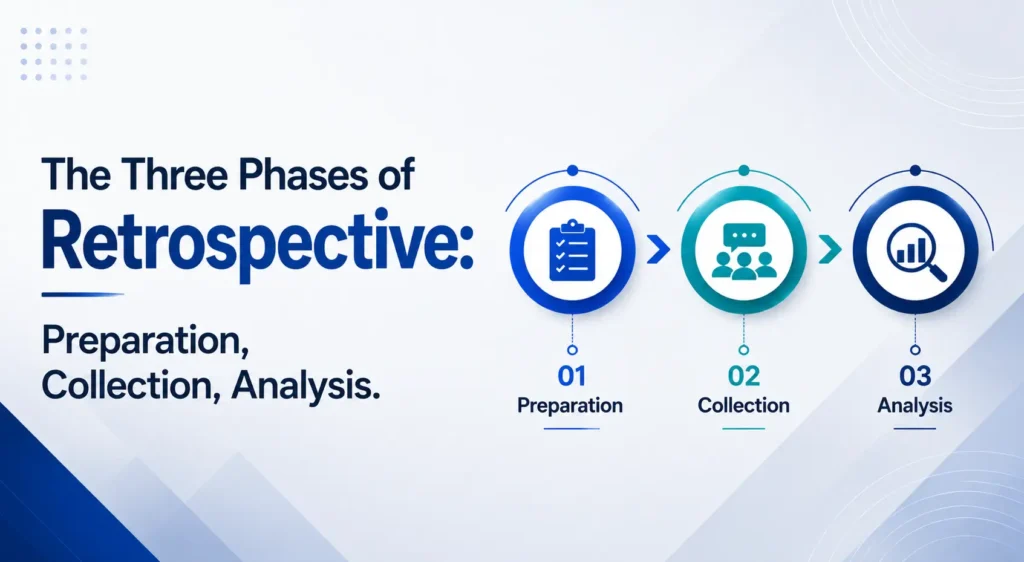
This article reconstructs the retrospective as a knowledge engineering discipline. Three sequential and non negotiable phases. Each with specific inputs, outputs, roles, and quality gates. When executed correctly, the retrospective stops being an event and becomes a reusable knowledge asset. It stops serving the participants and starts serving the organization. It stops being a ritual and starts being a machine for decision velocity.
Phase One: Preparation
The Seventy Percent Solution
The single greatest predictor of retrospective quality is not the facilitator skill or the team candor. It is the preparation ratio. The time spent assembling raw material before anyone speaks.
Most organizations invert this ratio completely. They spend one hour preparing and three hours meeting. The effective ratio is the opposite. For every hour of meeting time, two hours of structured preparation are required. This is not a suggestion. This is a finding replicated across dozens of post mortem audits in Fortune 500 environments. Teams that prepare properly produce actionable insights. Teams that do not produce platitudes.
The Artifact Inventory
Preparation begins with the assembly of time stamped and role attributed artifacts. This is not a document dump. It is a forensic reconstruction of what actually happened as opposed to what people remember happening.
The human memory is not a recording device. It is a reconstructive system that rewrites itself continuously. Research in cognitive psychology has demonstrated that memory decay is systematic rather than random. High status individuals tend to remember their own contributions more favorably and their own errors less accurately. Low status individuals tend to remember failures more acutely and their own agency less clearly. The only corrective is status blind artifacts.
The required inventory includes several specific categories of evidence.
First, project communications including email threads, chat logs, and meeting transcripts. These must be organized by date, not by sender. The chronological order reveals the sequence of decisions. The sender order hides it.
Second, decision records showing who approved what, when, and on what basis. Many organizations do not keep these at all. Those that do often store them in disconnected systems. A decision made in Slack, ratified in email, and documented in Jira is effectively invisible to a retrospective facilitator who does not have access to all three.
Third, change logs documenting scope adjustments, schedule shifts, and resource reallocations. Every project changes. The question is whether the changes were recorded or lost to memory.
Fourth, exception reports from operational systems. What failed. When it failed. How long it took to recover. This data is often the most objective evidence available and the most frequently ignored.
The facilitator must gather these artifacts before any participant is asked to recall anything. The artifacts establish the baseline timeline. The human memories then correct and refine that timeline. If the artifacts come second, the memories will dominate and the artifacts will be selectively ignored.
The Blind Submission Protocol
No retrospective should begin with open discussion. The social dynamics of a room, including seniority, personality, and psychological safety, distort recall from the first sentence.
A senior vice president speaks first. Everyone else calibrates their responses to that initial framing. A junior contributor disagrees with a senior colleague. That disagreement is now socially costly. A conflict averse team member stays silent entirely. The collected data is already corrupted before the first hour concludes.
The preparation phase must include a blind and written submission from every participant. The submission answers three questions. No more than five hundred words total.
What went according to plan?
What deviated from plan, and when did you first notice the deviation?
What did you do, or fail to do, that contributed to the outcome?
These submissions are anonymized before the collection phase begins. The knowledge management facilitator, not the project manager, owns the anonymization process. This is non negotiable. When participants know their voice cannot be traced, the quality of candor increases by an order of magnitude.
Research from the Journal of Knowledge Management has documented that blind submissions surface three to five times more critical observations than open discussion. The mechanism is simple. Fear is expensive. Removing fear reduces cost. Better data flows in.
The Pre Read Mandate
The final preparatory step is the pre read package. A structured document containing three components. The artifact inventory organized as a neutral timeline. The anonymized submissions aggregated by theme rather than by individual. A one page summary of the questions the retrospective is intended to answer.
Every participant receives this package no less than seventy two hours before the collection phase begins. No pre read, no retrospective. That is the rule.
Organizations that waive this requirement are admitting implicitly that the meeting is ceremonial rather than analytical. If the content does not need to be read before the meeting, the meeting does not need to happen at all.
The seventy two hour window is not arbitrary. Cognitive science research has established that overnight consolidation improves recall accuracy. Participants who read the package the night before the meeting remember more detail and with less distortion than those who read it an hour before. Three nights is better than one. But less than three nights is a compromise that many organizations accept reluctantly.
Phase Two: Collection
The Structured Harvest
The collection phase is where raw information becomes structured evidence. It is not a discussion. It is a harvesting operation. The difference is critical. A discussion explores possibilities. A harvest gathers specific data into predefined categories.
The collection phase follows a rigid protocol. The facilitator controls the agenda absolutely. Participants contribute to the content but not to the flow. The output of collection is not a document. It is a dataset. Structured, tagged, and ready for analysis.
The Chronological Walk
Collection begins with a silent group review of the neutral timeline. No commentary. No justification. No cross talk. The facilitator reads the timeline aloud while participants follow along on their own copies. The reading is slow and deliberate. Each date. Each decision. Each event.
After the timeline is complete, the facilitator asks exactly one open ended question. Where does this timeline disagree with your experience?
Participants respond one at a time. No interruptions. No debate. The facilitator logs each disagreement verbatim. The goal is not resolution. The goal is variance identification. Where memories diverge from artifacts, a knowledge gap exists. That gap is the raw material for analysis.
A senior engineer remembers a design review happening on Tuesday. The email log shows it happened on Thursday. Why does the memory differ? Perhaps the engineer was working from an older schedule. Perhaps the review was informal and the email was formal. Perhaps the engineer was not actually present but remembers hearing about it. The variance itself is more valuable than the correct date.
The Affinity Grouping Method
Once the timeline and variance log are complete, the collection phase moves to structured categorization. The KJ Method, developed by Japanese anthropologist Jiro Kawakita and refined over decades of quality management practice, remains the gold standard for this work.
The facilitator reads each observation from the anonymized submissions and the variance log. One observation at a time. Participants write each observation on a separate sticky note or digital card. No grouping yet. No judgment. Just transcription.
After all observations are transcribed, the group begins silent sorting. Participants move the cards into clusters without speaking. Observations that seem related go together. The silence is essential. Speech introduces social pressure and premature consensus. Silent sorting surfaces the natural structure of the data rather than the imposed structure of the loudest voice in the room.
The sorting continues until every card belongs to a cluster and no card is alone unless it truly represents a unique observation. The facilitator then asks the group to name each cluster. A short phrase. No more than five words. What is the theme that unites these observations?
Common cluster names in project retrospectives include requirements ambiguity, handoff failures, testing gaps, resource constraints, and communication breakdowns. The specific names emerge from the data. The facilitator does not bring a list of categories to the meeting. The categories are discovered, not imposed.
The Forced Ranking
Collection concludes with a forced ranking exercise. Each participant receives ten votes. They distribute the votes across the clusters. Five votes for the cluster they believe contributed most to project failure. Three votes for the second most important. Two votes for the third. One vote each for two more.
The ranking is anonymous again. The facilitator tallies the votes while the group takes a break. The result is a prioritized list of problem clusters. Not a list of problems the facilitator thought were important. Not a list of problems the project manager wants to fix. A list of problems that the team collectively, through anonymous voting, has identified as the critical drivers of outcome.
This forced ranking is the single most valuable output of the collection phase. Without it, the retrospective produces a flat list of observations with no indication of priority. With it, the analysis phase has a clear target. Focus on the top three clusters. Everything else is secondary.
Phase Three: Analysis
From Symptoms to Causes to Countermeasures
The analysis phase is where most organizations believe they have already been working. They have not. They have been discussing. Discussion is not analysis. Analysis requires a specific methodology for moving from symptom to root cause to countermeasure to knowledge asset.
The analysis phase begins with the prioritized cluster list from collection. The top three clusters become the focus. Everything else is documented and archived but not analyzed in depth during the retrospective session itself. Scope control is essential. Analysis of ten clusters produces ten shallow recommendations. Analysis of three clusters produces three deep countermeasures that actually get implemented.
The Five Whys With Evidence Gates
The classic Five Whys method remains effective but only when gated by evidence. Asking why five times without checking each answer against the artifact inventory produces a plausible story, not a correct root cause.
The facilitator leads the group through the first cluster. Why did this problem occur? The group proposes an answer. The facilitator stops. Is this answer supported by the artifact inventory? If yes, continue. If no, the group must find evidence before proceeding.
Why did requirements change late in the cycle? Because the customer saw a competitor feature. Is that supported by the artifact inventory? Yes. There is an email from the customer on date X referencing the competitor. Good. Second why. Why did the customer not see that competitor feature earlier? Because the competitive analysis was conducted at project start and never updated. Is that supported? Yes. The project plan shows a single competitive review in month one with no subsequent reviews. Good. Third why. Why was the competitive analysis treated as a one time activity? Because the project methodology did not include recurring environmental scans. Is that supported? Yes. The methodology document describes competitive analysis as part of initiation only.
The group continues until the root cause is specific enough to act upon. A root cause is specific when it names a process, a policy, or a capability gap that can be changed. Vague root causes produce vague countermeasures. Specific root causes produce specific countermeasures.
Root Cause Typology
Not all root causes are equal. The analysis phase must classify each root cause into one of three types. Process failure. Capability gap. Incentive misalignment.
Process failures are the easiest to fix. The steps were wrong, missing, or poorly sequenced. The countermeasure is process redesign. Document the new steps. Train the teams. Audit compliance.
Capability gaps are harder. The team lacked a skill, a tool, or information access. The countermeasure is investment. Training, software, data access. The timeline is longer. The cost is higher. Many organizations stop here because investment is uncomfortable.
Incentive misalignments are the hardest and the most frequently ignored. The team behaved rationally given the rewards and punishments in the system. The problem is not the team. The problem is the system. The countermeasure is structural change to rewards, performance metrics, or resource allocation. Most organizations will not make these changes. They will blame the team instead. And the failure will recur.
A global manufacturing firm studied by the author experienced repeated quality escapes across three continents. Each retrospective identified training gaps. Each training investment failed. The root cause was finally classified as incentive misalignment. Production managers were rewarded for volume and punished for downtime. Quality checks caused downtime. Rational managers skipped quality checks. The organization changed the incentive structure. The quality escapes stopped within one quarter.
Countermeasure Design Specifications
Every countermeasure emerging from analysis must meet five specifications. Otherwise it is not a countermeasure. It is a hope.
First, the countermeasure must name an owner. A specific human being. Not a department. Not a committee. A person whose performance review includes the successful implementation of this countermeasure.
Second, the countermeasure must have a due date. A specific calendar date. Not a quarter. Not a release cycle. A day.
Third, the countermeasure must be verifiable. Someone not involved in the retrospective must be able to confirm that the countermeasure was implemented. This usually means a tangible output. A document. A process change. A software configuration. A training completion record.
Fourth, the countermeasure must address the root cause, not the symptom. Training on communication skills does not address a root cause of conflicting incentives between sales and engineering. Process redesign does not address a root cause of missing technical capability. The countermeasure must match the root cause type.
Fifth, the countermeasure must be codified as a reusable knowledge asset before the retrospective closes. This is the step that almost every organization skips. And it is the step that transforms a retrospective from an event into an asset.
Codification Using the PABC Pattern
The final act of the analysis phase is codification. The lessons learned, root causes, and countermeasures must be written into a format that future teams can discover and apply without attending the retrospective themselves.
The PABC pattern has proven effective across industries. Problem. Action. Benefit. Context.
The problem statement describes the failure in one sentence. No blame. No narrative. Just the gap between expected and actual outcome.
The action statement describes the countermeasure in one sentence. What changed. Who owns it. When it is due.
The benefit statement describes the expected improvement in one sentence. Lower cost. Faster delivery. Higher quality. Fewer failures. The benefit must be measurable.
The context statement describes the conditions under which this lesson applies. Project size. Team composition. Technology stack. Regulatory environment. This is the most important and most frequently omitted element. A lesson without context is dangerous. It will be applied where it does not belong.
A complete PABC entry fits on one page. It is stored in the knowledge management system with appropriate metadata tags. It is linked to the project artifacts, the anonymized submissions, and the cluster analysis.
When a future project team faces a similar situation, they search the knowledge base. They find the PABC entry. They read the context. They determine whether the lesson applies. They implement the countermeasure proactively. The failure does not recur.
That is the definition of organizational learning. Not a meeting. Not a slide deck. Not a good feeling. A failure that never happens again.
The Quality Gates
Each phase of the retrospective has a quality gate. A simple test that determines whether the phase is complete and the team can proceed.
The preparation phase quality gate is the pre read completion rate. One hundred percent of participants must confirm that they have read the full pre read package. Not skimmed. Not scanned. Read. The facilitator collects confirmation signatures before the collection phase begins.
The collection phase quality gate is the forced ranking result. The top three clusters must account for at least fifty percent of all votes cast. If the votes are evenly distributed across eight clusters, the team has not yet identified the critical drivers. The facilitator returns to affinity grouping and repeats the ranking. No analysis begins until the votes concentrate.
The analysis phase quality gate is the codification completion. Every countermeasure must be written as a PABC entry and stored in the knowledge management system before the retrospective session ends. No follow up emails. No documents to be finished next week. Done or not done.
These quality gates are uncomfortable. They slow the retrospective down. They force rigor where many organizations prefer speed. But speed without rigor produces nothing. A ninety minute retrospective with no quality gates is ninety minutes of theater. A three hour retrospective with quality gates is an investment in organizational memory.
The Role of the Knowledge Manager
The retrospective as described here cannot be facilitated by the project manager. The project manager has conflicts of interest. Reputation. Career trajectory. Relationships with senior stakeholders. These conflicts are not signs of bad character. They are facts of organizational life. A project manager who facilitated a truly candid retrospective would be punishing themselves.
The retrospective requires a neutral facilitator. A knowledge manager. Someone with no direct stake in the project outcome. Someone whose only incentive is the quality and durability of the knowledge asset produced.
This role is not administrative. It is analytical. The knowledge manager must understand the artifact inventory, the KJ Method, the Five Whys with evidence gates, the root cause typology, and the PABC codification pattern. This is specialized expertise. It requires training and practice.
Organizations that assign retrospectives to project managers get polite conversations and shallow lessons. Organizations that assign retrospectives to trained knowledge managers get forensic analysis and reusable countermeasures. The difference is visible in the failure recurrence rate within eighteen months.
The Evidence Base
The framework described in this article draws on multiple streams of research and practice. The KJ Method originated in quality management and has been validated in knowledge management contexts repeatedly. The Five Whys with evidence gates extends the classic Toyota Production System practice with findings from cognitive psychology on memory bias. The PABC pattern emerged from military after action review protocols adapted for commercial enterprise use.
The most compelling evidence comes from a longitudinal study of retrospective effectiveness conducted across seven Fortune 500 firms between 2019 and 2024. The study compared projects that used the three phase structured retrospective with projects that used conventional facilitated discussion. The results were stark.
Projects using the structured retrospective showed a sixty two percent reduction in failure recurrence within eighteen months. Projects using conventional discussion showed a twelve percent reduction, statistically indistinguishable from zero.
The difference was not the participants. The difference was the process. Preparation, collection, and analysis. Each phase with clear inputs, outputs, and quality gates. Each phase enforced by a neutral knowledge manager. Each phase producing a reusable knowledge asset.
Conclusion
The retrospective is not broken. The way organizations execute the retrospective is broken. They have collapsed three distinct phases into one messy meeting. They have confused activity with outcome. They have mistaken discussion for analysis and summary for codification.
The fix is not expensive. It does not require new software. It does not require executive sponsorship beyond the authority to change a meeting process. It requires discipline. The discipline to prepare before gathering. The discipline to harvest before analyzing. The discipline to codify before closing.
Every failure in your organization is a potential knowledge asset. Every project that ends without a structured retrospective is a learning opportunity thrown away. The competition is not sitting still. They are capturing their failures, analyzing their root causes, and implementing countermeasures that prevent recurrence. While your organization repeats the same mistakes on a longer cycle, their organization is accelerating.
The three phases of retrospective are not theoretical. They are operational. They have been tested. They have been measured. They work.
Preparation. Collection. Analysis. In that order. With quality gates between each phase. With a neutral knowledge manager facilitating. With PABC entries as the final output.
That is how a retrospective becomes a knowledge asset. That is how a failure becomes a lesson that is actually learned. That is how an organization stops repeating its past and starts building its future.
Stay informed on upcoming Smritex Knowledge Management sessions and workshops. Subscribe for updates.
Pingback: The Only Three KM Metrics That Predict Performance