
Most modern organizations no longer compete only through factories, equipment, or physical assets. They compete through ideas, expertise, speed of decision-making, customer insight, technical innovation, and the ability to solve complex problems faster than rivals. In practical terms, they compete through people who think for a living.
These employees are known as knowledge workers. They include engineers, consultants, analysts, researchers, designers, lawyers, architects, product managers, scientists, financial specialists, and strategic leaders. Their output is not measured only by hours worked or tasks completed. It is measured by judgment, creativity, insight, and solutions.
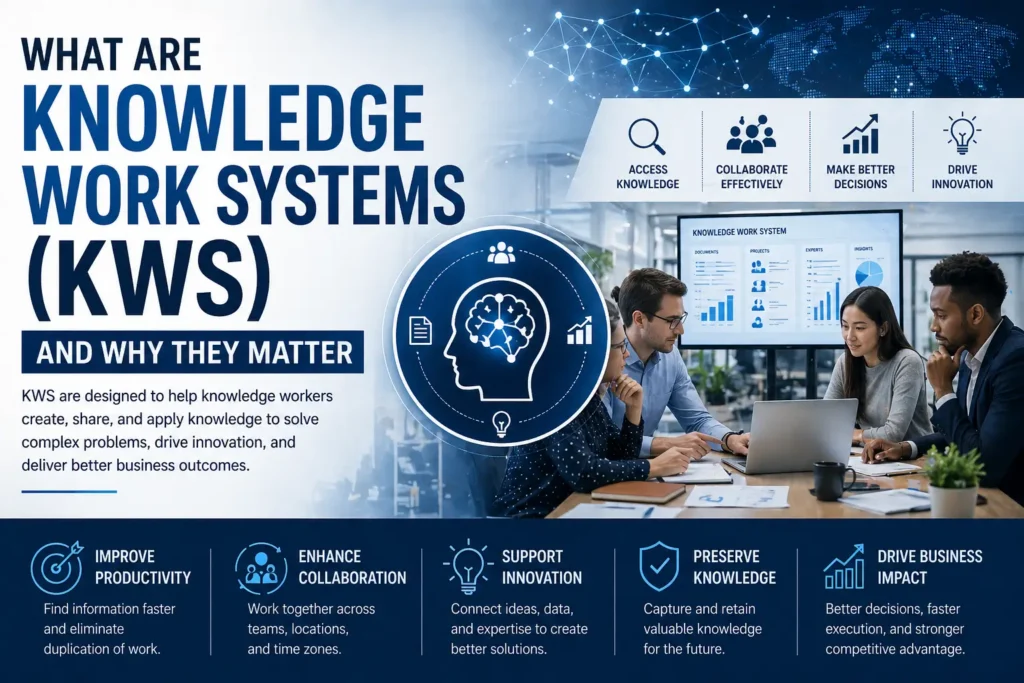
That is why Knowledge Work Systems (KWS) have become increasingly important. Standard business systems handle transactions well, but they are not always designed to support deep thinking, collaborative problem-solving, knowledge creation, or expert decision-making. Knowledge workers need systems built for the realities of intellectual work.
Knowledge Work Systems (KWS) are specialized digital systems that help professionals create, analyze, organize, share, and apply knowledge more effectively. They enable smarter work, faster innovation, and better business performance.
By the end of this article, you will understand what Knowledge Work Systems (KWS) are, how they differ from traditional systems, where they create business value, and why they now matter to nearly every enterprise.
What Are Knowledge Work Systems (KWS)
Knowledge Work Systems (KWS) are enterprise systems created to support knowledge-intensive roles. These systems help users perform tasks that require expertise, reasoning, analysis, design, innovation, and informed judgment.
Unlike routine operational systems, KWS focus on work where outcomes are not always predictable and solutions cannot be fully automated through fixed rules.
For example, processing an invoice is a structured transaction. Designing a new product, building a legal case strategy, modeling investment risk, or solving a customer engineering problem requires human expertise supported by strong systems. That is the domain of Knowledge Work Systems (KWS).
KWS often combine several capabilities into one working environment:
- Access to structured and unstructured information
- Search across internal knowledge sources
- Data modeling and analytics
- Collaboration and co-authoring tools
- Design, simulation, or planning software
- Knowledge repositories and reusable templates
- Expert directories and skill discovery tools
- AI-assisted drafting and summarization
The main purpose of KWS is simple: help talented people perform high-value work at a higher level.
Why Knowledge Work Matters More Than Ever
The global economy has shifted significantly toward services, technology, consulting, finance, healthcare, research, and digital operations. In these sectors, value is often created through knowledge rather than physical production alone.
A pharmaceutical company depends on scientists and regulatory experts. A consulting firm depends on analysts and advisors. A software company depends on developers and product thinkers. A bank depends on risk professionals and strategists.
Even traditional industries now rely heavily on knowledge work. Manufacturers use data scientists, engineers, supply chain planners, and automation experts. Retailers use pricing analysts, digital marketers, and customer insight teams.
This shift means that productivity is no longer only about machinery or throughput. It is about how effectively organizations support thinking work.
That is why Knowledge Work Systems (KWS) matter. If experts waste time searching for files, duplicating old work, waiting for information, or using outdated tools, the business loses value every day.
Who Uses Knowledge Work Systems
The users of Knowledge Work Systems (KWS) are typically professionals whose decisions or outputs require expertise. These roles exist in almost every large organization.
Common users include:
- Engineers creating products or solving technical issues
- Consultants preparing recommendations for clients
- Financial analysts evaluating investments or forecasts
- Lawyers managing research, contracts, and case strategy
- Scientists conducting experiments and interpreting data
- Product managers coordinating innovation roadmaps
- Architects designing buildings and systems
- Medical specialists using clinical knowledge tools
- HR leaders designing workforce strategy
- Executives making strategic decisions
These professionals often work with incomplete information, changing priorities, and complex trade-offs. Their performance improves dramatically when systems reduce friction and provide the right knowledge quickly.
How Knowledge Work Systems Differ from Traditional Business Systems
Many organizations use numerous software platforms, but not every platform qualifies as a KWS. Understanding the difference is important.
Transaction Processing Systems
These systems handle routine operations such as billing, payroll, inventory updates, and order processing. Their purpose is consistency, speed, and control.
Enterprise Resource Planning Systems
ERP platforms integrate finance, supply chain, procurement, and operations. They are vital for business control but are not primarily designed for deep knowledge work.
Management Information Systems
MIS tools summarize data into dashboards and reports for managers. They improve visibility and oversight.
Decision Support Systems
These help leaders compare scenarios using data models and forecasting tools.
Knowledge Work Systems
Knowledge Work Systems (KWS) support creativity, analysis, collaboration, design, expert judgment, and innovation. They help create new value rather than simply record or control existing processes.
For example, an ERP system may track manufacturing costs. A KWS may help engineers design the next product generation.
Core Features of Effective Knowledge Work Systems KWS
Not all KWS are identical, but high-performing systems usually include several core capabilities.
Knowledge Access and Retrieval
Knowledge workers need fast access to reliable information. This may include previous project files, technical documents, research notes, market intelligence, policies, or expert guidance.
Without strong retrieval systems, people recreate work that already exists.
Collaboration and Co-Creation
Modern knowledge work is highly collaborative. Teams often span departments, countries, and time zones.
Strong KWS support:
- Shared workspaces
- Real-time editing
- Version control
- Task coordination
- Comments and feedback loops
- Secure information sharing
Analytics and Modeling
Many knowledge workers need to test ideas before making decisions. Forecasting, simulation, scenario planning, and data modeling are common capabilities.
Knowledge Reuse
Organizations gain leverage when people build on previous work instead of starting from zero. Strong KWS make templates, prior proposals, case studies, and best practices easy to reuse.
Learning and Improvement
The best systems help teams learn continuously through lessons learned, feedback capture, and knowledge updates.
Real Examples of Knowledge Work Systems in Leading Organizations
IBM
IBM has long relied on internal knowledge environments to connect consultants, engineers, and specialists across global operations. Its knowledge systems help teams reuse frameworks, access expertise, and deliver faster solutions to clients.
This illustrates a core KWS principle: intellectual capital becomes more valuable when shared across the enterprise.
Microsoft
Microsoft’s ecosystem of productivity, collaboration, and search tools reflects how modern KWS support distributed knowledge work. Teams can co-author content, communicate instantly, search enterprise information, and manage complex projects from connected platforms.
Toyota
Toyota demonstrates that KWS are not limited to office environments. Engineering systems, process knowledge, and continuous improvement methods help technical teams solve problems and improve operations continuously.
McKinsey & Company
Consulting firms depend heavily on internal knowledge systems. Consultants need rapid access to prior research, industry insight, proven frameworks, and subject matter experts. Without this, delivery speed and quality would decline.
Why Knowledge Work Systems KWS Matter to Business Performance
The business case for Knowledge Work Systems (KWS) is stronger than many leaders realize.
Faster Decision-Making
When professionals can access relevant knowledge quickly, they make better decisions with less delay.
Higher Productivity
A significant amount of professional time is often lost searching, reworking documents, or locating the right expert. KWS reduce this waste.
Better Innovation
Innovation improves when teams can connect ideas, test concepts, and collaborate across silos.
Improved Quality
Reusable best practices, approved templates, and expert-reviewed knowledge reduce avoidable errors.
Stronger Knowledge Retention
When experienced employees leave, documented knowledge and captured expertise remain available.
Greater Agility
Organizations can respond faster to market shifts when expertise is easier to mobilize.
Common Problems Without Effective KWS
When organizations underinvest in Knowledge Work Systems (KWS), several issues appear repeatedly.
Employees may spend hours searching for information across disconnected tools. Teams unknowingly duplicate work completed elsewhere. New hires struggle to learn internal processes. Experts become bottlenecks because only they know how things work. Valuable lessons disappear after projects end.
Over time, these problems create a hidden productivity tax.
Many companies assume poor performance comes from people issues when the deeper cause is weak knowledge infrastructure.
How AI Is Transforming Knowledge Work Systems
Artificial intelligence is significantly expanding what Knowledge Work Systems (KWS) can do.
Modern AI can help by:
- Summarizing long reports
- Answering natural language questions
- Recommending relevant documents
- Drafting proposals and presentations
- Detecting duplicate content
- Mapping internal expertise
- Surfacing insights from large datasets
However, AI does not replace KM fundamentals. If source content is outdated, duplicated, or unreliable, AI outputs will also be weak.
That is why the smartest enterprises first improve knowledge quality, metadata, ownership, and governance, then layer AI on top.
How to Build Better Knowledge Work Systems
Organizations looking to strengthen Knowledge Work Systems (KWS) should begin with work patterns, not software demos.
Study how professionals spend time. Identify friction points such as:
- Searching for information
- Recreating previous work
- Waiting for approvals
- Poor cross-team coordination
- Lack of visibility into expertise
- Using outdated versions of documents
Then redesign the environment around those realities.
Strong implementation usually includes:
- Clear ownership of knowledge assets
- Integrated tools rather than app sprawl
- Searchable repositories
- Collaboration standards
- Governance and security controls
- User training and adoption support
- Continuous measurement and refinement
The best KWS feel invisible because they remove friction so naturally.
The Future of Knowledge Work Systems KWS
The future of Knowledge Work Systems (KWS) will be more intelligent, predictive, and personalized.
Instead of manually searching across multiple systems, professionals will increasingly receive proactive recommendations. AI copilots will surface relevant knowledge during meetings, project planning, customer interactions, or design work.
Skill graphs and expertise networks will make it easier to locate internal talent. Semantic search will understand intent rather than exact keywords. Workflow systems will automatically capture useful knowledge generated during work.
Organizations that modernize early will likely outperform slower competitors in speed, learning, and innovation.
CONCLUSION
The modern enterprise depends on people who solve problems, interpret complexity, create ideas, and make high-stakes decisions. That makes Knowledge Work Systems (KWS) strategically important.
These systems are not just software categories. They are the operating environment for intellectual performance.
When designed well, KWS help organizations use talent more effectively, retain expertise, improve quality, accelerate innovation, and make smarter decisions. When neglected, even highly capable employees lose time and energy fighting friction.
If your business relies on expertise, then strengthening your Knowledge Work Systems is no longer optional. It is a direct investment in organizational intelligence.
Best Knowledge Management Practices for Large Teams and Enterprises
FAQ SECTION
What are Knowledge Work Systems KWS?
Knowledge Work Systems (KWS) are digital systems designed to help professionals create, analyze, share, and apply knowledge. They support complex work such as planning, design, research, and decision-making. Their purpose is to improve the performance of knowledge workers.
Who uses Knowledge Work Systems?
They are commonly used by engineers, analysts, consultants, lawyers, researchers, scientists, executives, and product teams. Any role that depends on expertise and judgment can benefit from KWS.
Why are Knowledge Work Systems important?
They improve productivity, reduce wasted time, strengthen collaboration, and support faster decisions. They also help preserve valuable institutional knowledge.
Are KWS the same as ERP systems?
No. ERP systems focus on business transactions and operational control. KWS focus on expert work, problem-solving, and knowledge creation.
How does AI improve KWS?
AI can improve search, summarization, drafting, recommendations, and insight generation. It becomes most effective when the organization already manages knowledge well.
What is a real example of a Knowledge Work System?
Examples include engineering design platforms, enterprise collaboration suites, consulting knowledge repositories, legal research systems, and advanced analytics environments.